Korea-China Science and Technology Cooperation Center Hosts Seminar on Chinese Advanced Technologies
Professor Lee Woo-geun of Tsinghua University Institute of Integrated Circuits
"Advanced Semiconductors Require Ultra-Gap, General-Purpose Semiconductors Require Parallel Sub-Gap"
Professor Lee Woo-geun of Tsinghua University's Institute of Integrated Circuits argued that in response to the rapidly changing Chinese semiconductor industry ecosystem, a 'Ban (半) Gap' strategy should be considered in the field of general-purpose semiconductors. The Ban Gap is a concept contrasted with the 'Super (超) Gap,' which signifies a level of technological superiority that is difficult to surpass, and it is explained as a potential approach for limited semiconductor cooperation between Korea and China.
On the 19th, at a seminar titled "China's Advanced Technology Competitiveness and Future Strategy" hosted by the Korea-China Science and Technology Cooperation Center at the POSCO Building in Beijing, Professor Lee gave a presentation on the topic "Korea-China Semiconductor Industry Dynamics and Ban Gap Strategy," stating, "Semiconductor cooperation projects between Korea and China that can create a 'win-win' situation on the borderline between technology cooperation and technology leakage are limited."
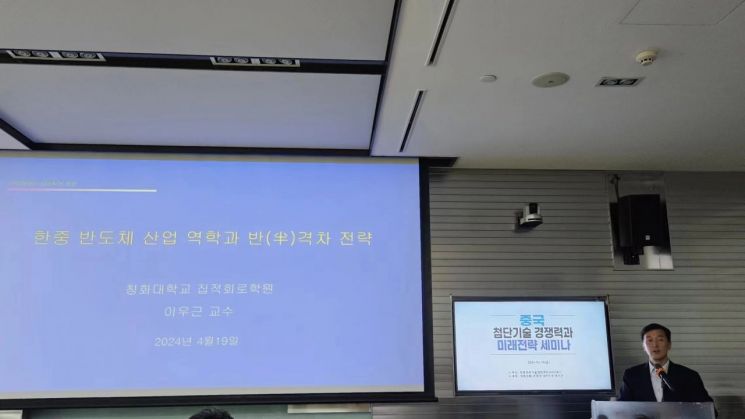 Professor Lee Woo-geun of the Department of Integrated Circuits at Tsinghua University is attending and presenting at a seminar held on the morning of the 19th at the POSCO Building in Beijing, China. (Photo by Kim Hyun-jung)
The core of his argument is that advanced semiconductors should maintain a super gap of unbeatable technological superiority, while the general-purpose semiconductor sector should aim for a Ban Gap, maintaining a moderate level of advanced technology to avoid losing market share. He said, "If we focus only on advanced semiconductor products with a super gap strategy and concede the general-purpose semiconductor sector, which occupies a larger market share in the semiconductor product lineup, to China, China could dominate legacy process products with low-cost strategies like in the display industry and gradually build competitiveness to threaten advanced products." He emphasized, "Considering the characteristics of the Chinese semiconductor industry and market, we need to pursue not only a super gap but also a 'Ban Gap' strategy for competition in the general-purpose semiconductor market."
He added, "In other words, while maintaining a super gap in the advanced semiconductor sector, we must prepare to fiercely compete within China in other general-purpose semiconductor fields based on Korea's superior semiconductor industry," and stressed, "Localization strategies and the cultivation of local specialized personnel in China must also be steadily promoted." He further explained, "When semiconductor chips are mentioned, people think of semiconductors for the latest smartphones, server memory, AI semiconductors, etc., but the demand for home appliances, wireless keyboards, toys, power, vehicles, and so forth is vast," adding, "In fact, the latter accounts for a much larger market." He also noted, "In this Ban Gap strategy, not only localization for local competition but also advancing in the patent field is important."
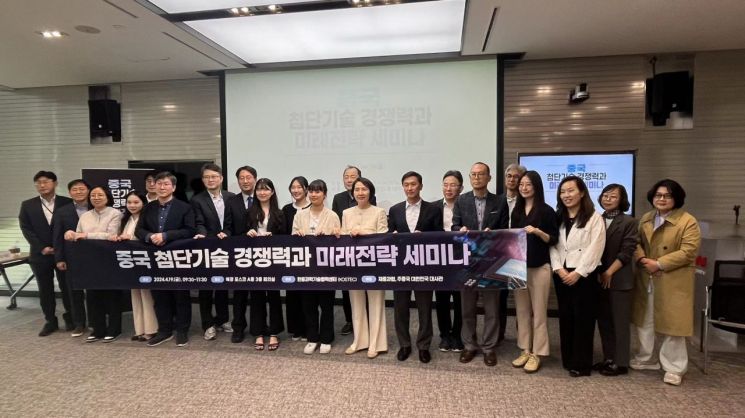 On the 19th, officials are taking a commemorative photo at the seminar "China's Advanced Technology Competitiveness and Future Strategy" hosted by the Korea-China Science and Technology Cooperation Center in Wangjing, Beijing. (Photo by Hyunjung Kim)
At the seminar, other presentations related to China's advanced technology were also delivered. Earlier, Seo Haeng-ah, director of the Korea-China Science and Technology Cooperation Center, gave a presentation titled "China's Technological Rise and Competitiveness," reviewing the status of China's technological self-reliance under the Xi Jinping administration and emphasizing the need to strengthen government-level diplomatic responses for industry-academia-research cooperation between the two countries.
Following this, Professor Kim Jong-myung of Shanghai University of Science and Technology presented on "China's Secondary Battery Creating New Trends," and Professor Jung Yong-sam of Nanjing Agricultural University spoke on "China's Synthetic Biology Responding to US-China Hegemony Competition." Additionally, Professors Kim Jung-sik of Beijing University of Aeronautics and Astronautics and Kim Ki-hwan of Tsinghua University continued with presentations on green hydrogen power generation and quantum information, respectively.
Meanwhile, the Korea-China Science and Technology Cooperation Center published "China's Advanced Technology Competitiveness and Future Strategy," proposing the current status of China's semiconductors, secondary batteries, advanced bio, hydrogen, and quantum information technologies along with Korea's strategies related to the presentations made that day. Jinsoo Lee, Science, Technology, and ICT Counselor at the Korean Embassy in China, said in the foreword, "In the context of the US-China technological hegemony competition, this book introduces China's technology and R&D status, which are not well known in Korea, and suggests how to respond in the future," adding, "With the advent of the era of 'Gijeonghak (技政學),' we hope this will be helpful to Korean policymakers contemplating future strategies and scientists and engineers in the field."
© The Asia Business Daily(www.asiae.co.kr). All rights reserved.
![Clutching a Stolen Dior Bag, Saying "I Hate Being Poor but Real"... The Grotesque Con of a "Human Knockoff" [Slate]](https://cwcontent.asiae.co.kr/asiaresize/183/2026021902243444107_1771435474.jpg)
















