Rapid Inundation Area in China with 67 Million Residents
Caused by Mining Development and High-Rise Building Surge Around Cities
Research has found that nearly half of China's major cities are gradually sinking due to uncontrolled groundwater development and the increasing load from buildings and facilities. A research team from South China Normal University and others reported on the 18th in the academic journal Science in a paper titled "A Nationwide Assessment of Land Subsidence in Major Chinese Cities," which surveyed 82 cities in China with populations over 2 million and revealed these findings.
 Shanghai and Tianjin have been struggling with the issue of urban subsidence since the 1920s. In particular, Shanghai has sunk by as much as 3 meters in just one century. This ground subsidence has recently been occurring over much wider areas.
 [Photo by Pixabay]
The paper shows that between 2015 and 2022, 45% of these cities sank more than 3 mm annually, and 16% subsided by more than 10 mm. This means that 67 million people live in areas where the ground is rapidly sinking. China has long faced land subsidence issues. For example, Shanghai and Tianjin have struggled with urban sinking since the 1920s. In particular, Shanghai has sunk by 3 meters over the past century. Recently, such land subsidence has been occurring over much wider areas.
The research team identified uncontrolled groundwater extraction as the key cause of urban land subsidence. As urban populations grow, residents extract groundwater indiscriminately from cities and surrounding areas to meet water demands, exacerbating the sinking phenomenon. The rapid increase in high-rise buildings and various facilities, which heavily press down on the ground, is also cited as a cause. Mining development around cities is another factor causing land subsidence. Pingdingshan in Henan Province, which is surrounded by large-scale coal mining areas, has been sinking at a very rapid rate of 109 mm annually. The team also predicted that although only about 6% of China’s land was below sea level in 2020, continuous sea level rise will cause 26% of the land to be below sea level in 100 years.
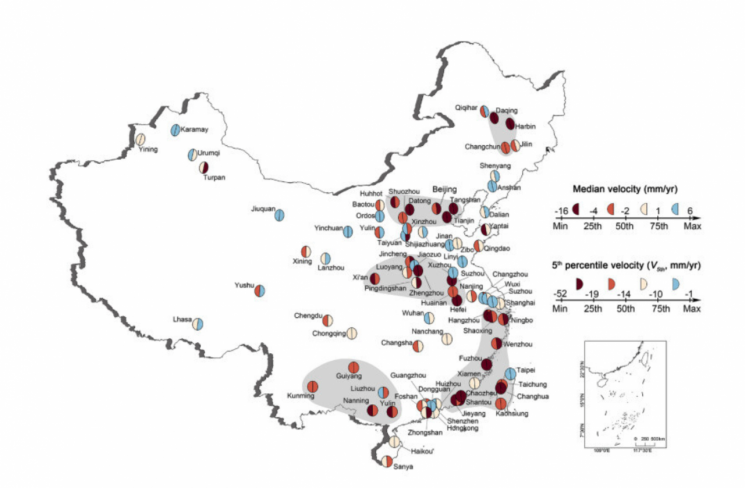
The research team stated, "Within the next 100 years, about one-quarter of the coast will be below sea level due to subsidence and sea level rise, causing massive damage and endangering residents' lives," adding, "Residents living in subsidence areas will suffer from frequent flooding and other hardships when combined with sea level rise caused by climate change."
Not only major Chinese cities but also New York in the United States is a representative city sinking due to excessive construction of high-rise buildings rather than groundwater extraction. According to a study published last year by researchers from the U.S. Geological Survey (USGS), New York is sinking by 1 to 2 mm annually. The researchers analyzed that the weight of approximately 1 million high-rise buildings, totaling 770 million tons, is pressing down on the ground. Especially, Manhattan, the city center, is sinking at about twice the rate.
Moreover, the number of cities worldwide experiencing land subsidence is steadily increasing. Last year, researchers from the University of Rhode Island used satellite data to analyze elevation changes in 99 coastal cities worldwide. According to that study, 33 cities experienced about 10 mm of annual land subsidence, while sea levels rose by 3 mm annually, significantly increasing the risk of flooding.
© The Asia Business Daily(www.asiae.co.kr). All rights reserved.
![Clutching a Stolen Dior Bag, Saying "I Hate Being Poor but Real"... The Grotesque Con of a "Human Knockoff" [Slate]](https://cwcontent.asiae.co.kr/asiaresize/183/2026021902243444107_1771435474.jpg)
















