Visiting the Women's Enterprise Pavilion at the 'Nara Marketplace Expo'
10 Women-Owned Businesses Busy with Small-Scale Contract Consultations
Public Small-Scale Contracts Up to 100 Million Won with Women-Owned Business Certification
“We are a women-owned business prioritized for public institution procurement.”
On the morning of the 18th, Kim Hee-ae, CEO of Yusys, a multi-vision installation company, promoted her company to public institution officials in front of the Women-Owned Business Pavilion at ‘Korea Public Procurement Expo 2024’ held at KINTEX in Goyang-si, Gyeonggi Province. The Public Procurement Expo is the largest public procurement exhibition in Korea held annually until the 19th to help small and medium enterprises market new technology products and assist startups in entering the public procurement market.
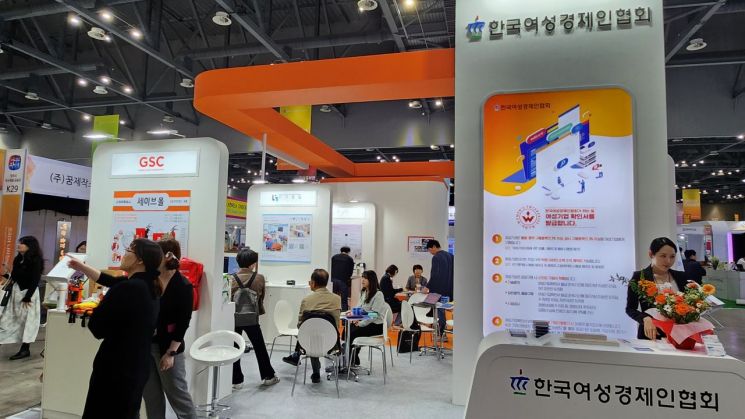 On the morning of the 18th, the Women's Enterprise Pavilion at the 'Korea Nara Market Expo 2024' held at Kintex in Goyang, Gyeonggi.
The Women-Owned Business Pavilion was established to promote women-owned businesses to public institutions and encourage the public purchase of products from women-owned companies. The pavilion is operated by the Korea Women Entrepreneurs Association, which is commissioned by the Ministry of SMEs and Startups to carry out the ‘Women-Owned Business Certification System and Promotion of Public Procurement of Women-Owned Business Products’ project.
This year, a total of 10 women-owned companies participated in the pavilion, including Yusys, Adoa, GSC Global Safe, TechConnect, Lopi, Gagu Club, Samchang CMD Construction, Ama Press, Plus One, and Chorim Danji Muk. Their goal is to meet public institution officials directly to conduct market research on public procurement and simultaneously expand their sales channels. Adoa, a video production company, attended this event to analyze which public institutions require educational videos and what video trends public institutions prefer.
At each booth, representatives and staff handed out pamphlets, souvenirs, and samples, catching the attention of passing public institution officials. CEO Kim said, “Since this event is attended only by people who are essential to us right now, we expect a high possibility of connection if we promote properly,” adding, “The stage is set, so we are putting all our effort into turning this into sales.” Yusys installs multi-vision systems in schools, research institutes, courts, and 119 emergency situation management centers.
The most emphasized point by the companies participating in the Women-Owned Business Pavilion to public institutions was that they hold a Women-Owned Business Certification. The certification is issued to companies, sole proprietors, and cooperatives that are owned and effectively managed by women under commercial law. As of this month, the number of valid companies holding the Women-Owned Business Certification is 74,509.
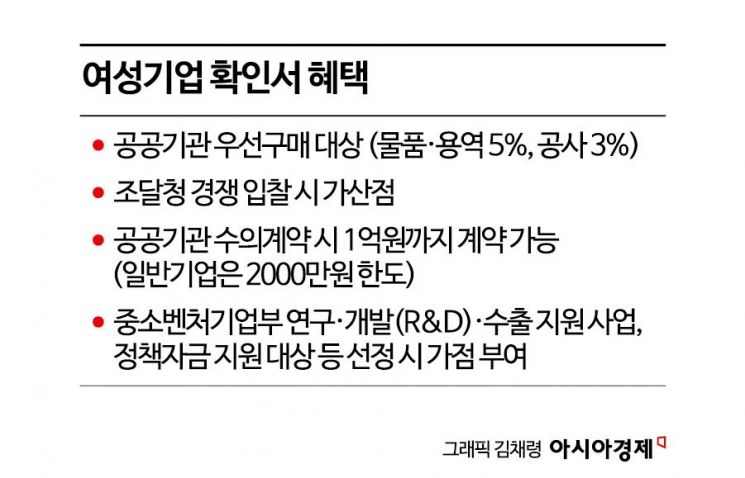
Companies with the Women-Owned Business Certification are classified as priority purchase targets for public institutions. Public institutions are required to purchase at least 5% of their total annual goods and services procurement and 3% of their total construction procurement from women-owned business products. From the perspective of public institutions, having women-owned business suppliers is essential. One female business owner emphasized, “There are still many people who, upon hearing that a woman is the CEO, think ‘What kind of technology could you possibly have?’ without even trying to do business with us,” adding, “Once a relationship is established even through this mandatory system, more places judge and choose based solely on technology without prejudice or bias, which greatly helps entry into the public procurement market.”
Public institutions can make direct contracts with general companies up to 20 million KRW, but with a Women-Owned Business Certification, this limit increases to 100 million KRW. A school contract officer from the Gyeongbuk region, who toured the Women-Owned Business Pavilion at the Public Procurement Expo, explained, “Women-owned business products are convenient because small direct contracts can be made without using the electronic bidding system.”
Additionally, companies with the Women-Owned Business Certification receive extra points in Public Procurement Service competitive bidding, and are given preferential treatment when selected for Ministry of SMEs and Startups research and development (R&D), export support projects, and policy fund support.
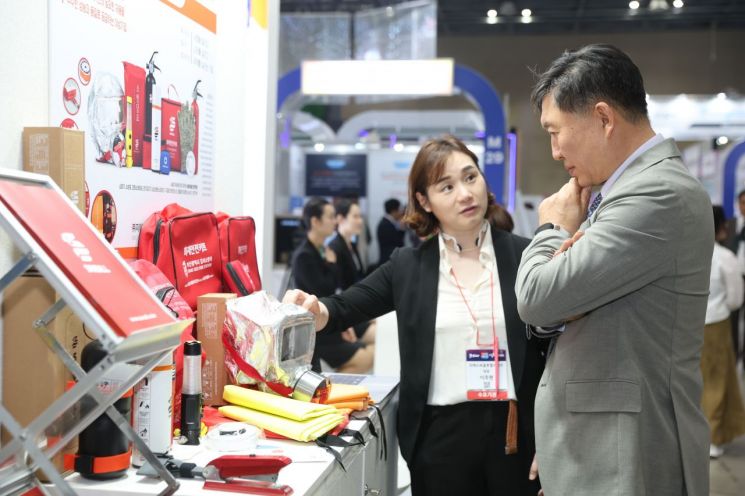 On the morning of the 18th, at the Korea Nara Market Expo 2024 held at KINTEX in Goyang, Gyeonggi Province, Lee Joo-hyun, CEO of GSC Global Safe, is explaining the products at the Women's Enterprise Pavilion.
 [Photo by Korea Women Entrepreneurs Association]
According to the ‘2023 Women-Owned Business Survey’ announced by the Ministry of SMEs and Startups in February, 8.8% of women-owned businesses have experience supplying government agencies through public procurement, and among them, 85.9% responded that the ‘mandatory public procurement system’ was helpful.
The Korea Women Entrepreneurs Association is focusing more on promotion to further increase the proportion of women-owned businesses supplying public institutions. They have created and distributed an electronic booklet promoting women-owned businesses and enhanced the search function to make it easier for public institutions to find needed women-owned companies. A representative from the association said, “We are planning education on the Women-Owned Business Certification System for public institutions so that they can better understand public procurement of women-owned businesses.”
© The Asia Business Daily(www.asiae.co.kr). All rights reserved.
![Clutching a Stolen Dior Bag, Saying "I Hate Being Poor but Real"... The Grotesque Con of a "Human Knockoff" [Slate]](https://cwcontent.asiae.co.kr/asiaresize/183/2026021902243444107_1771435474.jpg)

















