Lifting of 5-Day Quarantine Requirement
Hospital Mask-Wearing Mandate Changed to 'Recommendation'
The government has decided to lower the COVID-19 crisis level from the current 'Alert' to the lowest level, 'Interest,' starting from the 1st of next month. Accordingly, the legal obligation of '5-day isolation' upon COVID-19 confirmation will be lifted, and the mandatory mask-wearing in hospitals will be changed to a recommendation.
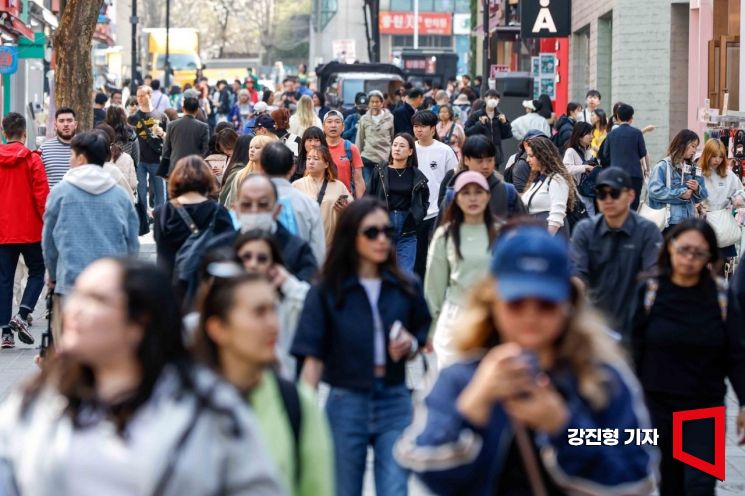 On the 2nd, foreign tourists visiting Myeongdong in Jung-gu, Seoul, are enjoying sightseeing. According to the Korea Tourism Organization, the number of foreign tourists visiting South Korea in February reached 1,030,244. This is 86% of the level compared to February 2019, before the COVID-19 pandemic. During the same period, tourists from China and Japan also recovered to 76% and 86% levels, respectively. Additionally, tourists from the United States and Taiwan increased by 8.4% and 2.3%, respectively. Photo by Jin-Hyung Kang aymsdream@
On the 19th, the Central Disaster and Safety Countermeasure Headquarters for COVID-19 held a meeting on the 'Plan to Lower the COVID-19 Crisis Level,' chaired by Ji Young-mi, Director of the Korea Disease Control and Prevention Agency (Central Disease Control Headquarters), and announced that the current COVID-19 crisis level, which is at level 3 'Alert,' will be lowered by two levels to level 1 'Interest.'
At the 'Interest' level, the legal obligation to isolate for 5 days from the specimen collection date upon COVID-19 confirmation will be lifted. Even if confirmed positive for COVID-19, individuals can resume daily activities once major symptoms such as cough and fever improve and 24 hours have passed. However, for those with severe symptoms or immunocompromised individuals, the restriction period for attending school or work may vary based on a doctor's judgment, similar to the standards for seasonal influenza.
The mandatory mask-wearing when visiting infection-vulnerable facilities such as hospitals will also be changed to a recommendation. Preemptive testing, which was mandatory when entering nursing hospitals, will also be changed to a recommendation.
The Central Disaster and Safety Countermeasure Headquarters explained that medical support related to COVID-19 will be integrated into the general medical system at the level of seasonal influenza, while minimizing the burden of testing and treatment costs to protect high-risk groups.
Therefore, support for testing costs for asymptomatic individuals will be discontinued. Currently, asymptomatic high-risk hospitalized patients, caregivers, and guardians do not bear the cost of polymerase chain reaction (PCR) diagnostic tests, but from next month, they will have to pay 100% of the cost themselves, ranging from 30,000 to 60,000 KRW.
However, for symptomatic individuals aged 60 or older, those aged 12 or older with underlying conditions or immunocompromised status who are eligible for oral antiviral treatments, nursing institutions located in medically vulnerable areas, emergency room visitors, and intensive care unit inpatients, rapid antigen tests (RAT) will continue to be supported as before, with a cost burden of 6,000 to 9,000 KRW. The temporarily supported PCR tests will end, and patients are expected to bear costs of about 10,000 to 30,000 KRW.
COVID-19 vaccines will remain free for all citizens only through the 2023-2024 season, and from the 2024-2025 season, free vaccination will be provided only to high-risk groups such as seniors aged 65 and older and immunocompromised individuals. Additionally, treatments such as Paxlovid, which are currently supported for high-risk COVID-19 groups, are undergoing registration procedures for health insurance coverage, but until then, a partial out-of-pocket expense of 50,000 KRW will be charged. Medical aid recipients and those eligible for reduced out-of-pocket expenses will continue to receive free support.
The Central Disaster and Safety Countermeasure Headquarters stated, "Currently, countries like Japan and the United States have stopped government free support at the end of 2023, requiring patients to purchase medications through health insurance or out-of-pocket. As the crisis level is lowered, it is necessary to impose out-of-pocket costs similar to other Class 4 infectious diseases, and until health insurance registration is completed, a minimal burden will be applied."
Prescriptions and dispensing of treatments will continue to be carried out at pharmacies and medical institutions designated as COVID-19 treatment centers, as before.
The reason for lowering the COVID-19 crisis level this time was based on the continuous decrease in COVID-19 confirmed cases, fatality rates, and severity rates.
According to the Korea Disease Control and Prevention Agency, the weekly number of new COVID-19 positive cases was 2,283 (2nd week of April), fluctuating between 4,000 and 5,000 weekly cases but continuously decreasing since the 3rd week of March. The annual COVID-19 fatality rate dropped from 2.19% in 2020 to 0.06% as of August 31 last year, and the severity rate decreased from 4.34% to 0.15% during the same period. Currently, most countries including the United States and Japan have lifted their emergency response systems.
Ji Young-mi, head of the Central Disease Control Headquarters, said, "Although the COVID-19 crisis level is being lowered and isolation requirements for confirmed cases are being eased, the culture of resting when sick is an essential culture for preserving the health of our society's members." She added, "Please continue to visit nearby medical institutions for treatment if you have COVID-19 symptoms and strictly follow personal hygiene rules such as handwashing and cough etiquette in daily life."
© The Asia Business Daily(www.asiae.co.kr). All rights reserved.
![Clutching a Stolen Dior Bag, Saying "I Hate Being Poor but Real"... The Grotesque Con of a "Human Knockoff" [Slate]](https://cwcontent.asiae.co.kr/asiaresize/183/2026021902243444107_1771435474.jpg)















