Full Financial Creditors Meeting Held on the 18th... Review of Corporate Improvement Plans
Some Bridge PF Projects to be Quickly Processed via Light Auction
KDB "Minimizing Loss Burden for Financial Creditors and Stakeholders"
"Model Restructuring Case Established" Applying Revised Debtor Rehabilitation Act and Workout MOU Improvements
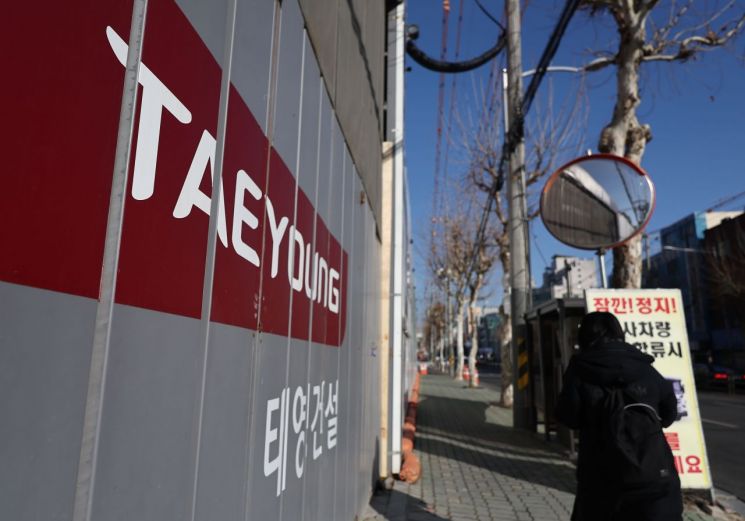
Industrial Bank of Korea (IBK), the main creditor bank of Taeyoung Construction, held a general meeting of all financial creditors to discuss the results of due diligence, the possibility of business normalization, and the future schedule. IBK projected that if the project financing (PF) sites of Taeyoung Construction are managed according to the proposed handling plan, no contingent liabilities significantly deviating from expectations will arise, and liquidity can be secured starting next year.
On the 18th, IBK held a financial creditors' council at its headquarters in Yeouido, Seoul, for all financial creditors of Taeyoung Construction to explain the previously established corporate improvement plan. The council reviewed the corporate improvement plan, which aligns with restructuring principles including sustainable normalization measures, the major shareholder’s fulfillment of responsibilities, and loss-sharing among stakeholders. So far, accounting firms Anjin and Samil have been examining the economic impact on Taeyoung Construction based on the PF lenders’ submitted site handling plans.
According to the corporate improvement plan based on the due diligence results, a significant number of PF sites will proceed with construction normally or be completed to minimize losses for creditors, pre-sale buyers, and Taeyoung Construction. However, some projects in the bridge phase (land acquisition stage) will be promptly resolved by the PF lenders through light auctions and other measures.
IBK stated, "If the PF site handling plan is implemented as scheduled, Taeyoung Construction is unlikely to incur contingent liabilities that significantly deviate from initial expectations." It added, "In particular, the Taeyoung Group has been resolving Taeyoung Construction’s liquidity according to the self-help plan pledged at the time of the workout application (supporting 334.9 billion KRW since the application) and has not used the new funds resolved at the second council meeting in February." Furthermore, IBK noted, "If financial support is provided to fundamentally resolve the full capital impairment, maintain a sound financial structure, and enable the company to continue its business operations, normalization is expected to be achievable."
The major shareholders of Taeyoung Construction, including affiliated companies, will implement a 100-to-1 free capital reduction of old shares as part of management responsibility and convert 100% of pre-workout loans (400 billion KRW) into equity. Additionally, post-workout loans (334.9 billion KRW) will also be converted 100% into perpetual bonds, with all held claims injected into capital expansion.
Financial creditors, considering the necessity of sufficient capital expansion and manageable debt levels, agreed to convert 50% (239.5 billion KRW) of unsecured bonds into equity, while the remaining 50% will be subject to a three-year repayment deferral and a 3% interest rate reduction. New funds and guarantees approved at the second council meeting will continue to support Taeyoung Construction’s business activities. Loss claims (guarantee debt performance claims) that the major lenders can claim from Taeyoung Construction during the PF site handling process will be treated the same as the unsecured bonds mentioned above, fundamentally resolving contingent liabilities from PF sites that caused liquidity crises.
IBK forecasted that if the newly established corporate improvement plan is smoothly implemented, it will not only resolve capital impairment but also improve profitability and secure liquidity, enabling business normalization. The workout and corporate improvement plan for Taeyoung Construction represent a significant milestone as the first case applying the revised Corporate Restructuring Promotion Act and the 'Workout Construction Company Memorandum of Understanding (MOU) Improvement Guidelines' to a major construction company.
IBK commented, "By having the main creditors of Taeyoung Construction and the PF lenders of the PF sites autonomously cooperate to devise an efficient and executable normalization plan, a soft landing of PF sites and orderly handling of PF contingent liabilities have become possible." It added, "The Taeyoung Construction case has demonstrated that autonomous agreements and solutions among PF lenders, developers, and contractors regarding PF site handling plans are feasible, greatly contributing to the stabilization of the PF finance market."
In particular, IBK emphasized, "The major shareholder has promptly injected available assets and capabilities into Taeyoung Construction’s normalization, establishing the principle of management responsibility and minimizing loss burdens for financial creditors and other stakeholders."
Meanwhile, following the creditors’ meeting on the same day, IBK plans to submit the corporate improvement plan to the financial creditors’ council on the 19th and conduct a voting procedure on approval or disapproval of the plan on the 30th.
IBK stated, "The successful progress of Taeyoung Construction’s workout will minimize losses for all stakeholders, significantly contribute to the stabilization of the real estate and financial markets, and serve as a best practice example of restructuring under the Corporate Restructuring Promotion Act. Therefore, we request financial creditors to cooperate in the approval and execution of the corporate improvement plan."
© The Asia Business Daily(www.asiae.co.kr). All rights reserved.

















