"Starting Outdoor Exploration While Eating Well, Including Carrots"
If Adaptation Is Fast, Public Release May Be Accelerated
The China Giant Panda Protection and Research Center released a video of Fubao living in quarantine at the Wolong Xian Suping Base in Sichuan Province.
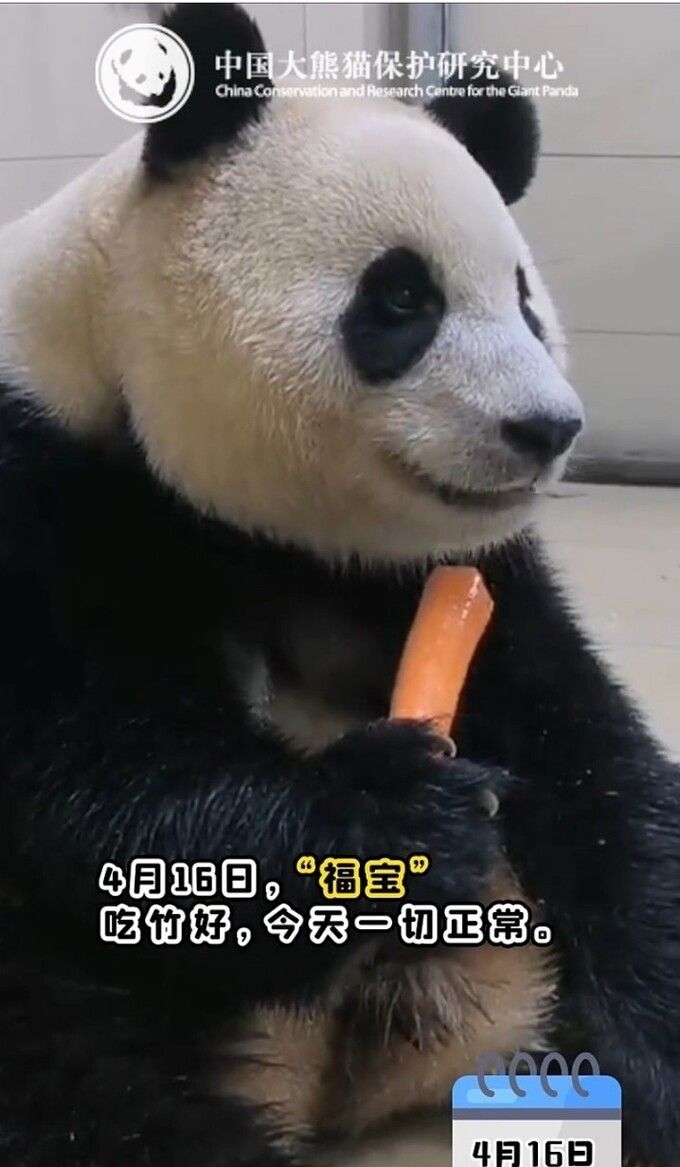 Through Chinese social networking service (SNS) WeChat, the China Giant Panda Protection Research Center revealed the appearance of Pubao, who has entered the second week of quarantine. The photo shows Pubao eating a carrot. [Image source=Captured from Giant Panda Protection Research Center Weibo]
On the 18th, through Chinese social networking services (SNS) such as WeChat, the China Giant Panda Protection and Research Center revealed footage of Fubao entering the second week of quarantine. This came about a week after releasing the first week’s quarantine video on the 10th. Like the previous video, this footage was created in a diary format, capturing Fubao’s life from the 12th to the 16th.
The video shows Fubao eating panda treats like wortou, carrots, and bamboo leaves, adapting well to life in China. Notably, on the 15th, scenes of Fubao roaming in the outdoor enclosure were also shown. The Panda Protection and Research Center explained, “Fubao has a good appetite and is full of energy,” adding, “She has started to ‘explore’ the enclosure, and her outdoor activities are gradually increasing.” The panda research center where Fubao lives is surrounded by mountains and valleys at an altitude of 1700 meters, where wild pandas naturally inhabit. The pandas are released into nature to ensure they do not lose their wild instincts.
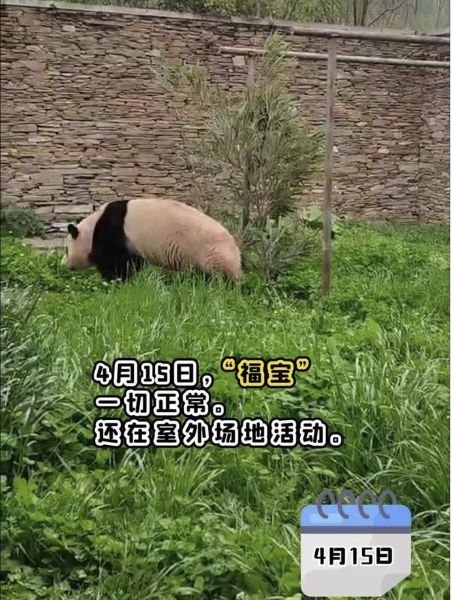 Through Chinese social networking service (SNS) WeChat, the China Giant Panda Protection Research Center has revealed the appearance of Pubao, who is entering the second week of quarantine. The photo shows Pubao exploring in the outdoor enclosure. [Image source=Captured from Giant Panda Protection Research Center Weibo]
If Fubao adapts quickly, the timing for public viewing may be moved up. Originally, after a month of quarantine, Fubao was scheduled to settle at one of four panda bases?Wolong Xian Suping Base, Wolong Hetao Ping Base, Dujiangyan Base, or Ya’an Base?and be revealed to the public. Previously, Zheng Yuan, a keeper at the Giant Panda Protection and Research Center, stated, “Since each panda’s adaptation period varies, the exact timing of public viewing cannot be predicted,” explaining, “Looking at past cases of pandas returning to China, it can take as little as 1-2 months or as long as 7-8 months.” In fact, Xiao Qiji, born in the U.S. and returned to Wolong Xian Suping Base on November 9 last year, was shown to the public on December 27 of the same year, less than two months later. On the other hand, Xiang Xiang, who returned from Japan to the Bifengxia Base in Ya’an, Sichuan Province on February 21 last year, had a delayed adaptation period and was able to meet general visitors only on October 7 of the same year.
The panda bases are also open to tourists. They operate from 7:30 a.m. to 6:00 p.m., with an admission fee of about 55 yuan (approximately 10,000 KRW) per adult. However, it is known that purchasing tickets is difficult without a local Chinese phone number.
Fubao is the first panda cub born domestically, naturally bred on July 20, 2020, between Lubao and Aibao, pandas sent by Chinese President Xi Jinping in March 2016 as a symbol of China-Korea friendship. However, under the Convention on International Trade in Endangered Species of Wild Fauna and Flora (CITES), she returned to China on the 3rd.
© The Asia Business Daily(www.asiae.co.kr). All rights reserved.
![Clutching a Stolen Dior Bag, Saying "I Hate Being Poor but Real"... The Grotesque Con of a "Human Knockoff" [Slate]](https://cwcontent.asiae.co.kr/asiaresize/183/2026021902243444107_1771435474.jpg)
















