Bank of Korea's Report on 'Changes in South Korea's Export Structure to the US'
Q1 US Export Value Surpasses Exports to China
High Production Costs, Trade Sanctions, and Other Risks
There is a prospect that the export growth effect resulting from our companies' investments in the United States may gradually weaken in the mid to long term. In particular, with the increasing likelihood of former President Trump winning the upcoming U.S. presidential election this year, it is analyzed that our exports could face greater threats if the Trump administration returns to power.
According to the 'BOK Issue Note: Evaluation of Changes in South Korea's Export Structure to the U.S. and Future Prospects' released by the Bank of Korea on the 18th, the export amount to the U.S. in the first quarter of this year ($31 billion) exceeded exports to China ($30.9 billion). This is the first time since the second quarter of 2003, and considering exports to the U.S. through global production hubs such as China and ASEAN countries, the significance of U.S. exports in our total exports has increased.
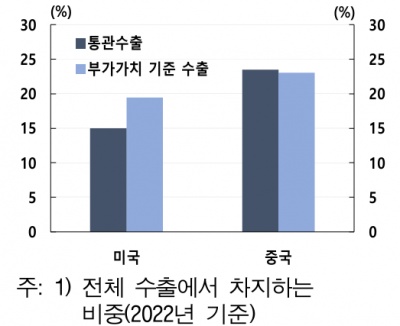 Comparison of Export Shares to the U.S. and China. Source: ADB MRIO, Bank of Korea Survey Department Estimates
However, there are concerns that large-scale trade surpluses with the U.S. could lead to trade sanctions against South Korea. In the past, the U.S. has strengthened various trade sanctions when the trade deficit with South Korea widened or when public opinion supporting protection of domestic industries gained momentum. Notably, during the Trump administration from 2017 to 2018, renegotiations of the FTA were pursued, and safeguard measures (policies that urgently restrict import volumes or raise tariffs on specific imported goods) were implemented.
At a briefing related to the report held that day, Nam Seok-mo, head of the International Trade Team at the Research Department, said, "Considering the policies during the Trump administration, the possibility of strengthening trade sanctions seems high," but he also drew a line by stating, "Since judgments can differ between election campaigns and actual policies after taking office, it is still premature to make definitive statements."
There is also a structural aspect. The report stated, "Since the second half of last year, our exports have continued to increase thanks to improvements in the semiconductor market and favorable exports to the U.S., and this trend is expected to continue," but added, "From a mid- to long-term perspective, due to the characteristics of the U.S. industrial structure, which has a low proportion of imported intermediate goods input and high production costs, the export growth effect from our companies' investments in the U.S. is likely to gradually weaken."
According to the Bank of Korea, by product category, recent increases in demand for eco-friendly products and infrastructure investments in the U.S. have significantly expanded chemical products such as electric vehicles, secondary batteries, and cathode materials, as well as machinery. The report states that direct investments and new factory establishments by domestic electric vehicle, semiconductor, and battery companies in the U.S. are expanding, and demand for these products in the U.S. is expected to continue.
However, the U.S. manufacturing production structure is characterized by a high proportion of domestic industry input centered on high value-added services, while having a low import inducement rate. The high production costs in the U.S. also make it difficult for South Korean small and medium-sized enterprises (SMEs) to enter alongside, which acts as a factor reducing the sustainability of export growth resulting from increased foreign direct investment (FDI) in the U.S. According to the report, the investment proportion of SMEs exceeds 40% in countries like China and Vietnam, but falls below 20% for the U.S.
Moreover, competition within the U.S. market is expected to intensify not only in existing major export items such as automobiles but also in advanced fields like artificial intelligence (AI). Therefore, the report recommends, "Our government and companies need to focus on trade policy and industrial structural risks rather than being complacent with the recent favorable export performance to the U.S., and prepare accordingly."
© The Asia Business Daily(www.asiae.co.kr). All rights reserved.
![Clutching a Stolen Dior Bag, Saying "I Hate Being Poor but Real"... The Grotesque Con of a "Human Knockoff" [Slate]](https://cwcontent.asiae.co.kr/asiaresize/183/2026021902243444107_1771435474.jpg)
















