Statistics Korea Announces Results of Agriculture, Forestry, and Fisheries Survey
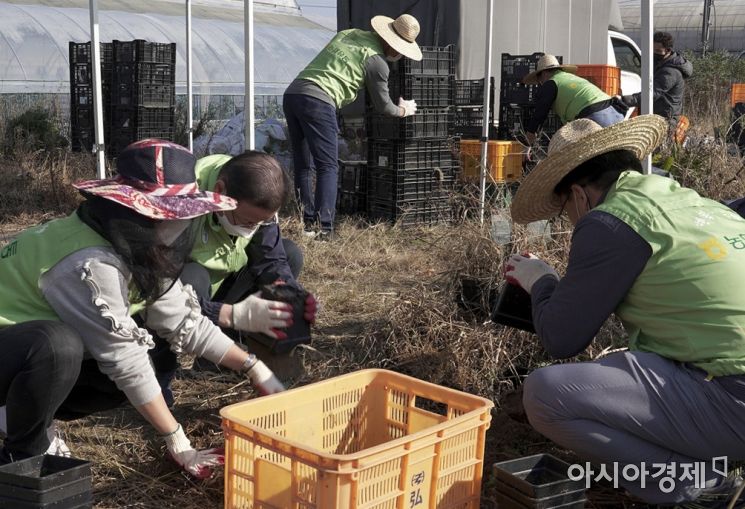 On the 20th, key attendees including Kim Tae-jong, Executive Director of Nonghyup Distribution, participated in bulb work at the Nonghyup Distribution labor support campaign held at our flower farm of Namsa Nonghyup in Yongin-si, Gyeonggi-do. Photo by Nonghyup Distribution
Last year, the aging rate of the farming population exceeded 50% for the first time in history. The aging phenomenon in farming households has intensified as the population in all age groups except those in their 70s has decreased in rural areas.
According to the "Agriculture, Forestry and Fisheries Survey Results" announced by Statistics Korea on the 19th, as of December 1 last year, there were 999,000 farming households nationwide, with a farming population of 2,089,000. Due to factors such as giving up farming and switching to full-time jobs caused by aging, the number of farming households decreased by 24,000 (2.3%) and the farming population decreased by 77,000 (3.5%) compared to the previous year. In particular, the number of farming households nationwide fell below the 1 million mark for the first time in history.
The proportion of elderly people aged 65 or older among the total farming population was 52.6%, marking the first time the aging rate of the farming population exceeded 50%. This is an increase of 2.8 percentage points compared to the previous year (49.8%). This rate is about three times higher than the overall elderly population ratio in South Korea (18.2%).
By age of the farm operators, those aged 70 or older accounted for 477,000 households (47.8% of all farming households), followed by those in their 60s with 342,000 households (34.2%), and those in their 50s with 141,000 households (14.2%). Compared to the previous year, farm operators aged 70 or older increased by 2.6%, while those under 40 and those in their 40s decreased by 22.7% and 20.9%, respectively.
Farming households with farm operators having more than 20 years of agricultural experience numbered 718,000, accounting for 71.9% of all farming households, while those with less than 5 years of experience were 31,000 households, about 3.1%.
Farming households with agricultural and livestock product sales under 10 million won accounted for 64.5% of all farming households, while those with sales over 100 million won accounted for 4.2%. Compared to the previous year, the proportion of households with sales under 10 million won decreased by 0.6 percentage points, and the proportion of households with sales over 100 million won increased by 0.4 percentage points.
The aging trend continued in fishing and forestry households as well. The fishing population was surveyed at 87,000, a decrease of 4.1 percentage points from the previous year (90,800). The proportion of elderly people aged 65 or older was 48.0%, up 3.7 percentage points from the previous year (44.2%).
The forestry population was 204,000, a decrease of 5,800 people (2.7%) from the previous year. The proportion of elderly people was 52.8%, increasing by 4.0 percentage points compared to the previous year, exceeding 50% for the first time in history.
© The Asia Business Daily(www.asiae.co.kr). All rights reserved.
![Clutching a Stolen Dior Bag, Saying "I Hate Being Poor but Real"... The Grotesque Con of a "Human Knockoff" [Slate]](https://cwcontent.asiae.co.kr/asiaresize/183/2026021902243444107_1771435474.jpg)















