Big Tech Reaches Out to Japan
Partnerships Formed Between Universities of Both Countries
Massive Investment in AI Talent Development
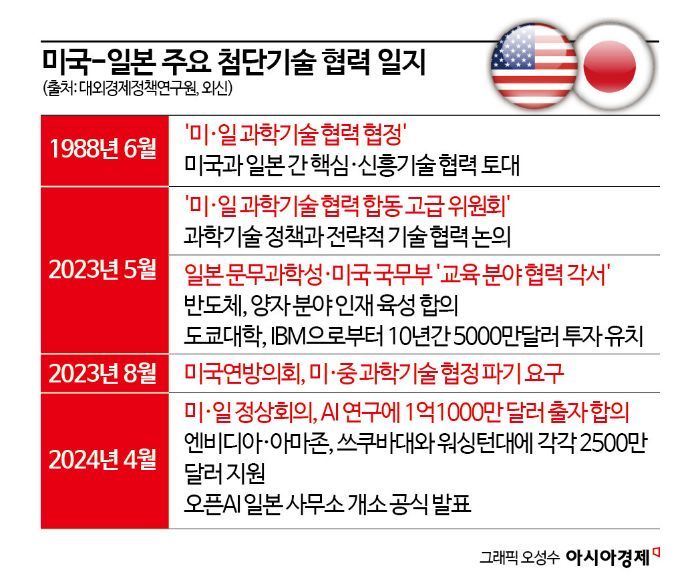
The United States and Japan are closely collaborating in artificial intelligence (AI) technology. Based on their "Science and Technology Cooperation Agreement," the two countries are strengthening cooperation in innovative technologies such as AI, forming what is being called an "AI alliance." Following OpenAI, the developer of ChatGPT, opening its first Asian office in Tokyo, Japan, Japanese universities are also beginning to attract investments from American companies.
U.S. Companies Investing in Japanese Universities
According to foreign media on the 17th (local time), Nvidia and Amazon have each decided to invest $25 million to support researchers at the University of Washington in the U.S. and the University of Tsukuba in Japan. Earlier, the Biden administration agreed during the U.S.-Japan summit on the 10th to collaborate on advanced technology development, with companies from both countries pledging a total of $110 million in funding for AI research. Investments from big tech companies are part of this plan.
Around the same time, Japan's Ministry of Education, Culture, Sports, Science and Technology and the U.S. Department of State signed a memorandum of cooperation in the education sector and agreed to nurture talent in the semiconductor and quantum fields. In the semiconductor sector, 11 universities from the U.S. and Japan promised to invest more than $60 million over the next five years to conduct advanced educational curricula. In the quantum field, IBM announced a plan to invest a total of $100 million over ten years at the University of Chicago and the University of Tokyo.
Why Did OpenAI Choose Japan?
Sam Altman, CEO of OpenAI, established the company's first Asian office in Japan to promote global business. Altman cited Japan's global technological leadership, service culture, and a social atmosphere that embraces innovation as reasons behind this decision. OpenAI developed a ChatGPT-4 model specialized for the Japanese language, featuring improved Japanese text and translation capabilities and boasting speeds three times faster than before.
Japan has already applied ChatGPT to public services. Public officials in Yokosuka City, Kanagawa Prefecture, have used it over the past year to improve public service efficiency, with 80% of employees reporting increased productivity. Yokosuka City has formed a network sharing ChatGPT use cases with 21 local governments, including the Tokyo Metropolitan Government and Kobe City. Local companies such as Rakuten and Toyota are also utilizing ChatGPT for data analysis, internal reporting, and work automation. The Japanese government aims to address rural population decline and labor shortages in companies through AI, and CEO Altman plans to actively cooperate with these efforts.
Microsoft (MS), an investor in OpenAI, also announced plans to invest $2.9 billion (approximately 3.9 trillion KRW) over two years to expand data centers in Japan to strengthen its AI foundation. This is the largest investment Microsoft has ever made in Japan.
Productivity Improvement through AI? South Korea Ranks 10th
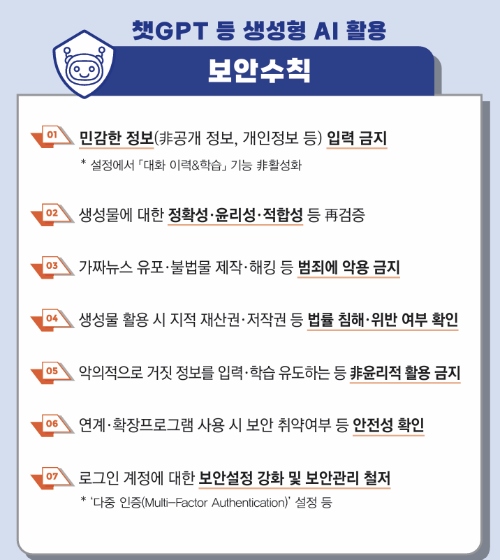
Our government and public institutions also attempted to utilize ChatGPT in their work, but progress was stalled last June when the National Intelligence Service issued the "Generative AI Usage Security Guidelines." The guidelines include strict security rules such as △prohibition of inputting confidential or personal information △verification of legal infringements like intellectual property rights (IP) when using generated content △revalidation of accuracy, ethics, and appropriateness of generated content. Additionally, AI models must be operated separated from external networks such as the internet if deployed within an institution's internal network.
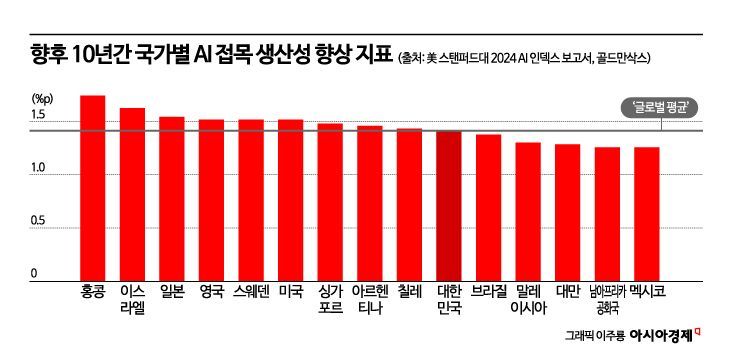
While focusing on security, South Korea is falling behind its goal of becoming one of the top three AI powers. According to the recent "AI Index Report" published by Stanford University in the U.S., the countries expected to see the greatest productivity improvements from AI technology integration over the next decade are Hong Kong (1st), Israel (2nd), and Japan (3rd). South Korea ranked lower than Argentina and Chile.
Yoon Ki-young, an adjunct professor in the Department of Business Administration at Hankuk University of Foreign Studies, said, "While we should not give up on developing domestic large language models (LLMs) to secure digital sovereignty, it is true that big tech companies dominate the global AI market." He emphasized, "Along with considering how to integrate AI into various fields such as robotics and space industries, it is necessary to develop long-term strategies for talent cultivation and resource investment."
 Excerpt from the 'Security Guidelines for Using Generative AI such as ChatGPT' published by the National Intelligence Service in June last year
© The Asia Business Daily(www.asiae.co.kr). All rights reserved.
![Clutching a Stolen Dior Bag, Saying "I Hate Being Poor but Real"... The Grotesque Con of a "Human Knockoff" [Slate]](https://cwcontent.asiae.co.kr/asiaresize/183/2026021902243444107_1771435474.jpg)

















