On the night of the 17th, a magnitude 6.6 earthquake occurred in the strait between Kyushu and Shikoku in western Japan.
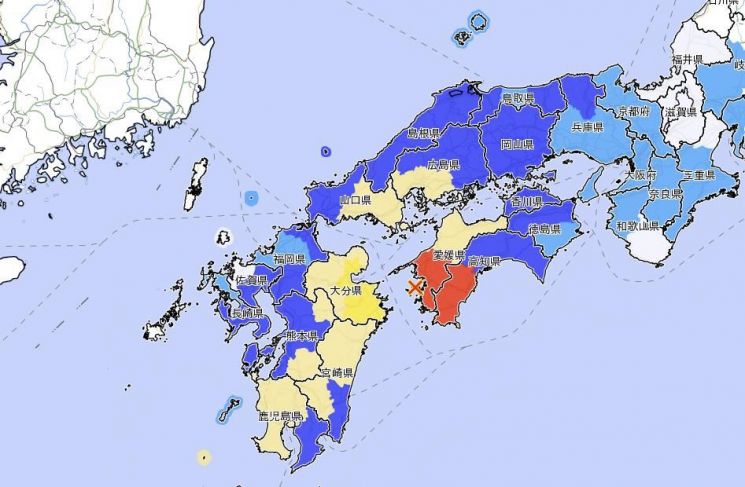
The Japan Meteorological Agency announced that at around 11:14 a.m. that day, an earthquake with a magnitude of 6.6 and a focal depth of 39 km struck Sukumo City in Kochi Prefecture and Ainan Town in Ehime Prefecture, located in western Shikoku. When the shaking intensity is measured on a relative scale from 0 to 7, a lower 6 intensity was detected. A lower 6 intensity means it is difficult to stand, tiles on walls and window glass are broken, and bookshelves topple over. This is the first time since Japan’s current seismic intensity scale was introduced in 1996 that a lower 6 intensity shaking has been observed in Kochi and Ehime Prefectures.
Due to this earthquake, shaking of intensity 4 was also felt not only in Shikoku and Kyushu but in the western Honshu regions of Hiroshima Prefecture and Yamaguchi Prefecture. The Japanese government stated that there is no tsunami threat from this earthquake.
According to local public broadcaster NHK, a total of seven people were injured due to this earthquake: five in Ehime Prefecture in western Shikoku and two in Oita Prefecture in eastern Kyushu. In Sukumo City, Kochi Prefecture, where the strongest shaking was detected, streetlights fell, power lines were cut, and water pipes ruptured. In Ehime Prefecture, reports of falling rocks on roads were received.
The Japanese government held a press conference at around 1:15 a.m. on the 18th and said, "At this point, no abnormal reports have been received regarding nuclear facilities, including the Shikoku Electric Power Ikata Nuclear Power Plant." Shikoku Electric Power reported that the output of Unit 3 of the Ikata Nuclear Power Plant in Ehime Prefecture decreased by about 2%, but there was no impact on operations.
After the earthquake, the Japanese government established a countermeasures office at the Prime Minister’s Office Crisis Management Center and is collecting information on damage status and other details. Prime Minister Fumio Kishida said, "I have instructed that all possible measures be taken for emergency disaster response if any damage is confirmed."
The Mainichi Shimbun reported that this earthquake did not increase the likelihood of the "Nankai Trough megathrust earthquake," which is known to have a 70-80% probability of occurring within the next 30 years.
Meanwhile, it appears that many people in South Korea also felt the shaking from this earthquake in Japan. On social networking services (SNS) such as X (formerly Twitter), posts have been continuously uploaded reporting that people felt the earthquake and evacuated or were confused due to the absence of disaster alerts. According to the Korea Meteorological Administration, by 11:30 p.m. the previous day, about 140 reports of felt shaking had been received by fire authorities.
© The Asia Business Daily(www.asiae.co.kr). All rights reserved.
![Clutching a Stolen Dior Bag, Saying "I Hate Being Poor but Real"... The Grotesque Con of a "Human Knockoff" [Slate]](https://cwcontent.asiae.co.kr/asiaresize/183/2026021902243444107_1771435474.jpg)















