[Interview] Yoon Sung-yong, Director of the National Museum of Korea
Essential Changes in Museums to Welcome MZ Visitors
Plan to Expand Goguryeo Hall... Significant Release of Rubbing of Gwanggaeto the Great's Tomb Stele
An Open Museum Should Be a Space Where Contemporary Culture Meets and Coexists
Last year, 10.47 million people visited the National Museum of Korea and 13 affiliated museums nationwide. One in five citizens visited a national museum to enjoy cultural activities. Special exhibitions such as the 1st anniversary commemorative exhibition of the late Lee Kun-hee Collection, "An Invitation from a Collector," the Austria exchange exhibition "600 Years of the Habsburgs, Masterpieces of Fascination," and the "British National Gallery Masterpieces Exhibition" were sold out day after day. The number of visitors to permanent exhibitions also steadily increased, highlighting museums not as outdated educational spaces but as places where contemporary culture and encounters coexist.
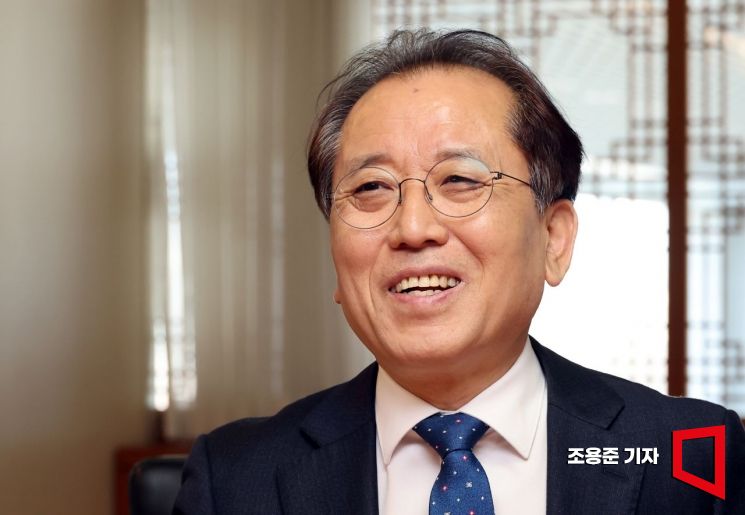
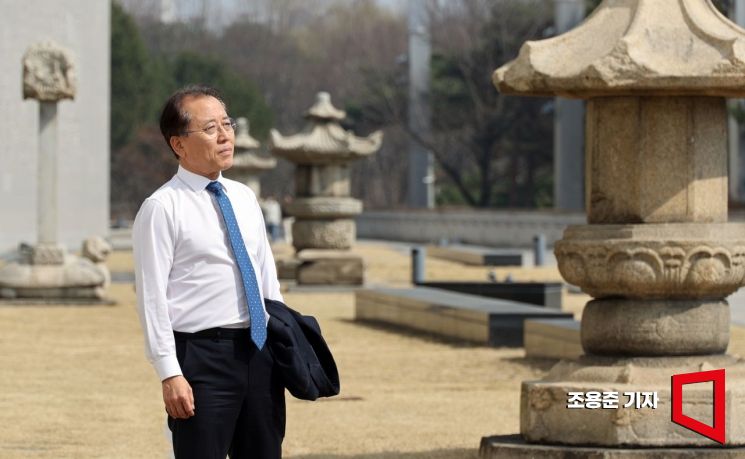
In particular, the National Museum of Korea features a "national treasure-level promenade" including the Mirror Pond, named for reflecting the museum building itself, the Celadon Pavilion, the Mir Waterfall, and the stone garden, making it a resting place where visitors can find solace just by taking a walk, even without viewing exhibitions. Yoon Sung-yong, director of the National Museum of Korea and a field expert who has been guarding the museum since its relocation to Yongsan, has emphasized a "museum for everyone" since his appointment. Walking along the Mirror Pond promenade inside the museum, Director Yoon introduced, "Until now, museums have been recognized only as spaces for history education, but in fact, there are such wonderful outdoor gardens and many places to rest and play. You can come, relax, play, and when you get bored, visit the exhibition halls to encounter the lives of people from 1,000 years ago."
- You started as a curator and have been a 'museum person' for 28 years. How did you enter this field?
▲ While attending graduate school, I was fortunate to have the opportunity to join a museum. However, my goal at the time was to become a university professor, so I kept pondering. One day, while playing soccer with the priest at my church, I was resting when he asked, "What is your goal?" I replied, "I want to live by teaching and researching at a university." Then he asked, "Why do you want to become a professor?" I realized that I had only the goal of becoming a professor but had never thought about what I wanted to do as a professor. Then I visited the museum exhibition hall. There was a special exhibition, and a group of elementary school students was on a field trip. I noticed them writing down the exhibition panel content I had written in their notebooks. Suddenly, I recalled the saying, "No matter how excellent your thesis is, will 2,000 people read it? Or 200? If 200 read it, your thesis is excellent." My exhibition panels were seen by 2,000, 20,000, even 200,000 people. At that moment, I realized that my existence should be about sharing what I have learned. Sharing my shallow knowledge is possible not only as a university professor but also in this position. I sat down right there. And so, I have come this far.
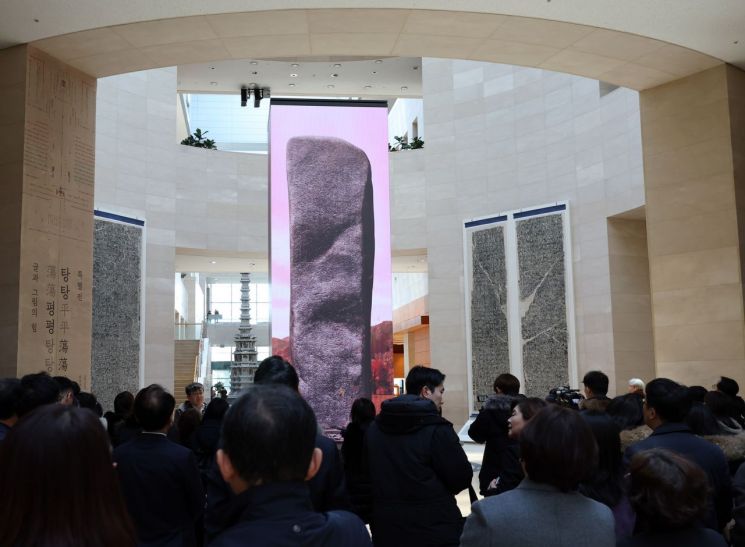 The Gwanggaeto the Great Stele digitally recreated is exhibited in the permanent exhibition hall "The Path of History" at the National Museum of Korea. The newly recreated stele at the museum is an LED pillar measuring 7.5 meters in height (8 meters including the base) and 2.6 meters in width, faithfully reproducing the artifact as it appears in Jian (集安), China. Each side of the pillar displays the stele's image based on photos and video materials.
 [Image source=Yonhap News]
- You are now in your second year as director. What changes and achievements have you emphasized through the "open museum" concept since your appointment?
▲ I have tried to move one step closer to a museum for everyone. First, to improve accessibility for culturally vulnerable groups, braille guide panels and QR codes for audio guidance were installed at exhibition entrances, and sign language videos and audio subtitles were provided in video spaces. Additionally, easy-to-understand booklets were placed throughout the museum's resting areas, and tactile exhibits allowing visitors to touch donated cultural heritage items were introduced, enabling not only people with developmental and visual disabilities but all visitors to experience exhibitions more comfortably.
- You have shown deep interest in the MZ generation as much as in culturally vulnerable groups. Aren't they a generation distant from museums?
▲ Museums, as organizations, must continuously attempt change and move forward. The change we must pursue is "new visitors." The MZ generation visits art galleries but not museums. Their experience of museums through institutionalized school education and field trips leaves an image of museums as somewhat boring and one-sided. Therefore, we are reflecting on why the MZ generation does not visit museums and what museums lack, striving to change. Specifically, we are pursuing changes in exhibition planning and production. Instead of simply showing artifacts, we use audiovisual media to expand senses and convey explanations through videos, allowing visitors to imagine the context, connections, and narratives of artifacts. We also run promotional participation projects where MZ visitors ask questions and suggest improvements, directly listening to and reflecting their voices. Moreover, the Celadon Room "Goryeo Bi-Saek" space uses specially produced music, receiving praise as a fresh exhibition.
- Last year, the total number of visitors to 13 national museums, including the National Museum of Korea, exceeded 10 million. What do you think is the reason behind this?
▲ The demand for cultural enjoyment, which had been suppressed during COVID-19, surged, and with the transition to endemic and continuous special exhibitions, more interest was generated. Also, the "Lee Kun-hee Collection" exhibitions held at the National Museums of Cheongju, Gwangju, and Daegu sparked curiosity, prompting many visitors to come to museums. This created a box office effect by arousing interest in the tastes and perspectives of Chairman Lee Kun-hee, who had been perceived as a distant figure. This was supported by solid exhibition planning; instead of simply listing the vast Lee Kun-hee Collection, the storytelling theme "An Invitation from a Collector" resonated with visitors, leading to positive reviews and word of mouth. Furthermore, it is encouraging that visitors who came for various special and planned exhibitions also visited permanent exhibitions. In fact, among the 4.18 million visitors to the National Museum of Korea last year, over 70% also visited the permanent exhibition halls, and this ratio is gradually increasing each year.
- In 2022, the National Museum of China caused controversy by exhibiting a Korean history timeline excluding Goguryeo and Balhae in a joint exhibition with Korea and Japan.
▲ I was the director when the exhibition was in the planning stage, so I know the process better than anyone. Before the exhibition, we discussed the timeline with the museum and shared final information before confirmation. However, the Chinese side manipulated the timeline and indicated that the National Museum of Korea provided it. When the incident became known, the Chinese side explained it was due to a lack of communication by the staff, but considering the thorough prior planning and discussions, this was impossible. We immediately demanded an official apology and correction. To prevent similar incidents in future overseas exhibitions, we added a clause in the exhibition agreement stating that if the exhibition content differs from prior agreements, the exhibition will be withdrawn.
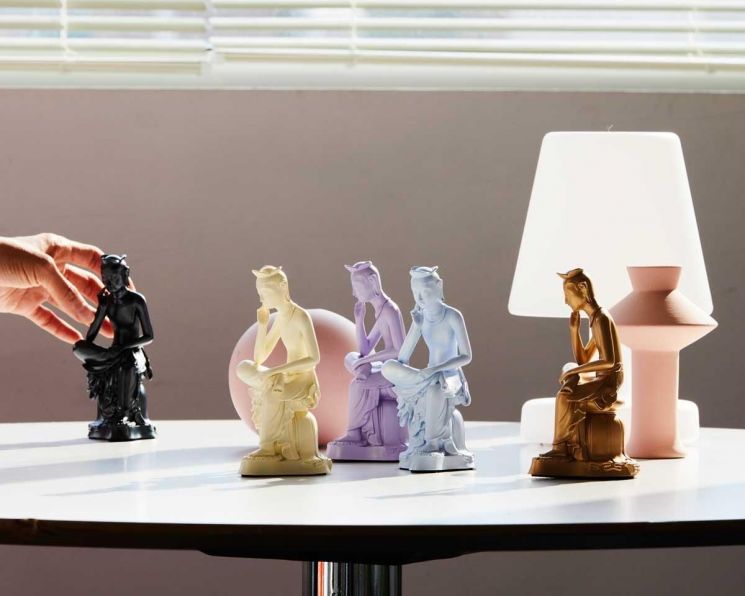 As interest in our cultural heritage grows, sales of products using major artifacts from museums (Muzeu·Museum Goods) have increased. According to the National Museum Cultural Foundation, sales of 'Muzeu' last year amounted to 14.9 billion won, a 27% increase compared to the annual sales of approximately 11.7 billion won the previous year.
 [Photo by National Museum Cultural Foundation]
- When discussing strengthening Goguryeo-related content, the absence of domestic Goguryeo cultural relics cannot be overlooked.
▲ We revise detailed exhibitions by hall every year, and surveys of visitors show many want the Goguryeo Hall expanded. At the museum's opening in 2005, the same was true, but since Goguryeo's historical stage was mainly in China and North Korea, spatial constraints limited the number of artifacts we could exhibit. However, 20 years later, many Goguryeo relics have been excavated in the Han River basin, including northern Gyeonggi Province. We have researched related artifacts and, although not perfect, we believe we can supplement the exhibition more than at the opening, so we are planning to expand the Goguryeo Hall. Also, one of this year's representative exhibitions is the original rubbing of the Gwanggaeto the Great Stele and its digital display, which hold special significance as key content representing Goguryeo history. The original rubbing we revealed better reflects the stele's original content, making it an important resource for reading and research. Last year, we were fortunate to acquire the original rubbing owned by the Confucian scholar Cheongmyeong Im Chang-soon, and the museum now has a space over 8 meters high to digitally restore and exhibit it. The original rubbing, made in the late 19th century before applying lime, is so rare that it allows visitors to appreciate the inscription in three dimensions, making it a precious heritage.
- As times change, the role of museums as spaces also requires transformation. What changes is the National Museum of Korea preparing?
▲ When I was a curator in 1999, people did not understand when I said the museum would screen films. Now, museums hold fashion shows and performances. (laughs) Museums should be places to meet people from thousands or tens of thousands of years ago. The materials we encounter in museums were all left by people. Exhibitions allow us to think and imagine what people at the time thought when they made these items. It should be a place to meet the past and prepare for the future. Museums are too attractive to be remembered only by restrictions like "Do not run," "Do not touch," or "Gather by a certain time after viewing." We plan to find ways for more people to rest, play, and meet ancient people in museums.
© The Asia Business Daily(www.asiae.co.kr). All rights reserved.
![Clutching a Stolen Dior Bag, Saying "I Hate Being Poor but Real"... The Grotesque Con of a "Human Knockoff" [Slate]](https://cwcontent.asiae.co.kr/asiaresize/183/2026021902243444107_1771435474.jpg)


















