Interview with Baek Young-hoon, CEO of Smilegate Japan
"High barriers in the Japanese market, but many niches to target... Plenty of potential for success"

"Based on the capabilities we have built up so far, we will create Asia's own ‘Steam’."
Smilegate is launching a full-scale push into the Japanese market this year. Baek Young-hoon, CEO of Smilegate Holdings' Megaport division, who is steering the direction of the company's entry into Japan, plans to penetrate the Japanese market not only with games but also as a platform. He envisions growing Megaport into a platform comparable to the global game service platform ‘Steam’.
In an interview with Asia Economy on the 17th, CEO Baek expressed his ambition, saying, "Our goal this year is to release a game that ranks within the top 5 in sales in Japan."
CEO Baek is known within the industry as a ‘Japan expert.’ He previously served as head of mobile business, vice president of business strategy, and head of the Japan branch at Netmarble, successfully launching titles such as ‘Seven Knights,’ ‘Lineage 2 Revolution,’ and ‘The Seven Deadly Sins: Grand Cross’ in the Japanese market. He moved to Smilegate last year and has concurrently served as CEO of the newly established Smilegate Japan branch since last month.
Currently, Megaport, where he works, is the publishing division of the group that services online games like ‘TalesRunner’ and ‘Epic Seven.’ At the end of last year, it merged with Smilegate Stove, a subsidiary operating a PC game platform, under the group holding company Smilegate Holdings.
CEO Baek described Megaport as "an organization that builds platforms from a technical perspective." He explained, "Technical support for game services has been covered by Smilegate Stove until now, but with the integration under the holding company, personnel have been efficiently reallocated and redundant investments reduced," adding, "This has laid the foundation for a comprehensive game distribution platform supporting mobile and PC game publishing, indie games, and independent games."
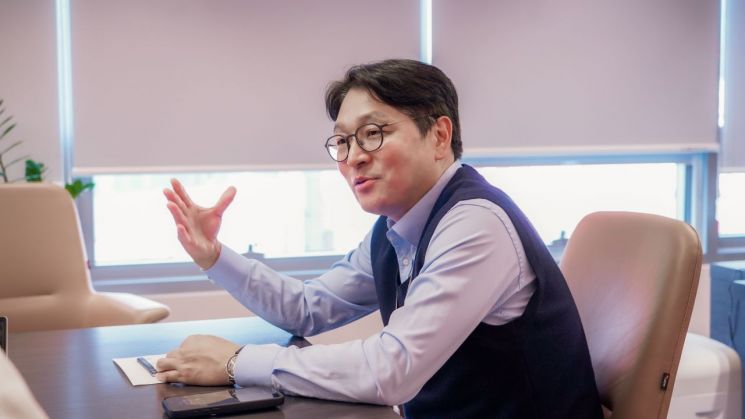
Regarding the background of entering the Japanese market, CEO Baek said, "Japan is the third largest market after China and the U.S., but I felt that we had not been successful there," and added, "Since I have experience succeeding in mobile games, I judged that we could definitely achieve results."
The Japanese branch is currently in its early stages and operates with a small team of five employees. CEO Baek himself visits Japan about three to four times a month to handle business. He said, "The branch was established in January this year and is still in the setup phase. I believe that increasing the size of the organization is not important by itself; it should be scaled according to the projects. Since I have a personal network in Japan, expanding the organization in the future should not be too difficult."
Japan is considered a graveyard for foreign game companies due to the difficulty of succeeding there. Domestic game companies have a solid foundation, and gaming usage patterns differ from other countries, creating high entry barriers. CEO Baek identified ‘subculture’ as a genre with high potential for success in Japan. Subculture refers to games featuring Japanese anime-style graphic design.
He said, "Japan is known as the holy land of ‘otaku,’ so there are many niche markets we can approach," and added, "We could bring in games that were hits in Korea and earn three to four times more, but even if the games are small, if they continuously generate a certain level of profit, I think that is meaningful."
CEO Baek noted, "Simply translating Korean games into Japanese does not have a high probability of success in Japan," analyzing, "One characteristic of the Japanese market is that users have very high IP (intellectual property) loyalty. If users find a game fun and consider its operation stable, they show continuous loyalty."
As a strategy for entering the Japanese market, CEO Baek is planning IP collaborations that allow one source, multi-use, such as with animation. He said, "Japan is a paradise for IP. We are making multifaceted efforts to create opportunities to develop games, animations, and more with Japanese IP creators," and added, "Considering the recent resurgence of the Korean Wave, I also think it would be good to create Korean-style content through collaboration with Japan."
© The Asia Business Daily(www.asiae.co.kr). All rights reserved.
![Clutching a Stolen Dior Bag, Saying "I Hate Being Poor but Real"... The Grotesque Con of a "Human Knockoff" [Slate]](https://cwcontent.asiae.co.kr/asiaresize/183/2026021902243444107_1771435474.jpg)

















