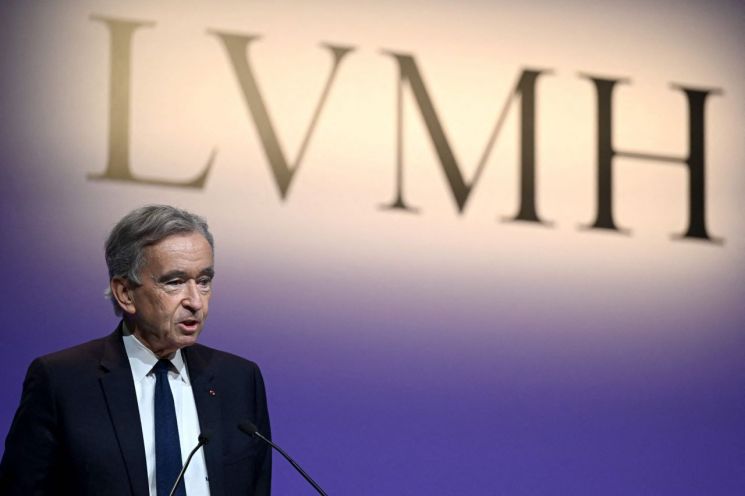
The global luxury goods industry, which had been soaring due to a surge in revenge spending following COVID-19, is now showing signs of a significant slowdown. Sales of LVMH, the world's largest luxury group Louis Vuitton Mo?t Hennessy (hereafter LVMH), have also contracted this year. Analysts attribute this largely to the reduced spending by China, a major luxury consumer, compared to previous levels.
According to Bloomberg and other sources on the 16th (local time), LVMH's revenue for the first quarter of this year (January to March) was 20.694 billion euros (approximately 30.5 trillion KRW), down 2% from the same period last year. This figure also fell short of the market forecast of 21.14 billion euros compiled by financial information firm Visible Alpha.
LVMH's first-quarter growth rate was the lowest since 2016, excluding the first quarter of 2020 when the global economy was shut down due to COVID-19. Sales in the core fashion and leather goods segment declined by 2.2%. Alcoholic beverages such as wine saw a double-digit drop of 10%.
LVMH owns 75 luxury brands including Louis Vuitton, Christian Dior, Celine, and Loewe. As the world's largest luxury company by market capitalization, LVMH's sales trends are considered a barometer for the global luxury industry outlook. Bloomberg explained, "This poor performance indicates that even LVMH, which has weathered the downturn better than most luxury companies, is beginning to feel the pressure."
The contraction in LVMH's sales is attributed to a slowdown in demand from China, the world's largest luxury consumer. The ongoing real estate slump and concerns about deflation (falling prices amid economic recession) in China have delayed economic recovery, which is directly reflected in the luxury industry.
Typically, luxury goods perform well even during recessions, but repeated price increases by luxury brands have pushed consumer sentiment beyond its limits, leading to poor performance. As the slowdown in luxury consumption has been observed, LVMH's stock price has fallen about 9% over the past month, giving back some of this year's gains.
The market views this as the end of the luxury industry's peak boom created by COVID-19. French retailer Kering also forecast last month that sales of its flagship luxury brand Gucci likely plunged 20% year-on-year in the first quarter.
Investment bank Barclays predicted that after recording double-digit growth rates post-COVID-19, the global luxury industry's expansion slowed to 9% last year and is expected to shrink further to the mid-single digits this year.
© The Asia Business Daily(www.asiae.co.kr). All rights reserved.
![Clutching a Stolen Dior Bag, Saying "I Hate Being Poor but Real"... The Grotesque Con of a "Human Knockoff" [Slate]](https://cwcontent.asiae.co.kr/asiaresize/183/2026021902243444107_1771435474.jpg)
















