Statistics Korea Announces Survey Results on Immigrant Residency and Employment Conditions
Among foreign workers who wished to change jobs last year, 6 out of 10 (58.6%) cited low wages and hazardous work as reasons for wanting to change jobs.
According to the "Survey on Immigrant Stay Status and Employment" released by Statistics Korea on the 17th, the proportion of foreign wage workers who wished to change jobs last year was 12.3%. The most common reason was "low wages" at 39.2%, followed by "work is hard or dangerous" at 19.4%.
By visa status, the proportion of workers wanting to change jobs due to "low wages" was highest among permanent residents (44.8%), followed by international students (44.4%) and skilled professionals (42.5%).
The proportion of foreign workers wanting to change jobs because "work is hard or dangerous" was highest among visit employment visa holders (36.0%), marriage immigrants (23.3%), and overseas Koreans (23.0%). The "visit employment" visa is granted under the Special Employment Permit System, allowing overseas Koreans of foreign nationality living in the former Soviet Union, China, and other countries to work in 38 industries.
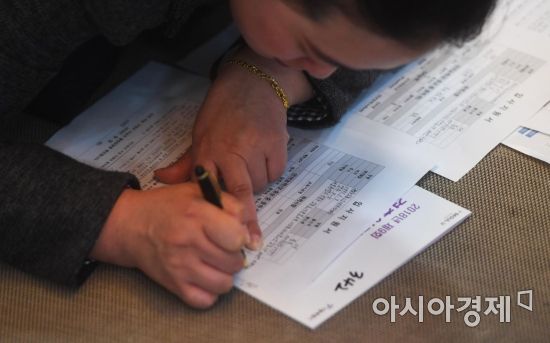 On the 6th, a marriage immigrant visiting the '9th Seoul Marriage Immigrant Employment Fair' held at the Citizen Hall in the basement of Seoul City Hall's main building is filling out a resume. At the fair, 14 companies including YBM NET and the United Nations High Commissioner for Refugees (UNHCR) are conducting one-on-one on-site interviews, and 45 companies are expected to provide job information. The city has deployed interpreters for marriage immigrants on-site who speak Chinese, Vietnamese, Russian, and Uzbek to assist those who have difficulty with interviews due to poor Korean skills. Photo by Moon Ho-nam munonam@
Over the past year, 13.5% of foreigners residing in Korea reported experiencing economic difficulties. The highest proportion was among international students (21.5%), followed by visit employment visa holders (16.3%) and overseas Koreans (14.8%). In particular, 46.4% of overseas Koreans and 43.0% of visit employment foreigners reported that they could not receive medical treatment due to the burden of hospital fees.
Last year, the most common weekly working hours for foreign workers were 40 to 50 hours, accounting for 56.5%. Those working 50 to 60 hours (18.1%) and over 60 hours (10.5%) made up 28.6% of workers working more than 50 hours.
By visa status, the proportion working over 50 hours was relatively high among non-professional employment visa holders (35.6%) and visit employment visa holders (30.3%). The "non-professional employment" visa is granted to foreign workers from 16 countries that have signed employment permit agreements.
Among foreign wage workers, 50.6% earned a monthly wage between 2 million and 3 million KRW.
By visa status, the proportion earning between 2 million and 3 million KRW was highest among non-professional employment visa holders (66.5%), skilled professionals (53.9%), and visit employment visa holders (51.5%). In contrast, 88.0% of foreign international students earned less than 2 million KRW per month.
The job satisfaction rate among foreign workers was 62.6%, with non-professional employment workers showing a relatively high satisfaction rate of 71.1%. Statistics Korea explained that this was influenced by the fact that non-professional employment workers tend to come from countries with relatively lower economic levels compared to other visa categories.
By nationality within visa categories, non-professional employment visa holders were predominantly from other Asian countries such as Uzbekistan and the Philippines (86.9%). Visit employment visa holders were mostly Korean-Chinese, known as "Joseonjok" (84.5%), and international students were mainly from Vietnam (34.6%) and China (29.9%).
© The Asia Business Daily(www.asiae.co.kr). All rights reserved.
![Clutching a Stolen Dior Bag, Saying "I Hate Being Poor but Real"... The Grotesque Con of a "Human Knockoff" [Slate]](https://cwcontent.asiae.co.kr/asiaresize/183/2026021902243444107_1771435474.jpg)














