Deputy Prime Minister Choi Sang-mok Meets with Finance Minister Suzuki Shunichi
Shared Concerns over Decline in Both Countries' Currency Values
Choi Sang-mok, Deputy Prime Minister and Minister of Economy and Finance, and Suzuki Shunichi, Japan's Minister of Finance, mentioned on the 16th (local time) that they could take appropriate measures in response to the sharp volatility in the foreign exchange market. As the won-dollar exchange rate surpassed the 1,400 won mark for the first time in one year and five months, the foreign exchange market became highly volatile, prompting the finance ministers of Korea and Japan to engage in a joint verbal intervention for the first time.
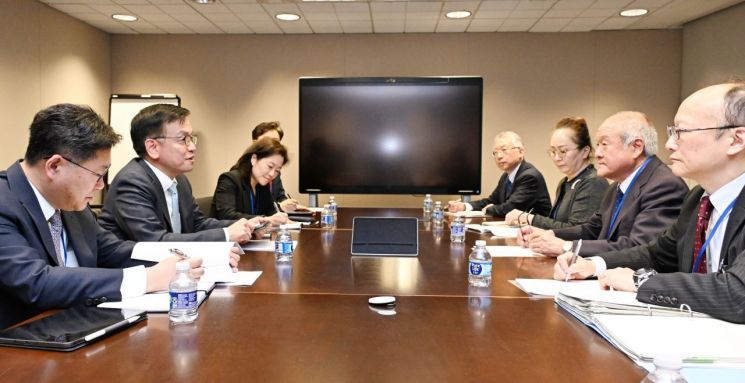 Choi Sang-mok, Deputy Prime Minister for Economic Affairs and Minister of Economy and Finance, who is visiting Washington DC, USA to attend the G20 Finance Ministers Meeting and the IMF·WB Spring Meetings, is meeting with Suzuki Shunichi, Japanese Minister of Finance, on the 16th (local time).
Deputy Prime Minister Choi held a meeting with Minister Suzuki in Washington D.C., USA, on the same day during the G20 finance ministers and central bank governors meeting.
Meeting Minister Suzuki for the first time since his inauguration, Deputy Prime Minister Choi shared concerns about the depreciation of both countries' currencies and mentioned that appropriate measures could be taken in response to the sharp volatility in the foreign exchange market. This is the first time the two finance ministers have jointly intervened verbally in the foreign exchange market.
Recently, as expectations for a Federal Reserve (Fed) interest rate cut have diminished and geopolitical risks in the Middle East have escalated, volatility in the foreign exchange market has increased. On the 13th (local time), Iran launched drones and cruise missiles at mainland Israel, raising concerns about an escalation in the Middle East conflict. This increased preference for the dollar, a representative safe-haven asset. On the 16th, the won-dollar exchange rate closed at 1,394.5 won. The Japanese yen also reached a 34-year low, trading at 153.82 yen per dollar in the New York foreign exchange market on the 15th.
As the foreign exchange market became highly volatile, the Ministry of Economy and Finance and the Bank of Korea issued a verbal intervention at 2:55 p.m. on the 16th, stating, “Foreign exchange authorities are closely monitoring exchange rate movements and foreign exchange supply and demand with heightened vigilance,” and added, “Excessive concentration in the foreign exchange market is undesirable for our economy.” This is the first verbal intervention since September 15, 2022. Japanese authorities have also been conducting daily verbal interventions against the depreciation of the yen. On the 16th, Minister Suzuki said, “We will not exclude any means and will take appropriate measures against excessive exchange rate movements,” adding, “We are monitoring the situation with a high level of tension.”
On this day, the two ministers agreed to further strengthen bilateral cooperation for the economic development of both countries. They especially agreed on the importance of communication and cooperation between the two countries as partners pursuing common interests on international issues. The Ministry of Economy and Finance and Japan’s Ministry of Finance also agreed to continue cooperation in multilateral forums such as the G20 meeting and the ASEAN+3 finance ministers meeting. They also agreed to coordinate the schedule for the 9th Korea-Japan Finance Ministers’ Meeting, which will be held in Korea soon. The 8th Korea-Japan Finance Ministers’ Meeting was held in Japan on June 29 last year.
© The Asia Business Daily(www.asiae.co.kr). All rights reserved.
![Clutching a Stolen Dior Bag, Saying "I Hate Being Poor but Real"... The Grotesque Con of a "Human Knockoff" [Slate]](https://cwcontent.asiae.co.kr/asiaresize/183/2026021902243444107_1771435474.jpg)















