Concerns Over Escalation if Israel Retaliates
"Airstrike on Iran's Nuclear Facilities Will Only Backfire"
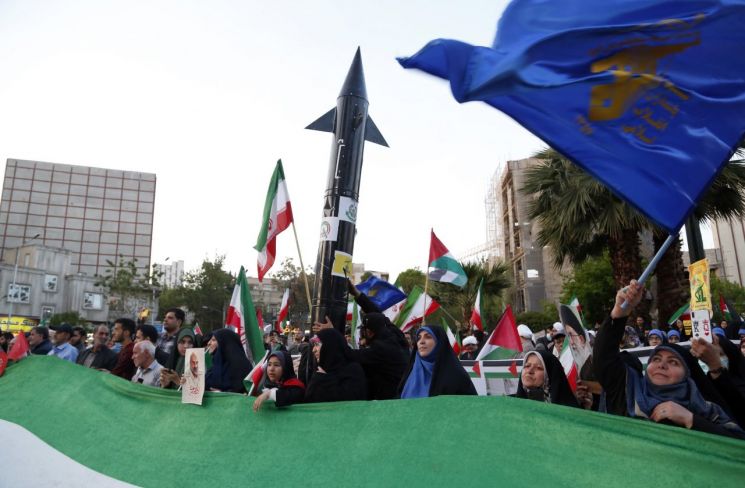 On the 15th (local time), protesters in Tehran, Iran, displayed a missile-shaped sculpture reminiscent of nuclear weapons during an anti-Israel demonstration. [Tehran=EPA·Yonhap News]
The International Atomic Energy Agency (IAEA) announced that it has temporarily suspended the activities of its inspection team due to concerns over Israel's potential airstrike on Iran's nuclear facilities. As the possibility of Israel retaliating against Iran's airstrikes by attacking nuclear sites arises, both the IAEA and Western countries are urging restraint. If the Israeli government carries out an excessive airstrike on Iran's nuclear facilities, the situation in the Middle East could escalate uncontrollably.
IAEA Director General Urges Israel to Exercise Extreme Restraint
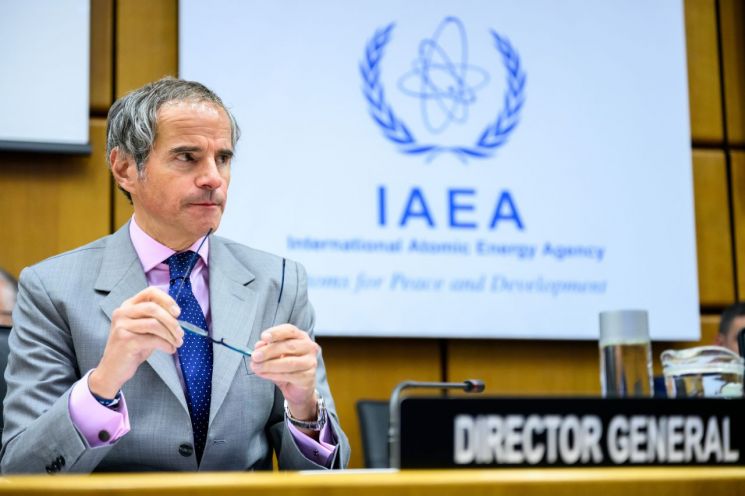 On the 11th (local time), Rafael Grossi, IAEA Director General, attending the Board of Governors meeting held at the International Atomic Energy Agency (IAEA) headquarters in Vienna, Austria. [Vienna=EPA·Yonhap News]
According to the Times of Israel on the 15th (local time), Rafael Grossi, Director General of the International Atomic Energy Agency (IAEA), stated at a press conference, "For security reasons, the activities of the IAEA inspection team dispatched to Iran's nuclear facilities have been suspended since Sunday," adding, "Access to the nuclear facilities by the inspection team has been blocked until the situation fully calms down. Inspection activities will resume starting tomorrow."
The security reason he mentioned refers to the possibility of a retaliatory attack by Israel. When asked about the possibility of Israel attacking Iran's nuclear facilities, Director General Grossi emphasized, "We are always concerned about this possibility," and urged, "Israel to exercise extreme restraint."
Concerns have been raised both inside and outside Israel that Israel, which declared retaliation for Iran's drone and ballistic missile airstrikes on the 13th, might launch an airstrike on Iran's nuclear facilities. The New York Times (NYT) reported, "From the perspective of some hardline Israeli officials, Iran's recent airstrikes could be seen as an opportunity to attack nuclear facilities," adding, "Plans could include direct strikes on nuclear sites as well as cyberattacks or attacks on drone manufacturing facilities, among other measures Israel has already taken against Iran."
For now, the Israeli government has declared its intention to carry out retaliatory attacks but has not specified the methods. On the same day, Israel's Channel 12 reported, "The wartime cabinet is discussing multiple retaliation options, which are painful to Iran but do not trigger a regional war." It further explained, "We will choose methods that allies such as the United States do not oppose, but we will deliver a clear and strong response to send a powerful message that Israel will not tolerate Iran's airstrikes."
"Attacking Iran's Nuclear Facilities Would Backfire... Accelerate Iran's Nuclear Armament"
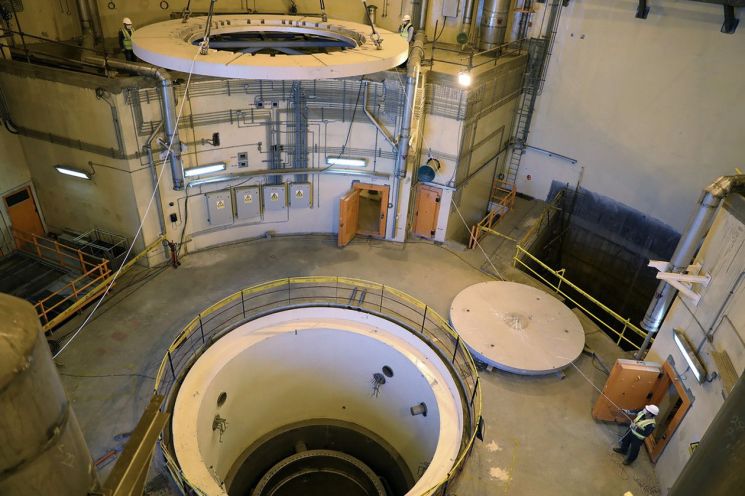 Appearance of the nuclear facility using heavy water in Arak, Iran. [Image source=Atomic Energy Organization of Iran (AEOI)]
There are also concerns that if Israel proceeds with an attack on Iran's nuclear facilities, it could instead increase the likelihood of Iran acquiring nuclear weapons. It is impossible to bomb all the nuclear facilities spread extensively across Iran, and such an attack could provoke Iran further, strengthening its resolve to develop nuclear weapons.
The Arms Control Association (ACA), a U.S. think tank, stated in a report, "If Israel targets Iran's nuclear facilities, it would be a reckless and irresponsible escalation decision that significantly increases the risk of a wider regional war," adding, "Conversely, Iranian authorities are likely to use Israel's attack as justification to develop stronger nuclear weapons and may decide to do so."
The ACA emphasized, "When the U.S. and Israel discussed a preemptive strike on Iran's nuclear facilities in 2012, it was expected that Iran's nuclear program would be set back by four years, but in reality, it was accelerated," and added, "If a nuclear facility attack occurs, Iran will likely relocate its nuclear facilities deeper underground, where conventional weapons cannot reach, to evade international scrutiny."
There are also concerns about the heavy burden on Israel, which is already engaged in a prolonged conflict with Hamas, if it has to open another front. The British Guardian reported, "Reports indicate that after more than six months of fighting Hamas, there are shortages of military supplies on some fronts in the Gaza Strip," and added, "Iran possesses at least 3,000 ballistic missiles, and if caught off guard by a surprise attack like the one on the 13th, Israel's multilayered air defense system could be overwhelmed."
© The Asia Business Daily(www.asiae.co.kr). All rights reserved.
![Clutching a Stolen Dior Bag, Saying "I Hate Being Poor but Real"... The Grotesque Con of a "Human Knockoff" [Slate]](https://cwcontent.asiae.co.kr/asiaresize/183/2026021902243444107_1771435474.jpg)

















