Map Including 4,000 Galaxies and Quasars to Be Completed by 2026
A research team including Korean researchers has created the world's largest 3D map of the universe.
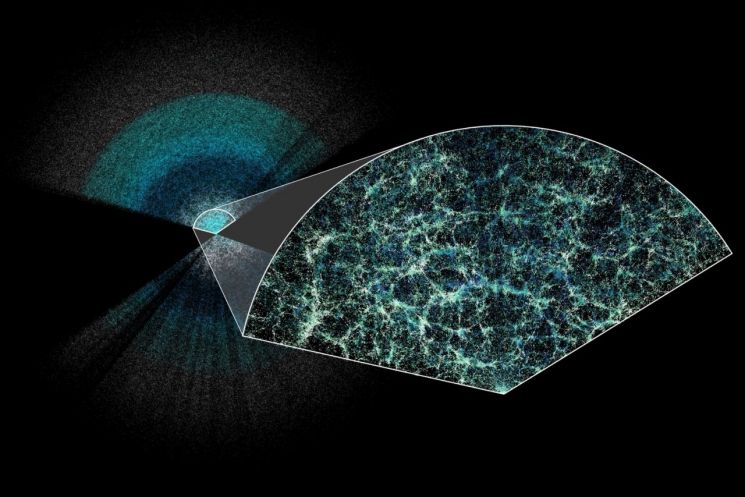 A three-dimensional map of the universe created by the DESI research team, showing the distances and directions of about 6 million galaxies and quasars. It is a narrow wedge-shaped observation data of the sky reaching right ascension 190 degrees and declination 14 degrees, with the Milky Way at the center. The distance from the center corresponds to the redshift observed by DESI. In the enlarged large map showing the region within about 2.7 billion light-years of redshift, several spherical patterns of baryon acoustic oscillations are clearly visible. (Source: DESI)
According to the Korea Astronomy and Space Science Institute on the 15th, the first product of the Dark Energy Spectroscopic Instrument (DESI) project, which involved over 900 researchers including those from Korea, has been released: a 3D map of the universe. It is regarded as an important milestone in understanding the expansion of the universe and the role of dark energy.
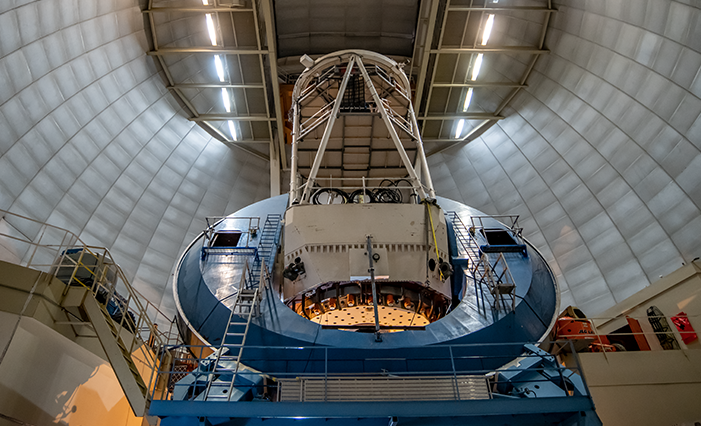
This map was developed to uncover the nature of dark energy, which constitutes most of the total energy in the universe. About 900 researchers from 11 countries and 70 institutions, including Korea, used a telescope equipped with a multi-channel spectrograph located at the summit of Kitt Peak in Arizona, USA, to precisely observe the spectra of light from distant galaxies and study dark energy. The telescope’s multi-channel spectrograph consists of 5,000 fiber-optic robots.
The research team used DESI to observe light from galaxies and quasars up to 11 billion light-years away over the past year, measuring how fast the universe has expanded. The amount of data observed by DESI in the past year is larger than all previously observed 3D spectroscopic maps combined.
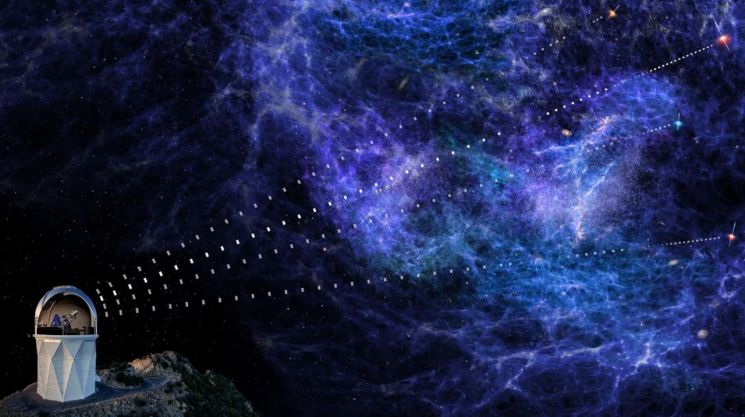
The DESI research team plans to create a cosmic map including a total of 3 million quasars and 37 million galaxies by 2026.
Professor Hyungmok Lee of the Department of Physics and Astronomy at Seoul National University explained, “The recent results from DESI represent the largest-scale and most accurate 3D analysis of the early universe’s history.”
Dr. Shapiel Rualman of the Korea Astronomy and Space Science Institute (Professor at the University of Science and Technology, Core Researcher at the Gravitational Wave and Space Research Center) said, “Through the DESI project, we discovered a very high possibility that the properties of dark energy change over time,” adding, “This observational data is expected to play an important role in verifying various theories about the universe’s expansion process and gravity, and in identifying the true nature of dark energy.”
▲Quasar = A celestial object that emits enormous energy in the radio spectrum due to a supermassive black hole at its center. It is very bright in visible light and X-rays, making it observable even from great distances.
▲Dark energy = An unknown form of energy that has the largest-scale influence on the universe.
© The Asia Business Daily(www.asiae.co.kr). All rights reserved.
![Clutching a Stolen Dior Bag, Saying "I Hate Being Poor but Real"... The Grotesque Con of a "Human Knockoff" [Slate]](https://cwcontent.asiae.co.kr/asiaresize/183/2026021902243444107_1771435474.jpg)

















