Legal Community "Concerns Over Political Conflict in Appointment Process"
Consecutive Term Expirations in Second Half of Year
Anticipated Criticism Attacks in Hearings
Impact on Judiciary Budget Planning Expected
In the legal community, there are concerns that the appointment procedures for Supreme Court justices and Constitutional Court justices may become politicized following the April 10 general election results, which saw a landslide victory for the opposition and a crushing defeat for the ruling party. This is because bipartisan agreement is necessary not only for the composition of the highest-ranking judges in the two major judicial institutions but also for the judiciary's budget allocation.
Challenges in Constitutional Court and Supreme Court Composition and Budget Allocation
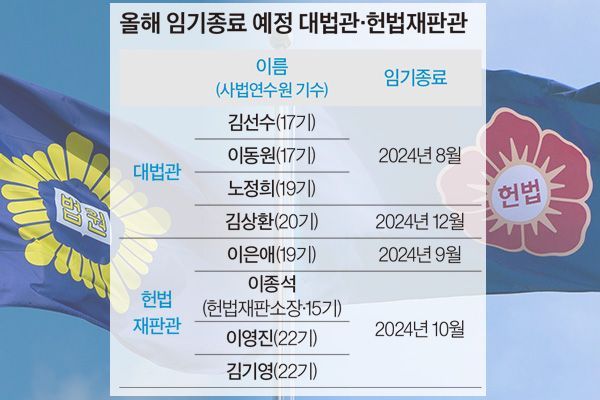
On the 12th, the Supreme Court began the process of selecting successors for Justices Kim Seon-su (63, Judicial Research and Training Institute Class 17), Lee Dong-won (61, Class 17), and Noh Jeong-hee (61, Class 19), who will retire in August. These justices were appointed by former President Moon Jae-in (71, Class 12) and recommended by former Chief Justice Kim Myung-soo (65, Class 15). Justice Kim Sang-hwan (58, Class 20) is also set to retire in December this year.
Once President Yoon Seok-yeol (64, Class 23) appoints their successors, the number of justices appointed under the Yoon administration will total nine, including Justices Oh Seok-jun (61, Class 19), Seo Kyung-hwan (57, Class 21), Kwon Young-jun (53, Class 25), Eom Sang-pil (58, Class 23), and Shin Sook-hee (55, Class 25).
However, considering that last year, during the successor selection process for former Chief Justice Kim Myung-soo, Seoul High Court Chief Judge Lee Gyun-yong (62, Class 16) was rejected in a plenary vote due to opposition from the opposition party, the legal community widely agrees that in the current political landscape of a ruling minority and opposition majority, the opposition party's influence will inevitably play a role in Supreme Court appointments.
The general election results are also expected to impact the composition of the Constitutional Court, which holds jurisdiction over constitutional violations, impeachment, and disputes over authority. Four of the nine Constitutional Court justices, including Chief Justice Lee Jong-seok (63, Class 15), will see their terms end in September and October this year.
Justice Lee Eun-ae (58, Class 19), nominated by former Chief Justice Kim Myung-soo during the Moon administration, will have her term expire on September 20. The terms of Chief Justice Lee Jong-seok, recommended by the Liberty Korea Party (predecessor of the People Power Party), as well as Justices Lee Young-jin (63, Class 22, recommended by the Bareunmirae Party) and Kim Ki-young (56, Class 22, recommended by the Democratic Party of Korea), will end on October 17.
Currently, the Constitutional Court consists of six progressive and three conservative justices. When conservative Chief Justice Cho Hee-dae (67, Class 13) appoints Lee Eun-ae's successor in September, the balance is expected to shift slightly to five progressives and four conservatives.
In October, all three justices appointed by the National Assembly will be replaced simultaneously, bringing further changes. Of the three justices appointed by the National Assembly, one is recommended by the ruling party, one by the opposition, and the third is recommended through bipartisan agreement.
Just as the Bareunmirae Party, which became a parliamentary negotiation group through a merger in February 2018, took the National Assembly appointment rights, if the Joguk Innovation Party becomes a parliamentary negotiation group through future mergers after the general election, it could gain the right to recommend Constitutional Court justices, potentially shifting the balance from “five progressives and four conservatives” to “six progressives and three conservatives.” A chief judge at a metropolitan district court said, “With the consecutive expirations of Supreme Court and Constitutional Court justices’ terms in the second half of this year, there is concern that the confirmation hearings could become politically charged and adversarial. If appointments are delayed, vacancies could arise, leading to trial delays and potentially paralyzing judicial functions.”
There are also forecasts that the general election results could affect the judiciary’s budget allocation. If political strife intensifies in a ruling minority-opposition majority situation, there could be disinterest in the judiciary’s budget or difficulties in increasing it. A lawyer who is a former chief judge remarked, “Members of the National Assembly who are judges below the level of senior chief judge and lack managerial experience seem to attack the courts more than they show affection.”
“Concerns Over Investigation Retraction”… Rise of Law School Graduates
Within the prosecution, there are fears of concentrated attacks such as impeachment of prosecutors and the introduction of special prosecutor laws. Especially with many opposition lawmakers critical of the prosecution being elected, there is a sense of crisis that the push for “complete removal of prosecution’s investigative authority” (Geomsu Wanbak) might intensify. The Joguk Innovation Party has proposed transforming the prosecution office into a purely prosecutorial agency as its first pledge. A senior prosecutor in the metropolitan area said, “It is true that we are concerned because the opposition keeps trying to judge the prosecution,” adding, “There are even talks about holding back for a while,” expressing worries about investigation retraction. Another chief prosecutor said, “Inside, some worry that the prosecution might disappear, while others naively think the public wouldn’t hate the prosecution that much.”
There were also voices of hope placed on young lawmakers who graduated from law schools. Park Jong-myeong, head of the Subtext Public Policy Research Institute, said, “Legal professionals are basically accustomed to one-sided communication through cross-examination and tend to think within the framework of the law,” advising, “For law school graduate politicians to have longevity, they need to quickly break away from the typical legal professional way of thinking and communicating.” A law school professor who is also a lawyer said, “It would be good if young politicians from law schools actively convey the living voices from the field on various legal issues and work hard on legislative activities.”
Park Su-yeon, Lee Soon-gyu, Woo Bin, Hong Yoon-ji, Legal News Reporters
※This article is based on content supplied by Law Times.
© The Asia Business Daily(www.asiae.co.kr). All rights reserved.
![Clutching a Stolen Dior Bag, Saying "I Hate Being Poor but Real"... The Grotesque Con of a "Human Knockoff" [Slate]](https://cwcontent.asiae.co.kr/asiaresize/183/2026021902243444107_1771435474.jpg)















