Xiaomi "Early Forecast Did Not Consider Strong SU7 Sales"
However, No Mention of Estimated Losses or Other Details
Citigroup estimated that the company would incur an average loss of 6,800 yuan (approximately 1.3 million KRW) for each unit sold of Xiaomi's first electric vehicle SU7 (Chinese name: Suchi). Xiaomi refuted this, saying the estimate did not take into account the popularity of the SU7 and lacked accuracy.
According to local media including the Chinese economic outlet Caijing Daily on the 15th, Citigroup recently stated in a research report that "Xiaomi SU7's deliveries in April are expected to reach 5,000 to 6,000 units, with an annual total of 55,000 to 70,000 units," and projected "an average loss of 6,800 yuan per vehicle sold, resulting in a total loss of 4.1 billion yuan for the entire automobile manufacturing sector this year."
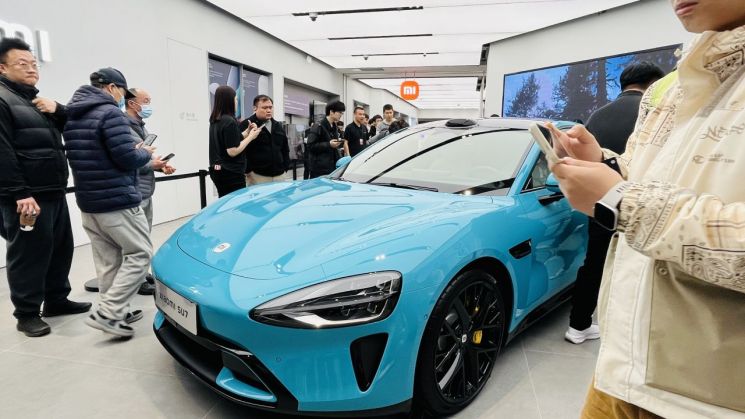
In response, Xiaomi pointed out on the social networking service Weibo that "the information could have a large margin of error," adding, "The analyst report is based on data as of April 2, which is insufficient to anticipate the strong sales of the Xiaomi SU7." They further explained, "Orders have been continuously increasing over the past few weeks, and we are doing our best to improve delivery capacity." However, Xiaomi did not directly respond to Citigroup's estimates regarding losses or the amount of loss.
Multiple institutions forecast that Xiaomi's vehicle deliveries this year will reach between 60,000 and 80,000 units. Regarding the deficit issue, Li Xiang, founder of the electric vehicle startup Li Auto (Li Auto), previously stated that reaching sales of 100 billion yuan with a gross profit margin of 15-25% is a condition for healthy survival.
According to Xiaomi's financial report last year, the company's total revenue was 271 billion yuan, a 3.2% decrease from the previous year, but adjusted net profit increased by 126.3% year-on-year to 19.3 billion yuan. As of the end of last year, the company held cash reserves of 136.3 billion yuan, and its automobile research and development (R&D) expenses exceeded 10 billion yuan. Xiaomi Chairman Lei Jun also stated that the company has sufficient cash to withstand intense competition over the next five years and will accumulate more cash if possible.
Meanwhile, Citigroup pointed out that it takes more than six months from order to delivery for the SU7. According to local media such as Pengpai News, the standard version of the SU7 takes about 26 to 29 weeks for delivery, the Pro version 26 to 29 weeks, and the Max version about 28 to 31 weeks. This means customers may have to wait nearly eight months after ordering.
Since the launch of the Xiaomi SU7, several Chinese electric vehicle companies have joined in price reductions. Nio (Future Automobile) announced subsidies of up to 1 billion yuan and also offered an option subsidy of 1,000 yuan per vehicle. Xiaopeng G9 has started a limited-time discount of up to 20,000 yuan, priced at 209,800 yuan. Chery Automobile is waiving purchase taxes on temporarily designated models and providing overlapping benefits for trade-in discounts on existing vehicles.
© The Asia Business Daily(www.asiae.co.kr). All rights reserved.
![Clutching a Stolen Dior Bag, Saying "I Hate Being Poor but Real"... The Grotesque Con of a "Human Knockoff" [Slate]](https://cwcontent.asiae.co.kr/asiaresize/183/2026021902243444107_1771435474.jpg)















