"Fees Must Increase 3 to 4 Times at Once to Be Realistic"
"Gradual Medical Reform Needed, Not Radical Change"
As the government maintains its stance on reducing the scale of medical practices at tertiary hospitals and operating them primarily with specialists, the medical community has criticized this approach as unrealistic, lacking consideration of financial aspects.
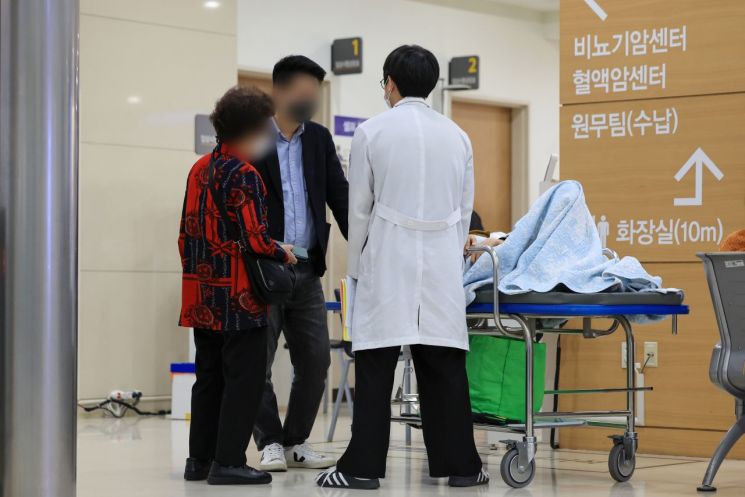 On the 8th, a medical professional and a guardian are having a conversation at a university hospital in Seoul. [Image source=Yonhap News]
Now entering the ninth week since residents submitted their resignation letters and left hospitals, university hospitals are reportedly experiencing daily deficits ranging from several hundred million won to over 1 billion won. According to the Korea Hospital Association, from the last two weeks of February this year, immediately after the resident resignation crisis, until last month, the revenue of 50 training hospitals for residents decreased by approximately 423.8 billion won. Consequently, among the 'Big 5' hospitals, Seoul Asan Medical Center, Severance Hospital (Yonsei University Health System), and Seoul National University Hospital have entered emergency management systems, with tertiary hospitals expressing serious financial difficulties.
The government plans to significantly increase fees in essential medical fields in the future so that even if medical practices are reduced to focus on specialists treating severe and emergency patients, tertiary hospitals will not incur deficits. Jeong Gyeong-sil, Director of Health and Medical Policy at the Ministry of Health and Welfare, stated at 'The 15th Korea Healthcare Congress 2024' (KHC 2024) during the 'Is Korean Healthcare Collapsing Like This? A Grand Debate on Medical Reform' on the 12th, "Specialist-centered hospitals incur very high costs, and it is difficult to generate profits while maintaining the current scale of medical practices and beds at university hospitals and transitioning to a specialist-centered model," adding, "Although there is variation among hospitals, statistics show that about 50% of outpatient visits are for mild cases. I believe hospitals need to restructure by shifting personnel to specialists and reducing the volume of medical practices."
He continued, "We will implement policies to significantly increase fees in essential fields such as severe cases, enabling hospitals to operate without seeing many patients," and explained, "By doing so, medical institutions will voluntarily reduce the unnecessary presence of mild patients at tertiary hospitals."
In response, the medical community has expressed that this approach lacks financial feasibility. Professor Jeong Jae-hoon of the Department of Preventive Medicine at Gachon University College of Medicine said, "The most important issue is that this poses a financial threat," adding, "Despite many problems in the current medical delivery system, the reason tertiary hospitals have been able to provide high-level medical services is that the current management method is practically the most efficient."
He further explained, "Reducing medical practices at tertiary hospitals ultimately means a decrease in revenue. It will not be financially sustainable," and "Such changes could actually undermine the future sustainability of our healthcare."
Woo Bong-sik, Director of Medical Policy Research at the Korean Medical Association, also stated, "To operate large hospitals with fewer medical practices, health insurance fees must be significantly increased. While prices have risen nearly 30 times since 1977, fees have only increased about eightfold. Fees would need to be raised three to four times at once, which is unrealistic."
Concerns were also raised about the government's inability to artificially reduce the already expanded scale of private hospitals and about workforce issues such as reductions in non-physician professions. Professor Jeong said, "It will be difficult for the government to physically restrict not only the current operating scale but also the beds for which approval and investment stages have already been completed," adding, "Reducing medical supply at large hospitals also means a reduction in employment and economic added value. These aspects must also be considered."
They suggested that gradual medical reform, rather than radical change, is necessary. Director Woo said, "Ultimately, it comes down to feasibility and financial issues. Without resolving financial aspects, failure is inevitable," and "We need to gradually explore concrete reform measures, including securing finances and increasing the number of medical personnel per patient."
Professor Jeong also said, "Changing the entire system at once is very difficult. Gradual changes should be pursued, considering accompanying cost increases such as health insurance premium hikes and budget investments."
© The Asia Business Daily(www.asiae.co.kr). All rights reserved.
![Clutching a Stolen Dior Bag, Saying "I Hate Being Poor but Real"... The Grotesque Con of a "Human Knockoff" [Slate]](https://cwcontent.asiae.co.kr/asiaresize/183/2026021902243444107_1771435474.jpg)
















