Engine Production from 1979's 'Phantom' to 'Boramae'
40 Billion KRW Investment, 5,000 Pyeong Smart Engine Factory Groundbreaking
Securing Korea's Only Integrated Design, Production, and MRO Capabilities
Hanwha Aerospace has achieved the production of 10,000 cumulative engines in 45 years.
On the 15th, Hanwha Aerospace announced that it held a “10,000th Aircraft Engine Shipment Ceremony” at its Changwon 1 Plant while producing the 10,000th engine, the F404 engine for the Air Force TA-50 trainer aircraft.
After the shipment ceremony, a groundbreaking ceremony was also held for a smart engine factory to produce the F414 engine to be installed on the KF-21, Korea’s first domestically produced fighter jet. This marks a proactive step to secure the development platform for 6th generation fighter jet engines.
The engine factory, which will be established on a scale of approximately 16,500㎡ (5,000 pyeong) with an investment of about 40 billion KRW by 2025, is a smart factory equipped with IT-based quality control and logistics systems. The strategy is to build an ecosystem in the aircraft engine field with accumulated capabilities and secure independent global-level aircraft engine technology by the mid-to-late 2030s.
About 200 officials from the public, private, and military sectors attended the event, including Kim Myung-joo, Vice Governor of Gyeongnam Province; Seok Jong-geon, Administrator of the Defense Acquisition Program Administration; Hong Nam-pyo, Mayor of Changwon; Yoo Jae-moon, Commander of the Air Force Logistics Command; Ahn Sang-min, Commander of the Navy Logistics Command; Park Jong-seung, Director of the Agency for Defense Development; Son Jae-hong, Director of the Defense Technology Promotion Research Institute; and Heo Geon-young, Director of the Defense Technology Quality Institute.
Securing Technology from Design to Testing and Certification... “Producing Over 1,800 Engines with Independent Technology”
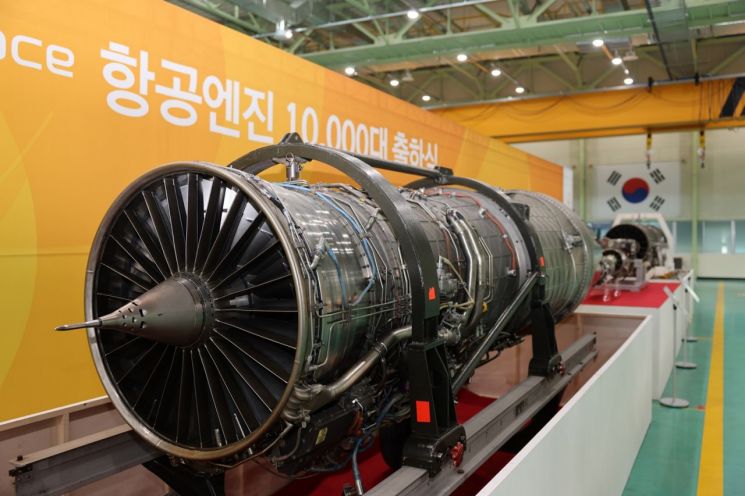 At Hanwha Aerospace Changwon Plant 1, aircraft engines produced by Hanwha Aerospace since 1979 are exhibited according to their eras.
 [Photo by Hanwha Aerospace]
Hanwha Aerospace started producing overhaul and maintenance of J79 engines for the Air Force F4 fighter jets in 1979 and has produced a total of 10,000 engines over 45 years, including those installed in aircraft, helicopters, and ships.
During this process, it secured foundational technologies and systems across the entire aircraft engine spectrum, including ▲engine design and analysis ▲materials and manufacturing ▲testing and certification, and based on this, independently developed and produced over 1,800 engines such as guided missile engines and auxiliary power units (APU).
In addition, along with producing engines for the Air Force’s main aircraft, it has maintained, repaired, and overhauled (MRO) a total of 5,700 engines over 45 years, uniquely possessing integrated capabilities in Korea from engine design to materials, manufacturing, and after-sales management.
Developing an Independent 15,000-Pound Class Engine... “Challenging the 150 Trillion KRW Market by 2029”
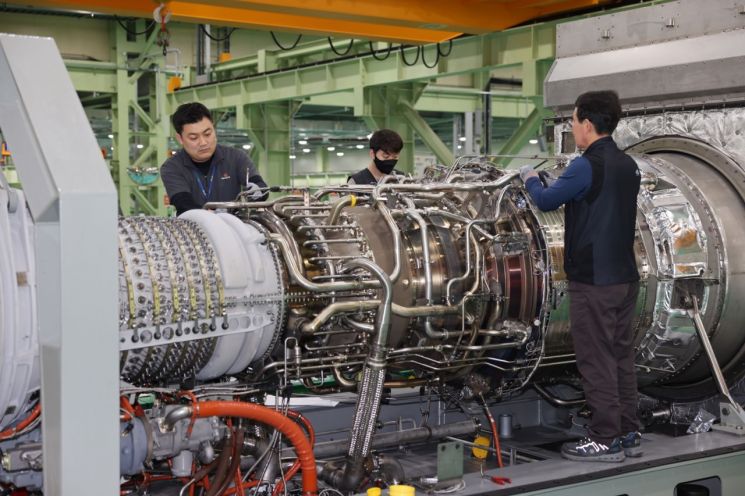 Hanwha Aerospace employees inspecting an engine at the Changwon 1 plant of Hanwha Aerospace
 [Photo by Hanwha Aerospace]
Starting with the production of 10,000 engines and factory expansion, Hanwha Aerospace plans to develop a 15,000-pound class engine comparable to the KF-21 engine by the mid-to-late 2030s in cooperation with the government.
By securing independent fighter jet engine technology, it aims to establish self-reliant defense and actively enter the global aircraft engine market, which is expected to exceed 150 trillion KRW around 2029, creating Korea’s “future growth engine.” Previously, production was based on licenses from overseas companies.
Hanwha Aerospace also revealed a mid-to-long-term strategy to create an ecosystem in the aircraft engine field with dozens of domestic companies, develop advanced independent engines, and additionally develop engines for unmanned aerial vehicles and commercial aircraft based on this.
It has also secured advanced technologies such as the “Engine-Integrated Electric Starter Generator (E2SG),” a core technology for 6th generation fighter jet engines requiring AI and manned-unmanned combined operations, and ceramic composite material development, planning to proactively respond to future battlefields for self-reliant defense.
In a video congratulatory message, Shin Won-sik, Minister of National Defense, said, “Aircraft engines are a concentration of advanced technology possessed by only a few countries and a core technology that determines leadership in the aerospace industry. The technology accumulated by Hanwha will be a great strength in strengthening the Republic of Korea’s defense capabilities.”
Son Jae-il, CEO of Hanwha Aerospace, said, “The Army, Navy, Air Force, government, and participating companies will all join forces to increase the technological independence of aircraft engines, which have relied on overseas sources, and contribute to the development of Korea’s aerospace and defense industries.”
© The Asia Business Daily(www.asiae.co.kr). All rights reserved.
![Clutching a Stolen Dior Bag, Saying "I Hate Being Poor but Real"... The Grotesque Con of a "Human Knockoff" [Slate]](https://cwcontent.asiae.co.kr/asiaresize/183/2026021902243444107_1771435474.jpg)

















