Discussion on Establishing Route Maps for Wheelchair Users and Disabled
Initial Survey and Analysis of Public Transport Conditions by Pier
Transportation and Pedestrian Improvements... Application of Universal Design
The Seoul Metropolitan Government is initiating discussions to improve access to the 'Hangang River Bus' for transportation-vulnerable groups such as wheelchair users. This measure reflects the directive of Seoul Mayor Oh Se-hoon, who emphasized that "accessibility must be the top priority for the River Bus to become a public transportation option for citizens."
According to the Seoul city government on the 15th, the city recently began analyzing the public transportation conditions at each dock to facilitate easier use of the River Bus by transportation-vulnerable groups. A city official explained, "This is to establish the safest route between the River Bus docks and the nearest subway stations so that people with disabilities can conveniently use Seoul's new public transportation."
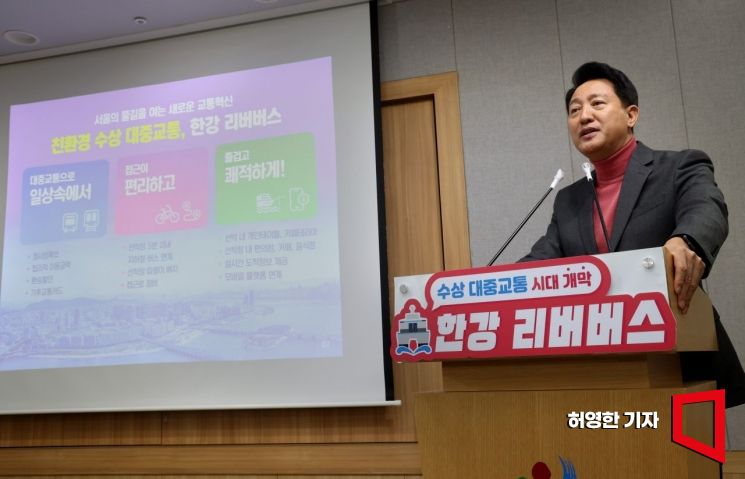 The Hangang River Rebirth briefing was held on the 1st at Seoul City Hall. Seoul Mayor Oh Se-hoon is explaining the River Rebirth project plan. Photo by Heo Young-han younghan@
First, Seoul plans to analyze available transportation routes near the docks, including subways, buses, village buses, and public bicycles. Based on this, they intend to establish routes that make transfers and direct use easier for transportation-vulnerable groups and provide highly visible guide maps.
Improvements to transportation and pedestrian environments will also accompany this effort. The city will identify areas for improvement along the routes used by transportation-vulnerable groups, such as subway stations, bus stops, and pedestrian paths, and complete priority enhancements before the official operation in October. Remaining tasks will be classified as mid- to long-term projects for further maintenance. The application of universal design will also be discussed. This universal design ensures that service users are not restricted by gender, age, disability, language, or other factors. Separate consultations will be conducted, reflecting the 'Basic Ordinance on Universal Design City Formation.'
Seoul plans to continue various discussions to improve citizens' access to the River Bus. Mayor Oh recently inspected the River Bus docks in person and instructed, "If the previously announced dock locations do not ensure citizen safety due to various circumstances, please prioritize safety by adjusting the dock locations as necessary." This reflects the judgment that accessibility to the docks must be the foremost consideration for the River Bus to become a public transportation option for Seoul citizens.
On-site, improvement plans are being reviewed for some docks such as Magok, Mangwon, and Jamwon, which are somewhat distant from subway stations. Seoul has also requested some autonomous districts to maintain and establish bicycle paths around the docks to facilitate smooth River Bus operations. This is to enhance citizen convenience by using bicycles as intermediate transportation. Internally, the city plans to reallocate budgets for facilities and auxiliary expenses to expand related safety facilities.
Additionally, Seoul has begun constructing the River Bus vessels. The linked projects, including shipbuilding and dock construction, are expected to be completed around September and will be unveiled to the public in October. The 'Hangang River Bus' vessels will be 35 meters long, 9.5 meters wide, and weigh 150 tons. The exterior will be made of aluminum, which is lighter than FRP (fiber-reinforced plastic), a material commonly used in general ships, and is resistant to external impacts and fire while reducing fuel consumption by about 35%. Furthermore, the vessels will be eco-friendly, equipped with electric-diesel hybrid engines that emit approximately 48% less carbon dioxide compared to diesel engines.
© The Asia Business Daily(www.asiae.co.kr). All rights reserved.
![Clutching a Stolen Dior Bag, Saying "I Hate Being Poor but Real"... The Grotesque Con of a "Human Knockoff" [Slate]](https://cwcontent.asiae.co.kr/asiaresize/183/2026021902243444107_1771435474.jpg)











