KOSPI and KOSDAQ Fall About 1%
Geopolitical Risks from the Middle East Raise Volatility
High Exchange Rates Stir Concerns Over Foreign Investor Flows
As geopolitical risks in the Middle East expand, concerns about the stock market are also growing. Following the general election, worries about the weakening momentum of corporate value-up programs, the retreat of expectations for interest rate cuts due to U.S. inflation instability, and the impact of external and internal uncertainties such as the strong dollar have caused the KOSPI to fall to the 2600 level. With another negative factor emerging, it is expected that a precarious market situation will continue for the time being.
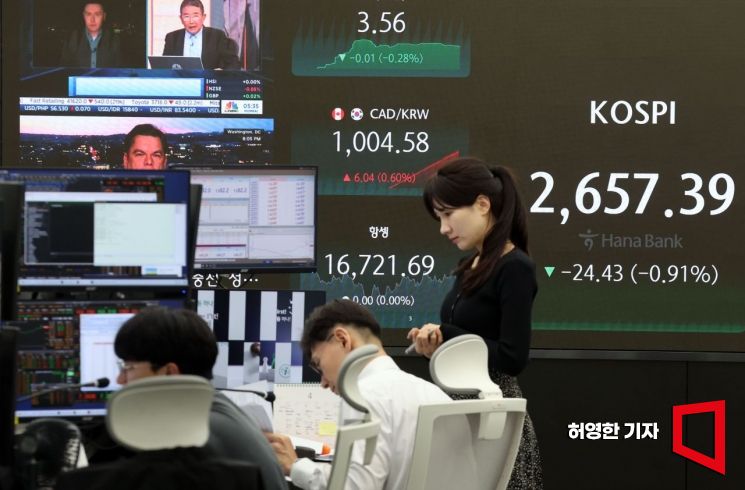 Due to concerns over rising oil prices amid Middle East instability caused by Iran's airstrikes on Israel, the KOSPI and KOSDAQ indices started lower on the 15th, while the won-dollar exchange rate rose. Stock and exchange rate indices are displayed on the electronic board in the dealing room at the Hana Bank headquarters in Euljiro, Seoul. Photo by Heo Younghan younghan@
As of 9:15 a.m. on the 15th, the KOSPI was down 34.09 points (1.27%) from the previous session at 2,647.73, and the KOSDAQ also fell 13.74 points (1.60%) to 846.73.
In an environment where the stock market’s surroundings are not favorable, the growing geopolitical risks from the Middle East appear to have poured cold water on already cautious investor sentiment. Due to weakened expectations for corporate value-up programs and concerns over delayed U.S. interest rate cuts, the KOSPI broke below the 2700 level for the first time in 16 trading days last week based on closing prices. On the 12th (local time), the U.S. stock market also recorded declines of over 1% across all three major indices amid heightened geopolitical tensions from the Middle East, poor first-quarter earnings from major banks such as JP Morgan and Wells Fargo, and rising inflation expectations at the University of Michigan, highlighting domestic and international uncertainties. Consequently, increased volatility in the domestic stock market is expected to be inevitable. Ji-young Han, a researcher at Kiwoom Securities, diagnosed, "The Korean stock market will experience volatile trading during the week influenced by factors such as the escalation of geopolitical tensions between Israel and Iran, real economy indicators like U.S. retail sales and industrial production, earnings from major U.S. companies such as Goldman Sachs, Tesla, and Netflix, and possible changes in foreign net buying due to the sharp rise in the won-dollar exchange rate."
Jaehyun Kang, a researcher at SK Securities, said, "As was the case last year, geopolitical risks are clearly risk factors, not only causing behavior that avoids risky assets but also potentially bringing inflationary pressures that do not accompany demand expansion in the real economy," adding, "Since the U.S. market has already undergone a correction, a domestic stock market adjustment due to this is also inevitable."
Foreign Demand as a Variable... Using Corrections as Buying Opportunities
In particular, concerns arise from the fact that Middle East geopolitical risks could stimulate oil price increases and a stronger dollar. The strong dollar can affect foreign demand, which has supported the stock market so far. On the 12th, the KOSPI fell below the 2700 level as foreign demand worsened due to the sharp rise in the won-dollar exchange rate. The won-dollar exchange rate reached its highest level in 17 months, and foreigners sold more than 1.2 trillion won net in the futures market, pulling the index down. Jinhyuk Kang, a researcher at Shinhan Investment Corp., said, "The dollar index is at its highest level since November last year, and the won-dollar exchange rate is also at its highest in 17 months since November 2022," adding, "Middle East instability is supporting the strong dollar, so attention should be paid to the downward rigidity of the exchange rate and foreign demand for the time being."
Daejun Kim, a researcher at Korea Investment & Securities, also explained, "External factors such as the Federal Reserve’s monetary policy and Middle East geopolitical risks are exerting upward pressure on the exchange rate, and at the same time, the high oil price phenomenon continues," adding, "The Korean stock market perceives high exchange rates and high oil prices as negative factors, and coincidentally, the biggest concerns for the Korean stock market?high exchange rates and high oil prices?are overlapping, so a conservative approach to the market is required at this time."
However, many opinions suggest that there is no need to reduce stock investment weight due to fears that geopolitical risks will escalate further, such as continued attacks. Researcher Ji-young Han said, "It is necessary to avoid assuming a worst-case scenario based on repeated additional airstrikes by Israel and countermeasures by Iran, and the consequent strengthening of involvement by the U.S. and Saudi Arabia," explaining, "Instead, it is appropriate to assume a scenario where diplomatic conflicts continue without further military attacks." She added, "Currently, as expectations for the timing of the Fed’s rate cuts are being pushed back and the U.S. first-quarter earnings season is not off to a smooth start, the addition of geopolitical risks amid a challenging environment both inside and outside the stock market is burdensome. However, considering related data and circumstances, while risk management is necessary, it is not appropriate to reduce stock positions below neutral due to excessive anxiety."
There are also opinions that, considering favorable corporate earnings, the war event could be a buying opportunity at low prices. Younghwan Kim, a researcher at NH Investment & Securities, said, "Although the index will decline due to geopolitical risks, considering the initial actions of Iran and the U.S. and the fact that it is a U.S. election year, the possibility of escalation into a fifth Middle East war is low," adding, "During a period of increasing corporate profits, the emphasis on war events allows for buying stocks cheaply, so buying responses are recommended in the KOSPI 2500 range." Researcher Jaehyun Kang also said, "Excluding geopolitical risks, the upside for the stock market remains open," adding, "If this risk does not prolong too much and does not push oil prices significantly higher, the stock market correction caused by the heightened geopolitical risks will be a buying opportunity."
Currently, sectors of interest include semiconductors and automobiles. Researcher Younghwan Kim explained, "Due to the strong dollar and weakening won caused by the emphasis on geopolitical risks, U.S. export stocks expected to have favorable earnings will gain additional momentum," adding, "Semiconductor, automobile, and machinery sectors are positive."
© The Asia Business Daily(www.asiae.co.kr). All rights reserved.
![Clutching a Stolen Dior Bag, Saying "I Hate Being Poor but Real"... The Grotesque Con of a "Human Knockoff" [Slate]](https://cwcontent.asiae.co.kr/asiaresize/183/2026021902243444107_1771435474.jpg)















