"US, UK, and Jordan Intercept Iranian Missiles...Reducing Damage"
Iran broke the so-called 'shadow war' tactic of using proxy forces such as Hezbollah to conceal the main attackers and directly attacked the Israeli mainland. Jang Ji-hyang, head of the Middle East Research Center at the Asan Institute for Policy Studies, predicted a low possibility of escalation into a full-scale Middle East war, emphasizing the likelihood of a face-saving attack.
On the 15th, Jang appeared on CBS Radio's 'Kim Hyun-jung's News Show' and said, "This is the first time the two sides have engaged in full-scale war," explaining, "Iran has been under sanctions from the international community, especially the United States, which has caused their weapons to become outdated. Therefore, they had Lebanon's Hezbollah, Iraq's Kata'ib Hezbollah, pro-Iran militias in Syria, Hamas in the Gaza Strip, and the Houthi rebels in Yemen fight Israel on their behalf." He added, "When Israel was attacked in this way, instead of engaging in full-scale war with Iran, they conducted shadow attacks such as infiltrating a few agents to assassinate nuclear scientists."
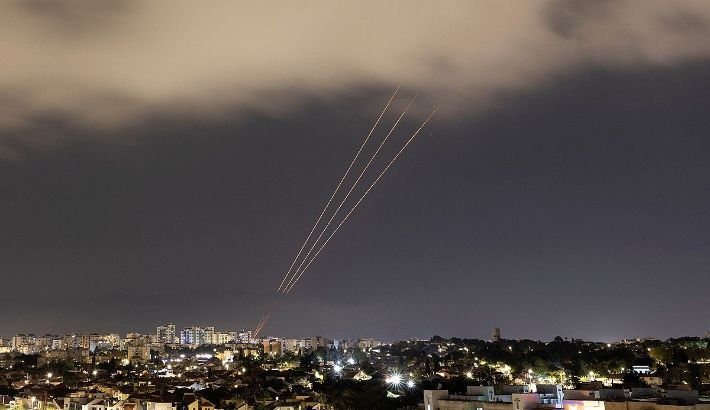 In the early morning of the 14th, Iran launched a large-scale attack on mainland Israel, including Jerusalem, using dozens to hundreds of armed drones and missiles. Photo by Reuters·Yonhap News
However, on the 1st, the Israeli military carried out an airstrike on the Iranian diplomatic compound in Damascus, the capital of Syria, killing two senior commanders including the second-in-command of the Islamic Revolutionary Guard Corps (IRGC). This incident sparked public outrage within Iran and became the backdrop for the current full-scale war, Jang analyzed. He said, "If the Israeli airstrike had not been made known to the Iranian public, this full-scale war might have been avoided. But domestic public opinion was boiling with questions like 'What should our authorities do?' and 'This is unacceptable; we cannot just stand by.' So, they had to do something as a show, to save face."
Regarding the types and forms of Iran's attacks, he explained, "About 185 attack drones equipped with explosives, called 'asset drones,' 36 cruise missiles, and at least 110 ballistic missiles were continuously launched toward Israel," adding, "Objectively, it was the largest air raid."
As for why Israel suffered minimal damage despite Iran's large-scale attack, he attributed it to the air defense system Iron Dome and the roles of allied and neighboring countries. He said, "Iron Dome intercepts low-flying missiles and drones, and there is also the Arrow system, which targets high-altitude threats like ballistic missiles. Additionally, drones were likely intercepted by fighter jets or helicopters."
He continued, "The U.S. Central Command is present in Iraq, Syria, and along the Mediterranean coast, and intercepted many missiles and drones heading toward Israel from Iran through Iraq and Syria. Moreover, the UK, France, and Jordan also participated in interceptions. Thanks to this multinational coalition interception operation, the damage was significantly reduced."
Regarding the possibility of a fifth Middle East war, he estimated it to be "below 20%," but predicted, "Israel will likely attack Iran's proxy organizations such as Hezbollah, Kata'ib Hezbollah, the Houthi rebels, and Hamas, as it cannot ignore its domestic audience."
© The Asia Business Daily(www.asiae.co.kr). All rights reserved.
![Clutching a Stolen Dior Bag, Saying "I Hate Being Poor but Real"... The Grotesque Con of a "Human Knockoff" [Slate]](https://cwcontent.asiae.co.kr/asiaresize/183/2026021902243444107_1771435474.jpg)
















