WSJ Economist Survey
Recession Probability 39% in Jan → 29% in Apr
Core PCE Inflation Expected at 2.5% by Year-End
Rate Cut Forecast Lowered from 4-5 to 3 Times This Year
The probability of a recession within one year, as predicted by American economists, has dropped to the 20% range. This is the lowest level in two years since April 2022, and expectations for a soft landing of the U.S. economy are spreading rapidly.
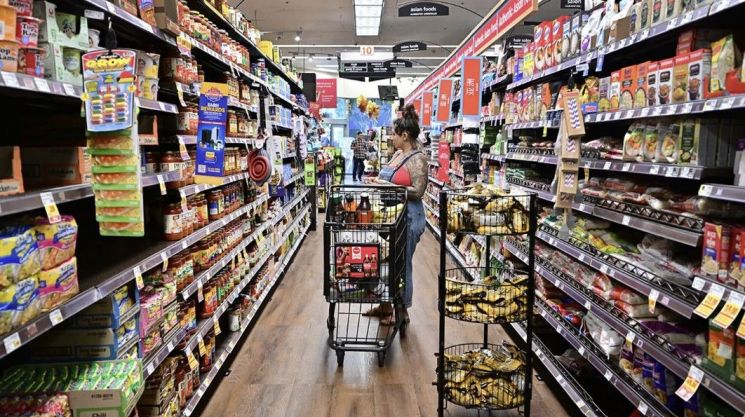
On the 14th (local time), the Wall Street Journal (WSJ) reported the results of a survey conducted from the 5th to the 9th among 69 economists. The survey showed that 29% of respondents believed the U.S. economy was likely to enter a recession within the next 12 months. This figure is 10 percentage points lower than the 39% recorded in the January survey and is the lowest since April 2022 (28%).
Economic growth forecasts were also revised upward. While respondents expected growth to remain below 1% during the first to third quarters of this year in January, the latest survey anticipates a growth rate of 1.4%, suggesting the economy has bottomed out. The percentage of respondents who predicted negative growth over the next year dropped to 10%, down from 33% in January.
Growth for the first quarter of this year is estimated at 2.2%, a significant upward revision from the January forecast of 0.9%.
James Smith, an economist at Econ Forecaster, commented, "The U.S. economy is performing very well," adding, "The whole world is envious."
Joe Brusuelas, Chief Economist for the U.S. at RSM, analyzed, "I believe the U.S. economy has entered a virtuous cycle where strong productivity drives growth beyond long-term trends, inflation remains between 2% and 2.5%, and unemployment stays between 3.5% and 4%."
Economists have raised their inflation forecasts for this year. The core Personal Consumption Expenditures (PCE) price index, which the Federal Reserve (Fed) prioritizes most, is expected to reach 2.5% by the end of the year, up 0.2 percentage points from 2.3% in January. The core PCE price index is projected to decline to 2.1% by the end of next year without a recession.
This survey was conducted just before the release of the March Consumer Price Index (CPI) on the 10th. Since the March CPI turned out to be hotter than economists had expected, inflation forecasts may be revised upward further. According to the U.S. Department of Labor, the March CPI rose 0.4% month-over-month and 3.5% year-over-year, exceeding expert estimates of 0.3% and 3.4%, respectively. The core CPI also increased by 0.4% month-over-month and 3.8% year-over-year, surpassing market expectations of 0.3% and 3.7%.
The strong U.S. economy poses a challenge in the "last mile" of the fight against inflation. If the inflation rate does not quickly slow to the Fed's target of 2%, prolonged high interest rates could hinder economic growth, raising concerns.
Brett Ryan and Matthew Luzzetti, economists at Deutsche Bank, diagnosed, "The risks are definitely skewed toward a hawkish (monetary tightening preference) outcome from the Fed," adding, "This could impede our growth outlook."
Economists have reduced their forecasts for the number of Fed rate cuts this year. Respondents expect the federal funds rate to be 4.67% by year-end, implying three rate cuts from the current 5.25?5.5%. In January, they had anticipated 4 to 5 cuts. This reflects confidence that the strong U.S. economy can withstand high interest rates. However, with the March CPI exceeding market expectations, the number of expected rate cuts may be further reduced.
The yield on the U.S. 10-year Treasury note was expected to fall from around 4.4% at the time of the survey to 3.97% by the end of this year and 3.78% by the end of 2026. This is higher than the levels predicted in the October survey last year when Treasury yields were surging.
Some voices suggest that the Fed may raise rates further, casting doubt on the optimism for a soft landing of the U.S. economy.
Jamie Dimon, Chairman and CEO of JP Morgan, known as the "Emperor of Wall Street," recently warned in his annual shareholder letter that interest rates could surge above 8% within the next few years. He stated, "The market estimates the probability of a soft landing at 70-80%, but I believe the probability is much lower."
© The Asia Business Daily(www.asiae.co.kr). All rights reserved.
![Clutching a Stolen Dior Bag, Saying "I Hate Being Poor but Real"... The Grotesque Con of a "Human Knockoff" [Slate]](https://cwcontent.asiae.co.kr/asiaresize/183/2026021902243444107_1771435474.jpg)















