6% Increase in Prices of High-Consumption Processed Foods in Q1 This Year
Chocolate and Sugar Prices Rise Along with International Oil Prices
Price Hikes Weighed After General Election... Increased Production Cost Burden
As the 22nd National Assembly general election concludes, concerns over rising prices are growing. The food industry had been considering price increases after the election due to rising raw material costs such as sugar and chocolate. However, with Iran carrying out retaliatory attacks against Israel, there is a possibility of a full-scale war in the Middle East, the largest oil-producing region, which could cause a significant surge in international oil prices?a key factor driving inflation.
According to the Korea Consumer Agency on the 14th, an investigation into the average prices of 32 frequently consumed processed food items in the first quarter of this year revealed that prices of 25 items rose by an average of 6.1% compared to the same period last year. This is roughly double the annual consumer price inflation rate of 3.6% recorded last year.
Despite Government's All-Out Efforts to Stabilize Prices, Processed Food Prices Rise by 6%
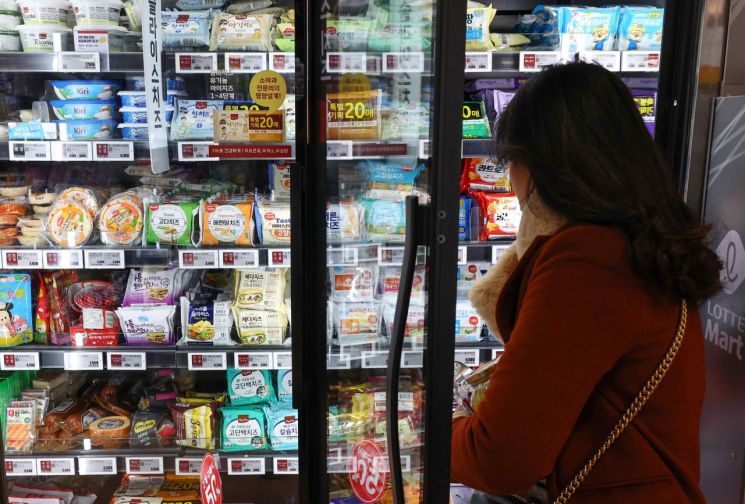
In particular, the average increase rate for the items that rose was 9.1%. Although the government has launched an all-out response to stabilize prices, the burden on consumers' shopping baskets has actually increased.
The price increases were more pronounced in essential ingredients than in luxury food items. Edible oil (100㎖) recorded the highest increase rate, rising 49.8% from an average of 643.3 won in the first quarter of last year to 963.7 won in the first quarter of this year. Sugar (27.7%) and doenjang (fermented soybean paste) (17.4%) also showed steep upward trends. Curry (16.3%), milk (13.2%), crab sticks (12.3%), coffee mix (11.6%), gochujang (red chili paste) (7.8%), ham (7.6%), and cereal (6.7%) were also among the top 10 items with the highest price increases.
Processed food prices are expected to rise further as international raw material prices soar. According to the Korea Agro-Fisheries & Food Trade Corporation (aT), on the 11th (local time), the cocoa futures price, which is used in chocolate, on the New York Mercantile Exchange rose 9.6% in one week to $10,373 per ton (approximately 14.3 million won). Compared to a month ago, it increased by 54.18%, and compared to the beginning of this year, it is 142.6% more expensive.
Sugar prices are also showing strength. According to the United Nations Food and Agriculture Organization (FAO), the sugar price index averaged 145.0 last year, up 26.6% from 114.5 the previous year. The sugar price index for the first quarter of this year averaged 136.7, 19.4% higher than in 2022.
Therefore, prices of snacks, ice cream, and chocolates that use sugar and cocoa are expected to rise.
Middle East Powder Keg on the Brink... "Dollar Soars and International Oil Prices Could Reach $130"

The full-scale conflict between Iran and Israel is spreading Middle East risks and further fueling international oil prices. International oil prices are one of the key factors driving inflation. When international oil prices rise, transportation costs for raw materials increase, leading to higher import prices, and production costs, including electricity bills, also rise. Domestic energy prices are soaring, placing a burden on the everyday economy.
Crude oil prices have already been rising as Iran has threatened retaliatory attacks against Israel. According to the Korea National Oil Corporation's oil price information system, Opinet, the average gasoline retail price in the second week of April was 1,673.3 won per liter, up 26.3 won from the previous week. GS Caltex gas stations had the highest price at 1,681.6 won, while discount gas stations had the lowest at 1,646.0 won.
Moreover, with recent sharp rises in international oil prices, there is a high possibility of further increases in domestic crude oil prices. On the 12th (local time), the May West Texas Intermediate (WTI) crude oil price on the New York Mercantile Exchange reached $87.67 per barrel during trading. WTI closed at $85.66, up $0.64 (0.75%) from the previous session. Brent crude oil prices rose to $92.18 per barrel intraday and closed at $90.45, up $0.71 (0.8%). Brent crude futures prices exceeding $92 is the first time in over five months since late October last year.
The won-dollar exchange rate has already approached 1,400 won. On the 12th, the Korean won exchange rate closed at 1,375.4 won, up 22.6 won from the previous week, marking the highest level in 17 months since November 10, 2022 (1,377.5 won). The weekly increase was the largest since January 19 (25.5 won).
The Middle East accounts for one-third of the world's crude oil production, and Iran is the third-largest oil producer in the Organization of the Petroleum Exporting Countries (OPEC). Therefore, depending on how the conflict unfolds, international oil prices may fluctuate. Additionally, if the Strait of Hormuz is blocked, oil prices could surge sharply.
The Strait of Hormuz serves as an export route for Middle Eastern oil-producing countries such as Saudi Arabia, Kuwait, Iraq, Iran, and the United Arab Emirates (UAE). One-third of the world's liquefied natural gas (LNG) and one-sixth of oil pass through this strait. Middle Eastern crude oil imported into Korea also passes through this strait. Bob McNally, CEO of the energy consulting firm Rapidan Group, expressed concern in an interview with CNBC, stating, "If the conflict escalates to the point of blocking the Strait of Hormuz, a major international crude oil transportation route, oil prices could soar to $120 to $130 per barrel."
© The Asia Business Daily(www.asiae.co.kr). All rights reserved.
![Clutching a Stolen Dior Bag, Saying "I Hate Being Poor but Real"... The Grotesque Con of a "Human Knockoff" [Slate]](https://cwcontent.asiae.co.kr/asiaresize/183/2026021902243444107_1771435474.jpg)
















