"Property Damage and Defamation, Difficult to Apply"
Ownership and Administrative Measures Also Challenging for Civic Groups
The Busan Peace Statue, installed to honor the victims of the Japanese military sexual slavery, has once again suffered damage. Although acts threatening the statue have been repeated for years, there is still no legal basis for punishment.
According to the police on the 14th, at around 5:30 p.m. on the 6th, a man in his 30s covered the Peace Statue and the Forced Laborer Statue in front of the Japanese Consulate in Dong-gu, Busan, with a black plastic bag labeled "Cheolgeo" (Demolition). A mask with the word "Cheolgeo" written in red letters was also attached over the bag.
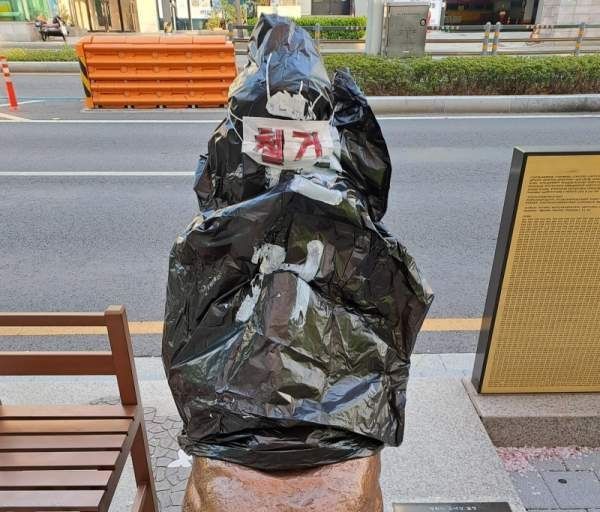
The man was stopped by police who arrived at the scene, and the bag and other items were collected by the police.
This is not the first time the Busan Peace Statue, symbolizing the victims of the Japanese military sexual slavery, has suffered damage.
In 2020, a bicycle was locked to the statue with a steel lock, and previously, a yellow cloth with "Park Chung-hee" written on it, prayer beads, and a red pouch hanging on a wooden stick were left on the statue.
Earlier, in 2017, a discarded flowerpot with papers taped to it near the statue, bearing phrases such as "How long will you hate Japan?" was found, and traces of blue paint were discovered on the statue's face.
Civil organizations view these acts as attempts by right-wing groups to insult or demean the statue.
Although threats to the Peace Statue have been repeated, there are no clear punishment regulations, so attempts to damage the statue have only been met with simple restraint.
Regarding the recent incident of covering the statue with a black bag, the police initially considered legal reviews for charges such as property damage or insult, but it seems difficult to apply such charges.
A legal expert stated, "Property damage requires harm to the utility of the statue, and insult or defamation must be committed against a person with a sense of honor, so it will be difficult to apply these charges."
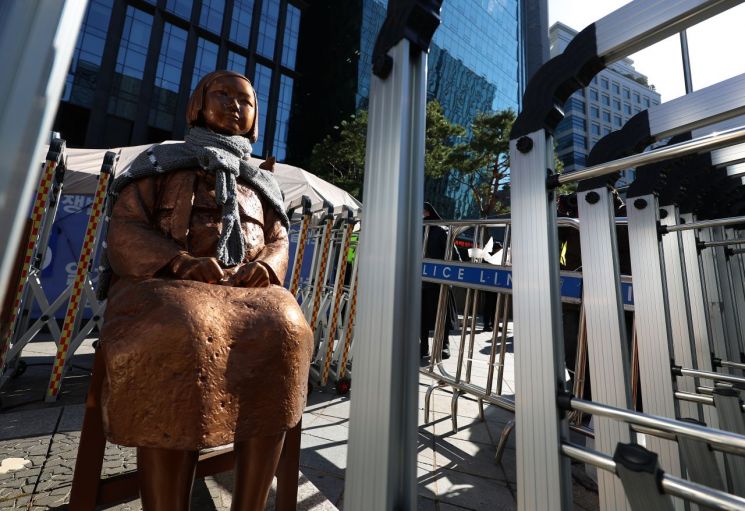
The local governments responsible for managing and protecting the statue are also unable to prevent attempts to damage it for the same reasons.
In 2021, as the statue was repeatedly threatened, Busan City established the "Peace Statue Management Plan," designating the city, Dong-gu, and civic groups as the management entities.
This plan stipulates that the city and Dong-gu regularly manage and inspect the statue, and that the civic groups who established the statue should file complaints and seek punishment if the statue is damaged. However, the plan does not include direct punishment provisions for perpetrators.
A Busan city official said, "The statue is owned by a civic group," adding, "Since it is not a public sculpture owned by the city, the city cannot include provisions in ordinances to impose administrative penalties such as fines for damaging the sculpture."
Civic groups argue that strong measures are needed to protect the statues established not only in Busan but across the country from those who damage them.
A representative from Busan Gyeore Hana said, "Recently, right-wing groups nationwide have been vandalizing the statues and causing disturbances," adding, "We are collecting cases jointly across the country."
They continued, "We plan to examine various countermeasures, such as access restrictions, to prevent their actions."
© The Asia Business Daily(www.asiae.co.kr). All rights reserved.
![Clutching a Stolen Dior Bag, Saying "I Hate Being Poor but Real"... The Grotesque Con of a "Human Knockoff" [Slate]](https://cwcontent.asiae.co.kr/asiaresize/183/2026021902243444107_1771435474.jpg)
















