"Academic Claims or Expressions of Opinion, Not Statements of Fact"
Judgment Following Supreme Court Remand Purpose
Park Yoo-ha, a 67-year-old honorary professor at Sejong University, who was indicted for defaming the honor of Japanese military comfort women victims in her book "Empire's Comfort Women," was acquitted in the retrial.
Last October, the Supreme Court overturned and remanded the second trial court's ruling, which had sentenced her to a fine of 10 million won, stating that "the expressions recognized as guilty by the second trial court can be evaluated as Professor Park's academic claims or opinions, making it difficult to view them as 'statements of fact' necessary for establishing defamation."
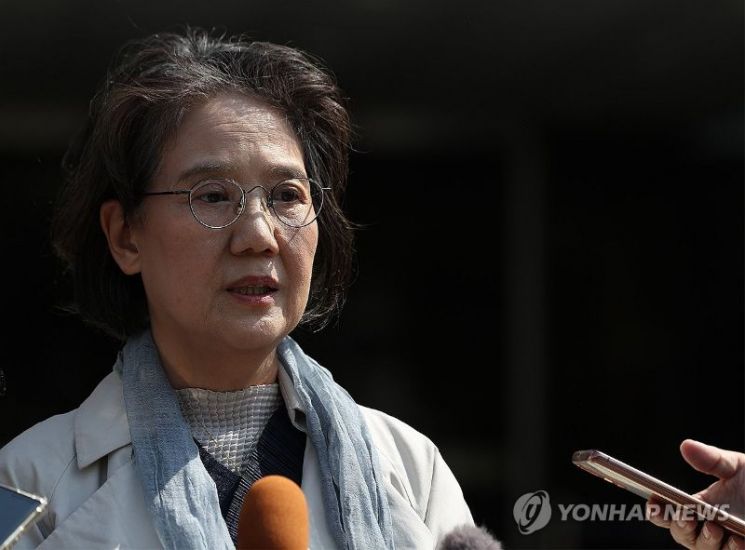 On the 12th, at the Seoul High Court in Seocho-dong, Seoul, Park Yoo-ha, an emeritus professor at Sejong University, who was acquitted in the retrial for defamation charges, is expressing his thoughts.
The Seoul High Court Criminal Division 8 (Presiding Judges Kim Jae-ho, Kim Kyung-ae, Seo Jeon-kyo) acquitted Professor Park on the 12th of defamation charges under the Criminal Act.
The court stated, "The expressions recognized as guilty in the second trial before remand are reasonably evaluated as academic claims or opinions," adding, "It is difficult to judge them as 'statements of fact' that defame the victims' honor."
Immediately after the verdict, Professor Park told reporters, "It has been 9 years and 10 months since I was accused, and during that time, the trial proceeded not only inside the courtroom but also outside," and expressed gratitude, saying, "I thank many people who sincerely helped me."
When asked to explain the context of the controversial expressions, she said, "The phrase 'voluntary prostitution' in the book was the most problematic, but many people in Japan use that term, and it was intended to criticize those who hold such views."
In 2013, Professor Park was indicted for defaming the honor of Japanese military comfort women victims by writing in her book "Empire's Comfort Women" that "comfort women had a comrade-like relationship with the Japanese military and were prostitutes, and were not forcibly taken by the Japanese empire."
The first trial court ruled that among the 35 expressions charged, five were statements of fact, but the remaining 30 were merely expressions of opinion and did not constitute defamation. The court acquitted her, stating, "Since the statements referred to a historical group called comfort women, it is difficult to say that specific victims were identified."
On the other hand, the second trial court recognized six additional expressions as statements of fact beyond the five acknowledged in the first trial, judging that each expression constituted false facts and defamatory statements. It also found that the victims were identified and that there was intent to defame. The court sentenced Professor Park to a fine of 10 million won, stating, "It led readers to perceive the facts differently from objective reality."
However, the Supreme Court's judgment differed. The Supreme Court ruled that the expressions recognized as guilty by the second trial should be evaluated as Professor Park's academic claims or opinions, making it difficult to view them as statements of fact punishable under defamation law, and overturned and remanded the second trial's ruling that had sentenced her to a fine of 10 million won.
The court emphasized, "It is necessary to be cautious in evaluating expressions of opinion based on academic research as statements of fact in defamation cases," adding, "Unless there are special circumstances such as violating fundamental research ethics, seriously exceeding the generally accepted scope in the field, resulting in acts that cannot be regarded as academic processes, or infringing on others' rights with expressions unrelated to the argument or context, academic research is fundamentally a legitimate act."
Regarding the expressions used by Professor Park, the court stated, "There is no evidence that she violated ordinary research ethics or disregarded the dignity of the victims by infringing on their self-determination or privacy," and added, "It does not appear that the expressions were used to deny forced abduction by the Japanese military, claim that Korean comfort women voluntarily engaged in prostitution, or assert active cooperation with the Japanese military."
Furthermore, the court said, "While Japan's responsibility for the Korean comfort women issue cannot be denied, there are clearly social structural factors such as imperialist ideology and traditional patriarchal order that contributed to the issue. Focusing solely on the former and escalating conflicts between the two countries is unlikely to help resolve the comfort women issue. It appears that the expressions were used to highlight this thematic awareness," and concluded, "It is difficult to allow recognizing implied statements of fact by hastily concluding the background or motives behind academic expressions without understanding the academic expressions themselves."
© The Asia Business Daily(www.asiae.co.kr). All rights reserved.
![Clutching a Stolen Dior Bag, Saying "I Hate Being Poor but Real"... The Grotesque Con of a "Human Knockoff" [Slate]](https://cwcontent.asiae.co.kr/asiaresize/183/2026021902243444107_1771435474.jpg)















