HUG 'Waiver of Priority Rights' Auction Housing Full Analysis
44 Out of 116 Units 'Failed to Sell'...Funding Recovery Difficult
31 Units Sold..."Driving Recent Recovery in Winning Bid Rates"
Regarding court auction properties due to jeonse fraud, the Housing and Urban Guarantee Corporation (HUG) has been relinquishing its priority rights before putting them on the market, but it has proven difficult to find successful bidders. It was found that 4 out of 10 properties have repeatedly failed to sell, causing creditors to struggle with recovering their funds.
"Relinquishing Priority Rights to Find Successful Bidders"
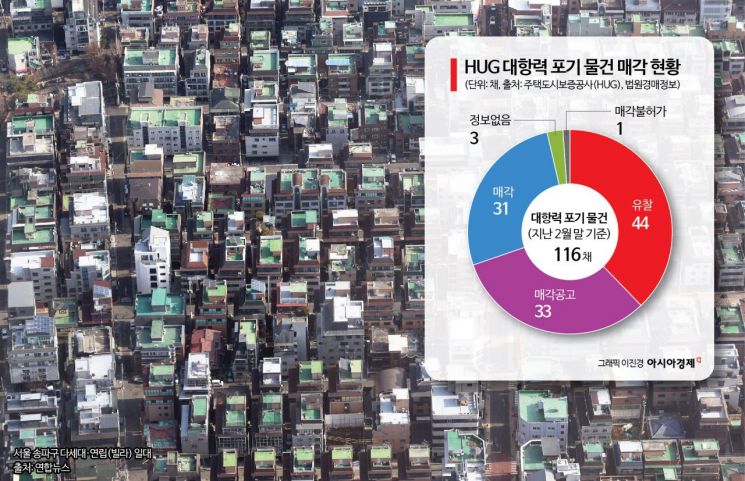
According to HUG on the 12th, as of the end of February, the total number of properties in auction for which HUG relinquished priority rights was 116 households. HUG transfers homes involved in jeonse guarantee accidents to auction to recover the subrogation payments made to tenants. At this time, the priority rights inherited by HUG from the tenants become a factor that makes bidding difficult. If the successful bidder acquires the property at a price lower than the tenant's jeonse deposit, the bidder must bear the difference between the winning bid and the jeonse deposit. HUG judges that in such cases, the burden on the successful bidder is high and the likelihood of sale is low, so it relinquishes the priority rights. This lowers the hurdle for bidding, and HUG considers it better to recover at least part of the claims it holds.
By region, Seoul had 100 households, the highest number of relinquished priority rights, reflecting the concentration of jeonse fraud damage last year. This was followed by Incheon with 5 households, Gyeonggi with 4 households, Chungnam with 4 households, Jeonbuk with 2 households, and Busan with 1 household.
Difficulty in Successful Bidding Due to Jeonse Fraud Aftermath
However, a comprehensive analysis by Asia Economy using court auction information revealed that among the auction properties for which HUG relinquished priority rights, 44 households (38%) have yet to find successful bidders.
Despite HUG's willingness to bear financial losses, successful bidders have not been found. For example, W Villa (27-35) in Oryu-dong, Guro-gu, Seoul, failed to sell after nine attempts, and Y Villa (81-201) in the same neighborhood went through five failed auctions. Additionally, failed auction cases have been frequent in areas heavily affected by jeonse fraud, such as Hwagok-dong in Gangseo-gu and Doksan-dong in Geumcheon-gu. The number of failed auctions accounted for the largest proportion of all properties with relinquished priority rights. On the other hand, 31 households were successfully sold following HUG's relinquishment of priority rights, accounting for 27% of all successful bids.
Some view this as a cause of the recent recovery in the villa auction market. According to Gigi Auction, a data specialist in auctions and public sales, the winning bid rate for villas in Seoul in March was 83.9%, up 7.2 percentage points from 76.7% in the previous month. The success rate also increased by 3.8 percentage points from 9.8% (116 out of 1,182 cases) in February to 13.6% (143 out of 1,048 cases) in March. The average number of bidders also rose from 2.79 to 3.78 during the same period.
Senior researcher Lee Joo-hyun of Gigi Auction explained, "In the case of villas related to 'empty jeonse' (Kkangtong Jeonse), the winning bidder had to assume the deposit, which led to repeated failures. However, as the number of homes for which HUG has relinquished priority rights increases, more bidders are participating."
Meanwhile, among the properties with relinquished priority rights, 37 households (32%) are preparing for sale, and one property has been denied sale approval.
© The Asia Business Daily(www.asiae.co.kr). All rights reserved.
![Clutching a Stolen Dior Bag, Saying "I Hate Being Poor but Real"... The Grotesque Con of a "Human Knockoff" [Slate]](https://cwcontent.asiae.co.kr/asiaresize/183/2026021902243444107_1771435474.jpg)
















