Democrats Maintain Majority... Sweep All 37 Seats in Seoul
Democratic Party Vote Share in the 52% Range, People Power Party in the 46% Range
"Single-Member District System Has Winner-Takes-All Issues"
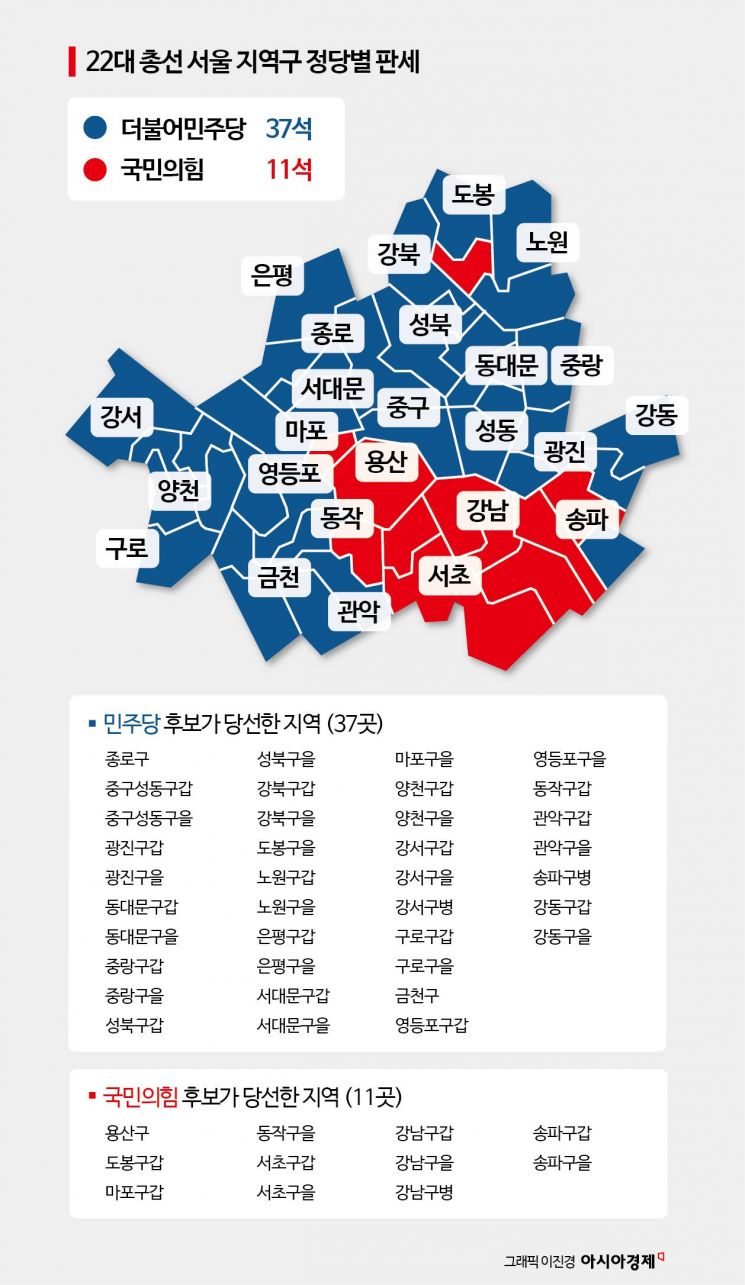
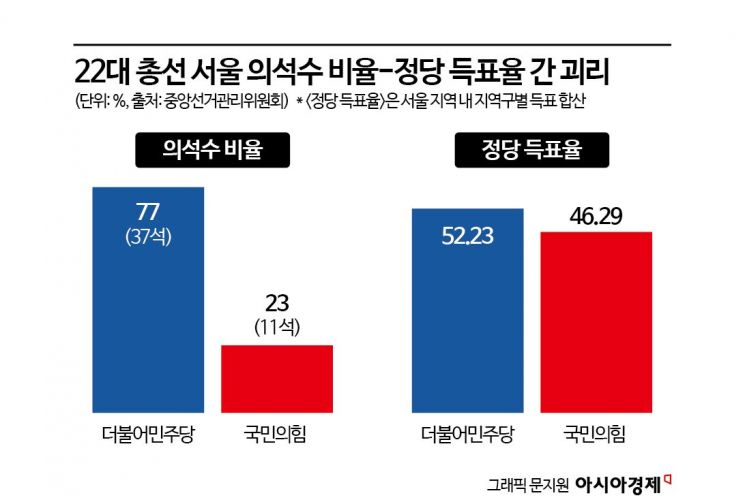
In the 22nd general election, among the 48 constituencies in the Seoul area, the Democratic Party of Korea won 37 seats, and the People Power Party won 11 seats, resulting in a difference of 26 seats. In terms of seat ratio, the Democratic Party's share was 77%, while the People Power Party's share was 23%, a gap of 54 percentage points. However, when looking at the vote share, the difference was only 5.95 percentage points. There was a significant discrepancy between the popular vote and the number of seats.
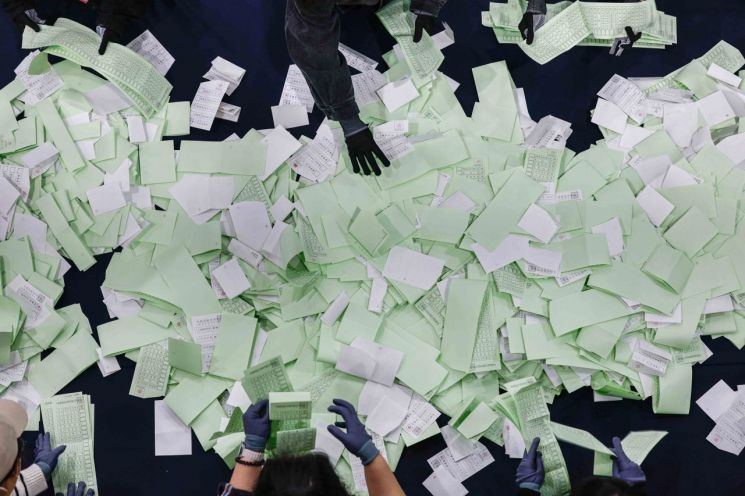
The Democratic Party maintained its position as the major opposition party by winning 161 seats in constituencies in this general election. In particular, it succeeded in defending its seats in the Seoul area by holding onto many of the battlegrounds known as the 'Hangang Belt.' It won after close contests in areas such as Yeongdeungpo-gu, Gwangjin-gu, and Jung-gu Seongdong-gu.
When viewing the entire Seoul area as a single constituency and summing the votes obtained by each party's candidates, there is a large discrepancy compared to the seat ratio. In Seoul, the Democratic Party received 2,964,809 votes (52.23%), while the People Power Party received 2,627,846 votes (46.29%). Looking only at the vote share, there is a 5.94 percentage point difference. If proportionality of votes were maintained, the number of seats should reflect the vote share similarly, but since winning even one more vote than the opponent in a single constituency results in victory, discrepancies occur between actual votes and seats.
A similar pattern appeared in the 21st general election. This was the election where the Democratic Party-affiliated parties (Democratic Party, Together Citizens' Party, Open Democratic Party) secured 183 seats. In 2020, the ruling Democratic Party won 103 seats in the metropolitan area, while the predecessor of the People Power Party, the United Future Party, won 16 seats in the metropolitan area, a difference of 87 seats. However, the vote share gap between the Democratic Party (53.7%) and the United Future Party (41.2%) was 12.5%.
Under the current single-member district system, many 'wasted votes' occur. Since the candidate with the highest votes in each district is elected, votes for other candidates are not reflected in the results. For example, in Yeongdeungpo-gu Eul district, Democratic Party candidate Kim Min-seok defeated People Power Party candidate Park Yong-chan by 1.15 percentage points (1,135 votes). There are many other constituencies where the runner-up received support in the high 40% range but still lost. Because of this, both parties focus their discussions on including or excluding areas in the redistricting process to gain even a slight advantage.
Kim Man-heum, Chair Professor at Hansung University, stated, "The results nationwide have always been in the form of 51 to 49," adding, "It is inevitable because of the single-member district system." He said, "About 70 to 80 countries adopt the single-member district system, but compared to other countries, politics in our country is more hostile and overheated, which causes problems." Choi Byung-chun, Director of the New Growth Economy Research Institute, said, "This is due to the 'winner-takes-all' problem of the single-member district system." He added, "The proportional representation system is supposed to compensate for this, but the number of proportional representation seats has been steadily decreasing since the system was introduced."
The single-member district system also makes it difficult for minor parties to gain seats in constituencies. However, in the 22nd general election, even when combining the votes received by Seoul candidates from parties other than the two major parties, the total was less than the proportion (2.08%) needed to secure one seat.
© The Asia Business Daily(www.asiae.co.kr). All rights reserved.
![Clutching a Stolen Dior Bag, Saying "I Hate Being Poor but Real"... The Grotesque Con of a "Human Knockoff" [Slate]](https://cwcontent.asiae.co.kr/asiaresize/183/2026021902243444107_1771435474.jpg)

















