The United States, Japan, and the Philippines are set to undertake an Indo-Pacific regional infrastructure investment project aimed at countering China.
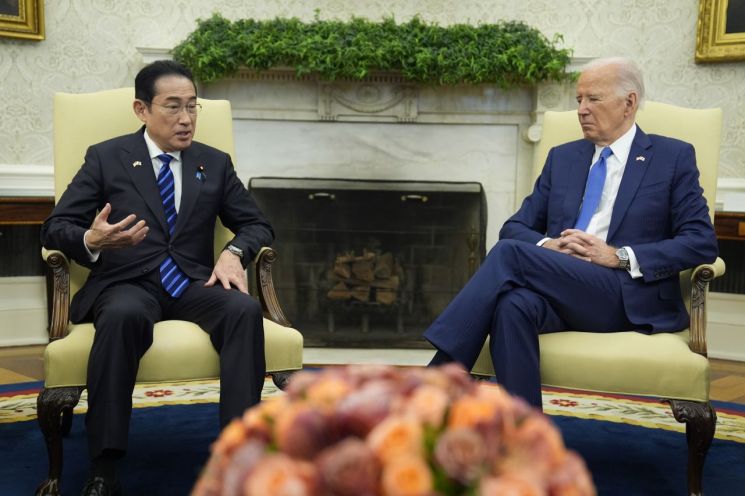
According to a senior U.S. administration official, on the afternoon of the 11th (local time), U.S. President Joe Biden, Japanese Prime Minister Fumio Kishida, and Philippine President Ferdinand Marcos will hold their first trilateral summit at the White House and announce cooperation plans for the Indo-Pacific regional investment project.
The Biden administration official stated in a briefing the previous day that the three leaders will announce the 'PGI Luzon Corridor,' which promotes major infrastructure investments such as ports, railroads, clean energy, and semiconductor supply chains connecting Subic Bay, Clark, Manila, and Batangas in the Philippines. The official said the Luzon Corridor is the first PGI corridor established in the Indo-Pacific region.
PGI (Partnership for Global Infrastructure and Investment) is the Biden administration's investment initiative designed to counter China's Belt and Road Initiative (the overland and maritime Silk Road connecting China, Central Asia, and Europe). The U.S. views China's infrastructure investments in developing countries as a means to impose debt burdens and subordinate these countries, despite China's claims of aiding economic development. PGI is presented as an alternative to the Belt and Road Initiative.
The United States and Japan plan to support with millions of dollars to conduct field tests of the wireless communication technology 'Open RAN' in the Philippines and to establish an Asia Open RAN Academy in Manila.
With China leading the 5G communication sector, the U.S. has urged its allies not to use Chinese communication products and has promoted the establishment and dissemination of Open RAN technology standards.
The senior official said, "We are working closely with the Philippine government to enable trilateral cooperation to introduce safe and reliable information and communication technology (ICT) in the Philippines."
He also mentioned that the U.S., Japan, and the Philippines will announce a strong stance against China's unjust territorial claims in the South China Sea. Despite losing a case at the Permanent Court of Arbitration (PCA), China continues to claim about 90% of the South China Sea. Chinese coast guard vessels have even fired water cannons at Philippine ships operating in the area.
In response, on the 7th, Australia, the United States, the Philippines, and Japan conducted joint naval and air force exercises in the Philippine Exclusive Economic Zone (EEZ) in the South China Sea. The senior official said joint exercises will continue in the future, and the coast guards of the U.S., Japan, and the Philippines will also operate together.
The joint statement from the three countries will include a "very strong expression" of support from the U.S. and Japan for the Philippines' lawful operations and rights in the South China Sea, the official added.
© The Asia Business Daily(www.asiae.co.kr). All rights reserved.
![Clutching a Stolen Dior Bag, Saying "I Hate Being Poor but Real"... The Grotesque Con of a "Human Knockoff" [Slate]](https://cwcontent.asiae.co.kr/asiaresize/183/2026021902243444107_1771435474.jpg)















