Lee Jun-seok, leader of the Reform New Party, entered the National Assembly after four attempts in the general election, but major third-zone candidates who ran in constituencies suffered defeat. Although the party initially aimed to be an alternative to resolve the extreme politics of the two major parties, it fell short of expectations.
According to political circles on the 11th, Lee ran in Hwaseong-si, Gyeonggi Province, in this general election and won with 51,856 votes (42.41%), beating Gong Young-woon, the Democratic Party candidate, by 3,278 votes (2.68 percentage points). Early polls showed Lee trailing Gong by 20 percentage points, but he achieved a dramatic comeback victory in the final vote. Lee’s strategy focused on aggressively targeting Gong’s alleged 'Daddy’s Chance' scandal while consolidating voter support until the end through his extensive political experience and skilled campaigning.
In contrast, other Reform New Party leaders such as Geum Tae-seop, Lee Won-wook, Yang Hyang-ja, and Heo Eun-ah, who had raised expectations, were all defeated. They showed limitations in asserting their presence amid low approval ratings and competition from candidates of the two major parties. After the vote, candidate Heo posted on her Facebook, "Despite the slim chances, I sincerely thank everyone who voted for Heo Eun-ah’s conviction and courage," adding, "I will never forget and will carry that spirit in my heart as I continue in politics."
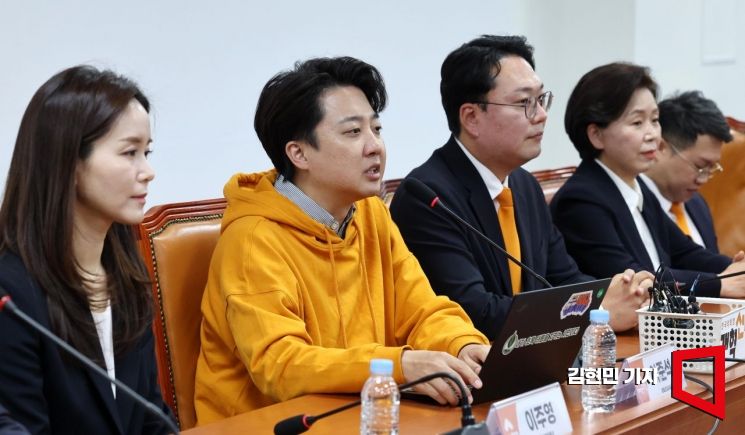 Lee Jun-seok, leader of the Reform New Party, is speaking at the Central Election Countermeasures Committee disbandment ceremony held at the National Assembly on the 11th. Photo by Hyunmin Kim kimhyun81@
The party-list vote share also fell short of expectations. The Reform New Party secured 3.61% of the proportional representation vote, winning two proportional seats. This figure is less than half of the initial goal of four to five seats set at the party’s founding.
The situation for New Future is even more difficult. Leader Lee Nak-yeon was decisively defeated by Min Hyung-bae, the Democratic Party candidate in Gwangsan-eul, Gwangju, casting uncertainty over his future political path. Immediately after the election results, Lee said, "Defeat is certain, but I want to thank the citizens of Gwangju," adding, "In any case, I humbly accept the will of the citizens of Gwangju."
Former senior Democratic Party figures who ran as New Future candidates, such as Seol Hoon and Hong Young-pyo, also lost in their respective constituencies. Within the party, Kim Jong-min, who ran in Sejong-gap, was the only candidate to win, preserving some pride. Kim was able to enter the National Assembly with support from former Democratic Party voters after the Democratic candidate’s nomination was canceled due to allegations of 'gap speculation.' He expressed gratitude, saying, "Many people chose Kim Jong-min with a precious intention." However, except for Kim, New Future failed to secure any proportional seats, resulting in a poor overall performance.
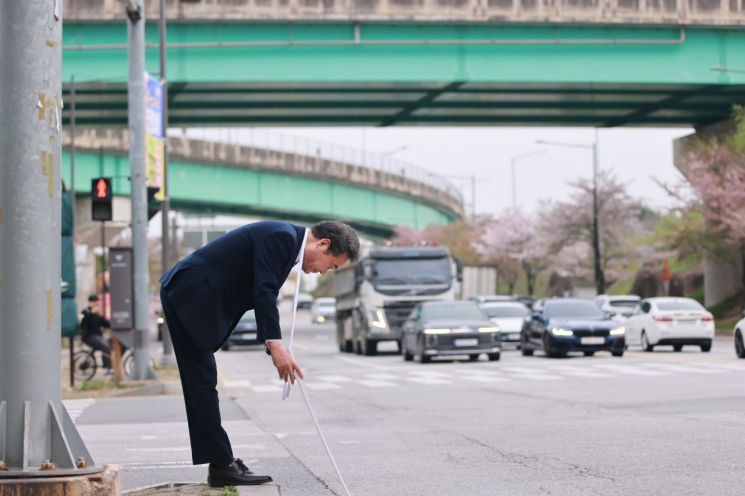 Bowed Lee Nak-yeon
(Gwangju=Yonhap News) On the morning of the 11th, Lee Nak-yeon, the candidate for Saeroun Mirae in Gwangsan, Gwangju, is seen greeting after his defeat at Sanwol IC in Suwan-dong, Gwangsan-gu, Gwangju. The candidate said, "I will continue to do my part for the normalization of the Republic of Korea, the rebuilding of democratic forces, and the development of Honam." April 11, 2024 [Provided by Saeroun Mirae. Resale and DB prohibited]
areum@yna.co.kr
(End)
<Copyright (c) Yonhap News, unauthorized reproduction, redistribution, AI training and use prohibited>
The Green Justice Party also suffered a crushing defeat in this general election. Shim Sang-jung, who lost in Goyang-gap, Gyeonggi Province, announced her retirement from politics, taking responsibility for the election results. Shim received 18.6% of the vote, finishing third behind Democratic candidate Kim Seong-hoe (44.2%) and People Power Party candidate Han Chang-seop (36.3%). She stated, "I intend to lay down the duty of progressive politics that I have devoted myself to for 25 years as a fate, with the remaining term of the 21st National Assembly," and asked, "Please allow me to bear the responsibility for my shortcomings and limitations."
Political circles analyzed that the third-zone parties failed to gain significant traction in the general election due to a combination of the two major parties’ fandom politics and the emergence of the Jo-guk Innovation Party. They were overshadowed by the two major parties and the Jo-guk New Party, resulting in a diminished presence. The premature merger attempts by leaders Lee Jun-seok and Lee Nak-yeon were also cited as strategic mistakes. Professor Shin Yul of Myongji University’s Department of Political Science and Diplomacy analyzed, "The process of New Future and Reform New Party merging and then splitting again could be seen as a kind of power struggle, which caused the new image to fade."
© The Asia Business Daily(www.asiae.co.kr). All rights reserved.
![Clutching a Stolen Dior Bag, Saying "I Hate Being Poor but Real"... The Grotesque Con of a "Human Knockoff" [Slate]](https://cwcontent.asiae.co.kr/asiaresize/183/2026021902243444107_1771435474.jpg)
















