People's Future 18 Seats, Democratic United Alliance 13 Seats Secured
'General Election Variable' Jo Guk Innovation Party 12 Seats, Reform New Party 1 Seat
Green Justice Party Fails to Surpass 3% Vote Threshold... 0 Seats Secured
Numerous Proportional Representation Parties Fail to Exceed 0.1% Vote Share
As the vote counting rate for party votes to elect the 22nd proportional representatives reached 99.97%, attention is focused on the vote shares of minor proportional parties besides the People Power Party and the Democratic Party of Korea.
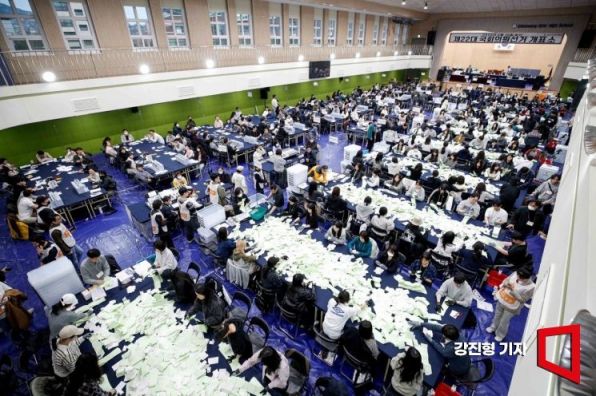 On the 10th, vote counting is underway at the Shin Gwang Girls' High School counting center in Yongsan-gu, Seoul.
 [Photo by Kang Jin-hyung, Asia Economy]
According to the Central Election Commission's counting status on the 11th, at 9 a.m. with a nationwide counting rate of 99.88%, the Democratic Party won in 161 districts, the People Power Party in 90 districts, and the Progressive Party, Reform New Party, and New Future each won in one district. At the same time, the party vote for electing proportional representatives recorded a counting rate of 99.97%. The People Power Party’s satellite party, People Power Future, secured 18 seats with 36.67% support, while the Democratic Party-led Democratic Coalition obtained 13 seats with 26.69%. The Jo Guk Innovation Party, led by former Minister of Justice Cho Kuk, received 24.25% support and secured 12 seats, and the Reform New Party, founded by former People Power Party leader Lee Jun-seok, gained 1 seat with 3.61%.
Besides these, there are numerous parties that received public support but garnered less than 3% of the vote share. Among parties with less than 3% vote share, the Liberty Unification Party showed the highest support with 2.26%, followed by the Green Justice Party, which includes Shim Sang-jung, the first progressive party candidate to attempt a fifth term but was defeated (2.14%). Next, New Future received 1.70% of the votes, and parties with less than 1% vote share include ▲Sonamu Party (0.43%) ▲Hannara Party (0.25%) ▲National Revolution Party (0.23%) ▲Saenuri Party (0.20%) ▲Liberty Democratic Party (0.14%) ▲Christian Party (0.12%) ▲National Grand Integration Party (0.10%) ▲Uri Gonghwadang (0.10%) ▲Gagahoho Gongmyeong Election Great Party (0.10%) ▲Women’s Party (0.10%), among others.
There are also parties that failed to exceed 0.1% vote share. These include ▲Hishtag National Policy Party (0.09%) ▲Labor Party (0.09%) ▲Financial Reform Party (0.07%) ▲Senior Welfare Party (0.05%) ▲Republican Party (0.05%) ▲Hongik Party (0.04%) ▲Korean Farmers and Fishermen Party (0.04%) ▲Great Korean People’s Party (0.04%) ▲Future Party (0.04%) ▲Gaga National Participation New Party (0.03%) ▲Tomorrow to the Future (0.03%) ▲Republic of Korea Party (0.03%) ▲Unification Korea Party (0.03%) ▲Anti-Communist Party Korea (0.02%) ▲Mass Democratic Party (0.02%) ▲Climate Livelihood Party (0.02%) ▲Garak Privilege Abolition Party (0.01%) ▲Hallyu Union Party (0.01%) ▲Korean Chamber of Commerce Party (0.01%) ▲K Political Innovation Union Party (0.01%) ▲New Korean Peninsula Party (0.00%), among others.
Meanwhile, proportional representation seats in the National Assembly election are allocated according to the distribution method stipulated in Article 189, Paragraphs 2 and 3 of the law to parties that have received at least 3% of the total valid votes or have won 5 or more seats in the constituency elections (total number of seats: 46). This means that a party must receive at least 3% of the party vote to be allocated proportional representative seats. In this election, the People Power Party and People Power Future secured 109 seats out of the total seats, while the Democratic Party and Democratic Coalition secured 175 seats. The Democratic Party secured an outright majority with constituency seats alone, achieving its goal for this general election.
© The Asia Business Daily(www.asiae.co.kr). All rights reserved.
![Clutching a Stolen Dior Bag, Saying "I Hate Being Poor but Real"... The Grotesque Con of a "Human Knockoff" [Slate]](https://cwcontent.asiae.co.kr/asiaresize/183/2026021902243444107_1771435474.jpg)















