Opposition Party's Landslide Victory Raises Concerns Over Corporate Value-Up Policies, Related Stocks Plunge
Uncertainty Over Financial Transaction Tax Abolition Spurs Individual Investor Withdrawal
Higher-Than-Expected US Inflation Fuels Fears of Delayed Interest Rate Cuts
In the 22nd National Assembly election, the opposition coalition achieved an overwhelming victory, while on the 11th, the stock market showed a sharp decline, breaking below the 2700 mark. The Democratic Party of Korea secured an outright majority, reflecting concerns about the policies pursued by the government. Key variables expected to influence the market after the general election include the weakening momentum of corporate value-up programs, the postponement of the financial investment income tax (금투세), and the timing of interest rate cuts in the United States. The decline on this day also reflected the impact of the U.S. stock market falling due to concerns that interest rate cuts would be delayed after the U.S. Consumer Price Index (CPI) for March, announced the previous day, exceeded expectations.
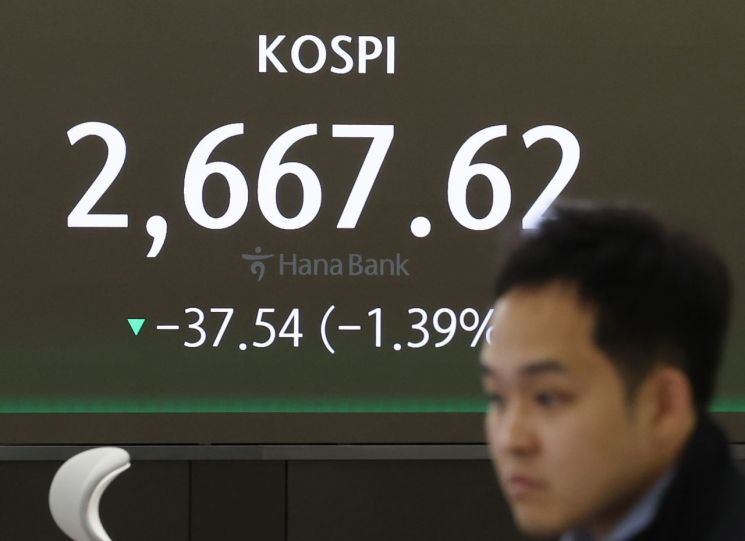
As of 9:05 a.m., the KOSPI recorded 2,666.07, down 39.09 points (1.45%) from the previous session. This is the first time the KOSPI has fallen below 2700 since the 20th of last month. This is interpreted as the combined effect of the general election and the U.S. CPI results. In particular, stocks related to corporate value-up programs, such as financial and holding companies, showed a sharp decline. Samsung C&T fell more than 7% immediately after the market opened, Samsung Life Insurance dropped by over 5%, KB Financial Group by over 4%, and Hana Financial Group by over 3%.
Weakening Momentum of Corporate Value-Up Initiatives
Concerns are rising that the momentum of corporate value-up programs and the abolition of the financial investment income tax (금투세), which the government has been promoting, will weaken due to the opposition party securing a majority of seats. Ji-young Han, a researcher at Kiwoom Securities, said, "Although the ruling party's number of seats has not changed significantly in the existing political landscape, the general view is that the opposition's influence on the current government's administration will be stronger than before." She analyzed, "In the stock market, the opposition party, which advocates taxation on issues requiring legal amendments such as the abolition of the financial investment income tax and capital gains tax relief?major points of contention between the ruling and opposition parties?has gained a majority, which may cause investors to retreat from expectations of tax abolition."
Chan-gyu Baek, head of the stock strategy team at NH Investment & Securities, said, "There will be negotiations between the ruling and opposition parties on legal amendments among the policies the government has proposed, and since it is difficult to predict the outcome, short-term uncertainty may cause volatility in the stock market." He added, "However, there are many areas where bipartisan agreement on institutional improvements in the Korean stock market can be reached, and since the possibility of weakening policy momentum has already been reflected in stock prices since the end of March, if additional volatility occurs in related stocks, it should rather be seen as a buying opportunity."
Regarding corporate value programs, a long-term approach is advised. Tae-bong Ko, head of the research center at Hi Investment & Securities, said, "Value policies are long-term national policies, and judging stock prices based solely on the general election is a short-term perspective." He added, "I believe there will be little disagreement that this is the path the Korean stock market should take in the long run, and I do not expect a retreat in policies related to treasury stock or the increased shareholder return ratio. I recommend approaching this from a longer-term perspective." He also pointed out that there is still room for the stock market to rise once more due to expectations of global economic recovery, semiconductor industry improvement, and the possible start of insurance-related interest rate cuts.
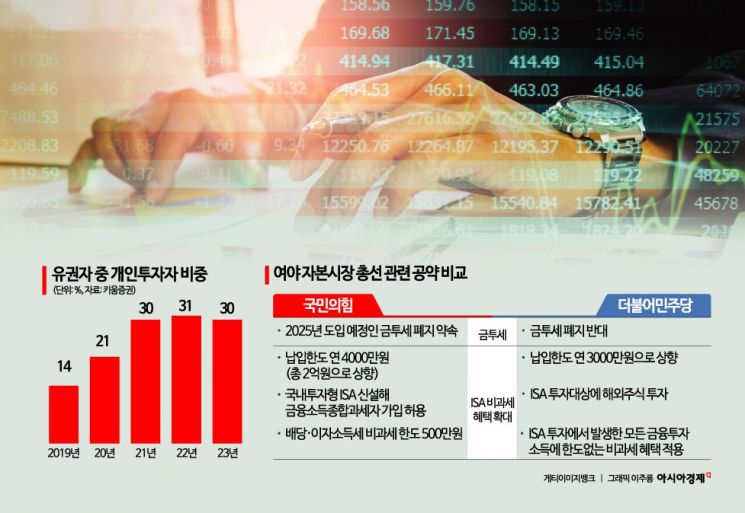
Potential Outflow of Retail Investors Due to Halt on Financial Investment Income Tax Abolition
As the abolition of the financial investment income tax (금투세) is expected to be stalled, an outflow of individual investors is anticipated. The Democratic Party of Korea opposes the abolition of the tax, meaning that from next year, individual investors will have to pay 22% tax on capital gains exceeding 50 million KRW and 27.5% on gains exceeding 300 million KRW. Originally scheduled to be implemented last year, it was postponed for two years due to backlash from individual investors. Ko said, "With the opposition party's significant victory, the likelihood of extending the postponement of the financial investment income tax is low," and predicted, "The impact on the stock market will become clearer toward the end of the year, with individual investors withdrawing and stocks favored by them declining." However, tax benefits for Individual Savings Accounts (ISA) are expected to be strengthened, so it will be necessary to weigh the pros and cons by asset type. So-yeon Park, a researcher at Shin Young Securities, said, "The abolition of the financial investment income tax requires amendments to the Income Tax Act, but with the ruling party's defeat in the general election, it faces obstacles, so we should be cautious about the possibility of selling pressure toward the end of the year." She added, "However, the Democratic Party of Korea is in favor of raising the ISA account contribution limit and making the entire contribution tax-exempt, so gains and losses may vary depending on the asset and product."
The timing of U.S. interest rate cuts is also cited as a key variable to watch after the general election. Dong-won Kim, head of research at KB Securities, said, "Domestically, it seems necessary to focus on additional policy directions for the value-up program, and externally, the timing of U.S. interest rate cuts appears to be a major variable." He noted, "If the possibility of U.S. rate cuts decreases two to three times within the year and the U.S. 10-year bond yield rises to the mid-to-high 4% range, it could be a correction factor for the domestic stock market." After the U.S. March CPI, announced the previous day, exceeded expectations and reached the highest level in six months, expectations for a June rate cut diminished, causing the U.S. stock market to close lower and affecting the domestic market as well. However, despite increased macroeconomic uncertainty, improved earnings forecasts are expected to strengthen the stock market's downside resilience. A researcher said, "Although U.S. inflation has been shocked for three consecutive months, increasing macro sensitivity, the first-quarter earnings season, led by semiconductors, has started smoothly, and the improvement in earnings forecasts will provide downside resilience to the stock market."
© The Asia Business Daily(www.asiae.co.kr). All rights reserved.
![Clutching a Stolen Dior Bag, Saying "I Hate Being Poor but Real"... The Grotesque Con of a "Human Knockoff" [Slate]](https://cwcontent.asiae.co.kr/asiaresize/183/2026021902243444107_1771435474.jpg)

















