Inspection Conducted at 104 Locations in 91 Busan Metro Underground Stations Last Year
Comparison of Fine Dust Concentrations in Seoul and 5 Major Metropolitan Cities Shows Busan Has the Best Air Quality
The Busan Metropolitan City Health and Environment Research Institute reported that the operation of the indoor air quality monitoring network in the underground stations of the urban railway in 2023 showed that the annual average concentrations of all six items were below the standards, indicating safe management.
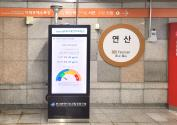 Underground Station Air Quality Automatic Monitor (Yeonsan Station).
To provide air quality information of underground stations and protect citizens' health, the institute measured six items, including fine particulate matter concentration, at 104 points in 91 underground stations of the Busan urban railway last year (91 platforms, 13 concourses).
The 2023 survey results showed that the annual averages were ▲PM-2.5 at 17.6 μg/㎥ (35% of the maintenance standard) ▲PM-10 at 28.4 μg/㎥ (28% of the maintenance standard) ▲carbon dioxide at 514 ppm (51% of the maintenance standard) ▲nitrogen dioxide at 0.028 ppm (28% of the recommended standard) ▲carbon monoxide at 0.4 ppm (6% of the maintenance standard) ▲formaldehyde at 1.3 μg/㎥ (1% of the maintenance standard), indicating that all items (annual averages) were below the standards, maintaining comfortable indoor air quality.
However, for PM-2.5, out of a total of 37,960 measurements, 426 exceeded the standard, showing an exceedance rate of 1.1%. Among the 426 exceedances, Line 1's Daeti Station recorded the highest number with 77 cases, accounting for 18%. This is analyzed as a result of increased pollution due to elevator installation construction inside the station.
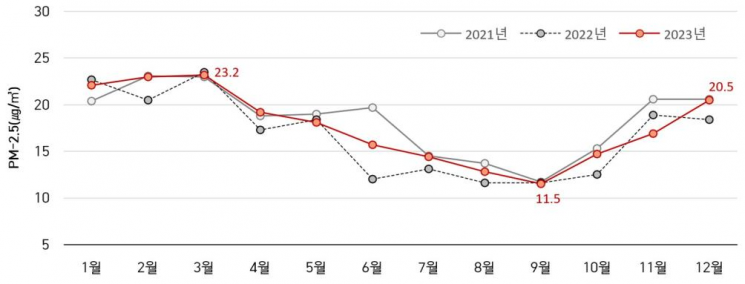
The monthly average PM-2.5 concentration peaked at 23.2 μg/m3 in March 2023 and reached its lowest at 11.5 μg/m3 in September, mainly due to fluctuations in PM-2.5 concentrations in the outdoor air supplied to the underground stations.
By subway line, Line 1 had the highest PM-2.5 annual average concentration at 20.1 μg/㎥. This is because Line 1 has the highest train operation frequency and passenger usage, and internal pollution phenomena caused by gravel track beds are also most vulnerable on Line 1.
The PM-2.5 concentrations ranked as follows: Line 1 (20.1 μg/㎥), Line 2 (17.0 μg/㎥), Line 3 (16.8 μg/m3), and Line 4 (14.8 μg/m3).
The main causes of internal pollution in underground stations are PM-2.5 generated from semi-enclosed safety doors (screen doors) and gravel track beds. By safety door type, the average PM-2.5 concentration was 16.4 μg/㎥ for fully enclosed doors and 18.9 μg/㎥ for semi-enclosed doors; by track bed type, concrete track beds averaged 16.8 μg/㎥, and gravel track beds averaged 20.4 μg/㎥.
Comparing PM-2.5 concentrations in underground stations of Seoul and the five major metropolitan cities, Busan showed the best air quality.
The 2023 average PM-2.5 concentrations were Busan (17.6 μg/㎥), Gwangju (21.8 μg/㎥), Daejeon (24.7 μg/㎥), Daegu (26.6 μg/㎥), Incheon (29.2 μg/㎥), and Seoul (36.4 μg/㎥), indicating that Busan maintains significantly better indoor air quality than the metropolitan area.
Jung Seung-yoon, Director of the Busan Health and Environment Research Institute, stated, “The indoor air quality in Busan urban railway underground stations is maintained at a safe level,” adding, “Since comfortable indoor air quality in underground stations is a key factor for promoting public transportation and citizens' health, sufficient ventilation through efficient management of air conditioning facilities is necessary. Continuous facility investment is also required to improve indoor air quality in underground stations, including air filtration devices, fully enclosed safety doors (screen doors), and securing concrete track beds.”
© The Asia Business Daily(www.asiae.co.kr). All rights reserved.
![Clutching a Stolen Dior Bag, Saying "I Hate Being Poor but Real"... The Grotesque Con of a "Human Knockoff" [Slate]](https://cwcontent.asiae.co.kr/asiaresize/183/2026021902243444107_1771435474.jpg)















