Auxiliary Battery Explosions Continue
All 5 Incidents Involve Products from the Same Manufacturer
Manufacturer States "Batteries Were Expired... Products Are Not Defective"
Incidents of portable battery explosions have occurred consecutively. The batteries involved in the accidents were imported by the same company, but the company insists there is no defect in the products, causing consumer backlash.
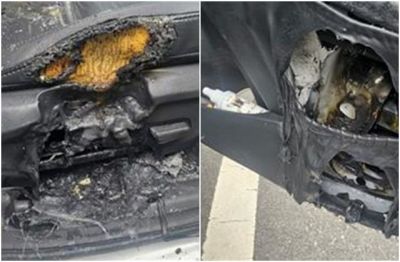
On the 10th, Yonhap News reported in the [OK! Tip-off] segment that "around 1 p.m. on the 8th, a portable battery exploded inside a vehicle in Gyeongju, Gyeongbuk." The explosion occurred the moment the vehicle owner placed the portable battery inside the car, accompanied by a crackling sound and smoke. The explosion caused the passenger seat and door of the vehicle to catch fire, and part of the vehicle melted. At the time, the portable battery was not connected to a phone or charger.
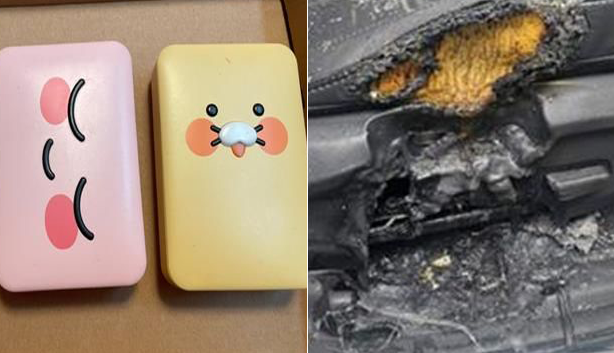 The same auxiliary battery as the one involved in the accident (left), and the vehicle damaged by the auxiliary battery explosion accident [Image source=Yonhap News]
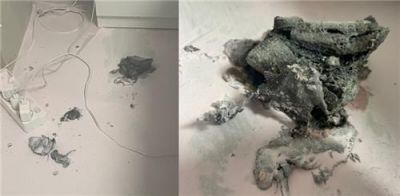
On the 5th, a fire broke out in a charging portable battery at an apartment in Haeundae-gu, Busan. Similar explosions of the same product also occurred on January 4th in Paju, Gyeonggi Province, on the 15th of last month in Pohang, Gyeongbuk, and on the 16th of last month in Jongno-gu, Seoul. A victim of the Paju explosion said, "The flames rose over 1 meter high, and the portable battery exploded into about seven pieces, causing a commotion as apartment residents evacuated."
All victims reported using the ‘Kakao Friends Square PD 20W Pocket Quick Portable Battery 10000mAh’ manufactured by Company D. Approximately 400,000 units of this product have been sold so far, and it is imported exclusively through Company D. Company D distributes the product under a character license agreement with Kakao.
Among these five incidents, two explosions occurred while the portable batteries were not being charged. All victims claimed, "There were no warning signs such as swelling or malfunction before the explosion, and the product had not been subjected to any significant impact." Four out of the five victims purchased the product themselves or received it as a gift from acquaintances around 2021. Only victim A was using a product gifted in 2023.
Company D collected debris from the two explosion incidents and issued a report concluding that the cause was ‘product aging.’ They stated that the product itself was not defective. A Company D representative said, “Before shipment, the product undergoes drop tests and aging processes. We actually invest more in safety than other companies, which do not conduct re-inspections or certifications, so we feel unfairly treated as the company that cares about safety.” The product has received safety certification from the Korea Testing Laboratory for Mechanical, Electrical, and Electronic Equipment and is covered by product liability insurance.
The representative added, “All products using lithium batteries can experience issues due to impacts, overcharging, and various environmental factors. Major manufacturers also use lithium batteries, and similar accidents occur.” They also stated, “The defect rate for this product is about 0.04%. If there were product issues, similar accidents would occur frequently, making continuous distribution impossible.”
The Company D representative explained, “A 10000mAh portable battery typically has a lifespan of about two years or 250 to 300 charge cycles after full discharge. The lifespan can be shorter depending on usage conditions and impacts.” They added, “Using the product for more than two years could actually be evidence that the product is reliable.” However, victims protested, saying, “Even after rechecking the product detail page, there was no information about the battery lifespan or number of uses.”
Regarding why the product detail page does not include usage period and cycle information, the Company D representative said, “Originally, that wording was included, but it disappeared when the detail page was updated. We judged that including it was meaningless because lifespan varies depending on usage conditions.” They also explained, “We think including battery lifespan would put us at a disadvantage compared to competitors.”
The representative continued, “We sincerely apologize to the victims and will do our best to compensate them.” They added, “We plan to officially announce and guide users on product characteristics and usage periods for safe use. We will take this incident as an opportunity to take greater responsibility and strive for quality and user safety.”
Meanwhile, Kakao stated, “Kakao only signs license supply contracts and the responsibility for the product lies with the seller. In case of accidents involving licensed products, we communicate to monitor the progress and take appropriate measures.”
Regarding the criteria for license contract signing, Kakao said, “We thoroughly review various factors including technology, safety, production-related matters, customer service (CS) operations, and post-sale liability processes before selection.” They added, “We will strengthen monitoring and inspections to prevent recurrence of portable battery explosion accidents.”
© The Asia Business Daily(www.asiae.co.kr). All rights reserved.
![Clutching a Stolen Dior Bag, Saying "I Hate Being Poor but Real"... The Grotesque Con of a "Human Knockoff" [Slate]](https://cwcontent.asiae.co.kr/asiaresize/183/2026021902243444107_1771435474.jpg)


















