Hyundai Department Store & Lotte, K-Designer 'Platform'
"Great Potential for Expansion with Style Content"
The distribution industry is actively stepping up to support the overseas expansion of domestic designer brands. Alongside the fashion platform Musinsa, which has been discovering emerging K-designer brands, major distribution companies such as Lotte and Hyundai Department Store have also joined the effort. As interest in K-content shifts toward K-fashion, they are eyeing it as a new growth business and moving to secure a foothold.
According to a comprehensive report by Asia Economy on the 9th, Hyundai Department Store and Lotte Duty Free will launch a new business this year in the first half to support the overseas expansion of domestic designer brands through a ‘platform business.’
Hyundai Department Store will kick off next month by operating a dedicated pop-up store for K-designer brands at Parco Shibuya. The first brand Hyundai Department Store is collaborating with is ‘NOICE.’ NOICE pursues a genderless style and is a leading domestic designer brand representing men’s young fashion. This is NOICE’s first time opening a standalone store in Japan. Actor Park Seo-joon is named as the ambassador. Hyundai Department Store and the local distribution group Parco expect significant interest in the NOICE store on opening day, as the drama ‘Itaewon Class’ is very popular in Japan.
Hyundai Department Store’s strategy is to transplant the brand value of ‘The Hyundai’ overseas. Hyundai Department Store has leased a total space of 660㎡ (approximately 200 pyeong) from Parco and will sequentially showcase pop-up stores for 11 domestic designer brands, starting with NOICE, followed by ‘IMIS’ and ‘MISCHIEF,’ among others. The space area, floor, and design will vary by brand. Rather than placing all domestic designer brands in one space, they aim to create pop-up stores that clearly express each brand’s unique identity.
Hyundai Department Store chose the K-fashion platform business due to synergy with department store competitiveness. A Hyundai Department Store official explained, “There was strong demand overseas to benchmark The Hyundai, and many requests came to collaborate on offline business, which led us to develop this business plan. We saw K-fashion as content that can maximize offline strengths and further expand into lifestyle content.”
Lotte Duty Free plans to launch a B2B (business-to-business) fashion platform by June. The core idea is to connect overseas buyers with domestic suppliers. Currently, Lotte Duty Free operates a ‘Seoul Fashion Week’ exclusive zone at its Tokyo Ginza store, where domestic designer brand clothing can be viewed at a glance.
As a duty-free operator, there are restrictions on opening offline stores, so Lotte Duty Free’s strategy focuses on facilitating B2B transactions. For product suppliers, it will provide global marketing strategies and help discover trading partners, while for buyers, it will offer various brand information and convenient payment services. To this end, Lotte Duty Free signed a memorandum of understanding (MOU) with ‘Newnex,’ which operates fashion platforms Brandy, Hybe, and Seoul Store. They plan to receive fashion infrastructure and fulfillment support for domestic designer brands.
A Lotte Duty Free official said, “It will not be just a simple intermediary platform. We will gradually build physical infrastructure to discover additional clients and manage the platform smoothly.” In February, Lotte Duty Free also recruited a platform MD to discover K-fashion brands and operate K-fashion pop-up stores at famous overseas department stores. Preferred qualifications included sales experience targeting overseas buyers in the fashion category.
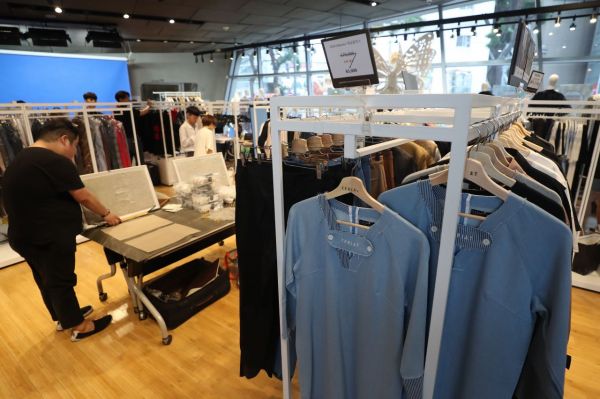
Musinsa, which has held showrooms twice for buyers in Japan, is focusing its overseas expansion strategy on emerging brands with high growth potential rather than well-known domestic designer brands. As a result, it is currently devising ways to enhance its own brand awareness. Recently, it released a collaboration product with Japanese contemporary artist and pop artist Takashi Murakami and BLACKPINK, reflecting this approach. Musinsa plans to launch more collaboration products that can attract local customers.
The reason Japan has emerged as a forward base for domestic distributors’ overseas expansion is due to growing local interest in Korean content. Demand for K-dramas and K-beauty is naturally expanding into K-fashion.
Above all, Japan’s geographical proximity and similar body types to Koreans are reasons for focusing on the Japanese market. Domestic designer brands have limited resources and lack the conditions to create new clothes for overseas markets. Therefore, they first target Japan, where body types and climate conditions are similar.
Already, mega brands with annual sales exceeding 100 billion won, such as MATTANGKIM, Marithe Francois Girbaud, and Mardi Mercredi, are well known to Japanese consumers. These are places Japanese visitors to Korea never miss. A distribution industry official said, “When we hold showrooms for Japanese buyers, questions often arise first about brands that are not physically present. They also highly evaluate the quality of products created by domestic designer brands, so we believe there is sufficient demand for domestic designer brands.”
© The Asia Business Daily(www.asiae.co.kr). All rights reserved.