Volkswagen Group's Operating Profit Down 22% Last Year
Volkswagen and Audi Struggle... Bentley and Lamborghini Perform Well
Audi New Models and Volkswagen HEV Lineup Missing
Volkswagen Faces Challenges as Mass Brand in Korea with High Hyundai Market Share
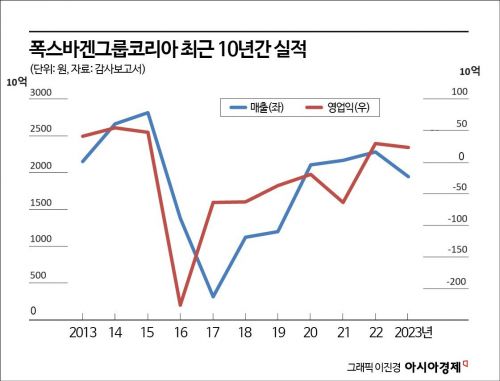
Volkswagen Group Korea experienced difficulties both internally and externally last year, resulting in a 22% decrease in operating profit compared to the same period the previous year. This was due to a slowdown in global electric vehicle demand, a decline in imported car demand domestically, and delays in new car launches from major brands under the group.
According to the audit report on the 8th, Volkswagen Group Korea recorded sales of 1.944 trillion KRW and an operating profit of 23 billion KRW last year. These figures represent decreases of 15% and 22%, respectively, compared to the same period the previous year. Volkswagen Group Korea owns four brands: Volkswagen, Audi, Bentley, and Lamborghini.
The decline in Volkswagen Group Korea's performance was directly influenced by a decrease in sales of Volkswagen and Audi, which had driven performance until now. Until 2021, Audi accounted for 70% of the total sales of the Korean subsidiary, but this dropped to 58% as of last year.
The biggest reason is the absence of completely redesigned new models and hybrid lineups. First, Audi had no significant new models for a while. The flagship mid-size sedan A6 had no new model launches for nearly five years since the completely redesigned model was released in 2019. This contrasts with competitors such as BMW, which launched a completely redesigned 5 Series in November last year, and Mercedes-Benz, which introduced a completely redesigned E-Class earlier this year.
Not only the A6, but the launch of new models for key electric sport utility vehicles (SUVs) like the Q6 e-tron has also been continuously delayed. This is due to ongoing issues in software development at Cariad, Volkswagen Group’s software subsidiary, which has delayed the launch of major Porsche and Audi models.
Volkswagen, which had been pushing the strongest electrification transition within the group, was hit hard by the slowdown in domestic electric and imported car demand. Of the 10,247 Volkswagen vehicles sold domestically last year, 90% were internal combustion engine vehicles, and the remaining 10% were electric vehicles. There was no hybrid lineup, which has recently been gaining popularity in Korea. Additionally, as a mass brand, Volkswagen’s target market in Korea overlaps with Hyundai and Kia. It is analyzed that the position of mass imported car brands is shrinking due to the strong performance of domestic premium brands such as Genesis.
On the other hand, high-end brands Bentley and Lamborghini performed well. Bentley’s sales increased by 21% to 230 billion KRW last year, and Lamborghini’s sales rose by 33% to 139.5 billion KRW. Bentley’s domestic sales last year ranked first in Asia-Pacific for the second consecutive year, surpassing Japan. Lamborghini also sold 434 units domestically, more than its home country Italy (409 units). A company official said, "Last year, we reorganized our strategic direction at the group level and strengthened our fundamentals. From next year, we will intensify the momentum of new car launches."
© The Asia Business Daily(www.asiae.co.kr). All rights reserved.
![Clutching a Stolen Dior Bag, Saying "I Hate Being Poor but Real"... The Grotesque Con of a "Human Knockoff" [Slate]](https://cwcontent.asiae.co.kr/asiaresize/183/2026021902243444107_1771435474.jpg)















