Expansion of On-Device AI Chip 'DQ-C' for Home Appliances
Collaboration with TSMC
Reducing External Dependence and Enhancing Product Performance
Developing Automotive Semiconductors
Partnering with Tenstorrent for AI Chip Development
LG Electronics, which is competing with Samsung Electronics for dominance in artificial intelligence (AI) home appliances, is accelerating the development of its semiconductor capabilities. This is to enhance product performance with semiconductors perfectly tailored for TVs, washing machines, and air conditioners, while simultaneously reducing dependence on external semiconductors. LG Electronics plans to expand semiconductor internalization by focusing not only on home appliances but also on automotive semiconductors.
On the 10th, LG Electronics announced that it will expand its home appliance-dedicated on-device AI chip, 'DQ-C,' to 46 models across 8 product categories (domestic basis) by the end of the year.
The DQ-C supports AI control, liquid crystal display (LCD) driving, voice recognition, and is a chip specialized for operating system (OS) home appliances. Previously, microcontroller unit (MCU) chips made by semiconductor companies were used, but the biggest difference is that LG Electronics designed this chip themselves. After more than three years of research and development, the chip was first introduced in July last year and is currently installed in five LG Electronics products, including washing machines, dryers, and air conditioners.
Samsung Electronics also equips its home appliances with self-developed AI chipsets, but LG Electronics was the pioneer. LG Electronics introduced the 'Up Appliance 2.0' washing machine and dryer equipped with the DQ-C in July last year and exhibited the actual DQ-C chip at IFA the same year.
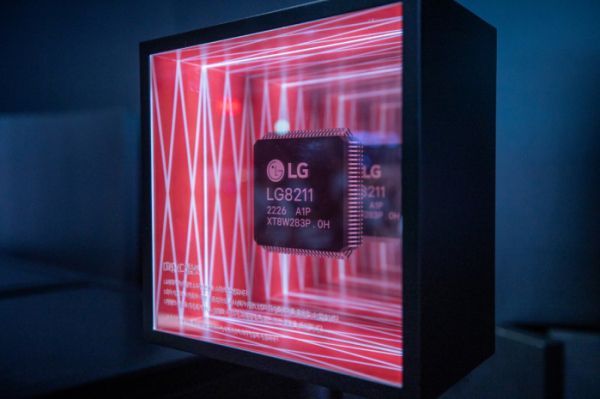
LG Electronics’ semiconductor development is handled by the System Semiconductor (SIC) Center, a research and development organization under the Chief Technology Officer (CTO). This organization began in 1992 as the Geumseong Central Research Institute ASIC Center, was reorganized into the SIC business team in 2006, and changed to its current SIC Center name in 2011 with the establishment of the TV System-on-Chip (SoC) development department. It is reported to have about 500 employees.
When the SIC Center designs semiconductors tailored to products, they are produced through external foundry companies such as Taiwan’s foundry company TSMC. The DQ-C is also known to be manufactured using TSMC’s 28-nanometer (nm, 1 nm is one billionth of a meter) process.
An LG Electronics official explained, "Designing chips directly instead of using general-purpose chips is for functions optimized for home appliances," adding, "LG Electronics is the only company designing AI chips optimized exclusively for home appliances."
Industry insiders expect that customized AI chip development will become more active to maintain product price competitiveness while equipping advanced AI performance. An industry source said, "It is not easy to add or remove functions that customers want in home appliances while maintaining accuracy and ensuring improvements," adding, "Especially given the cost-sensitive nature of the home appliance industry, unnecessary functions must be boldly removed and only necessary functions included to adjust the selling price, so a lot of effort will be put into related chip development."
LG Electronics is also expected to focus on semiconductor development for electric vehicles and autonomous vehicles. The MCU, essential for controlling electric products, is a representative example. While internal combustion engine vehicles had 200 to 300 MCUs per vehicle, electric vehicles are expected to have up to 2,000 MCUs installed.
To develop semiconductors, LG Electronics partnered with Canadian AI startup Tenstorrent in May. Tenstorrent is led by legendary semiconductor designer Jim Keller as CEO. LG Electronics is developing AI chips for smart TVs and automotive products together with Tenstorrent.
© The Asia Business Daily(www.asiae.co.kr). All rights reserved.
![Clutching a Stolen Dior Bag, Saying "I Hate Being Poor but Real"... The Grotesque Con of a "Human Knockoff" [Slate]](https://cwcontent.asiae.co.kr/asiaresize/183/2026021902243444107_1771435474.jpg)















