Full-Time Professors for Elective Courses in Law Schools Decrease Compared to 11 Years Ago
Among the elective subjects in the bar exam, 82.5% of candidates concentrated on the so-called 'Big 3' subjects?International Trade, Environmental Law, and International Law?which have a lighter academic burden. Despite high demand in practice, other subjects such as Labor Law, Intellectual Property Rights, Tax Law, and Economic Law are facing course cancellations due to a lack of students. There are concerns that the original purpose of introducing law schools?to cultivate diverse specialized legal professionals?is being undermined as specialized education weakens.
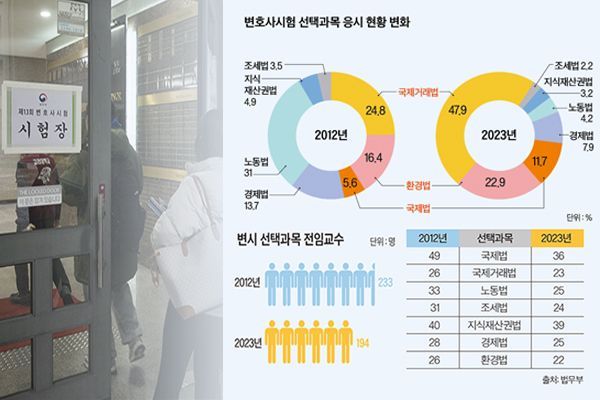
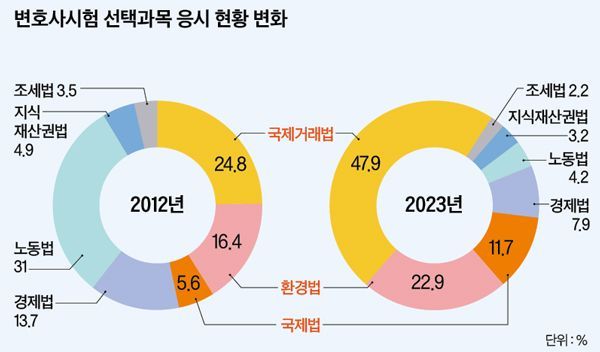
According to statistics from the Ministry of Justice, the number of candidates who took the specialized elective subjects in the 12th bar exam held last year were as follows: International Trade Law 1,559 (47.9%), Environmental Law 744 (22.9%), and International Law 382 (11.7%). The total number of candidates for these three subjects reached 2,685, accounting for 82.5% of all examinees. This represents a 35.7 percentage point increase compared to the 46.8% (780 candidates) who took the 'Big 3' subjects in the first bar exam in 2012. Last year, the number of candidates for other specialized subjects excluding the Big 3 were Economic Law 25 (7.9%), Labor Law 138 (4.2%), Intellectual Property Law 103 (3.2%), and Tax Law 71 (2.2%), each accounting for less than 10%.
The reason candidates flock to the 'Big 3' is that these subjects have a smaller volume of study, making it strategically efficient to secure study time for other subjects such as Civil Law, Criminal Law, and Public Law. A law school student in Seoul explained, "Since elective subjects are case-based, the important issues that appear on the exam are limited," adding, "It is more suitable for exam preparation to attend a final review lecture (5 sessions) offered by an academy in one day than to take a semester-long (15 sessions) course in International Trade Law or Environmental Law at school."
There are also concerns that the concentration on specific subjects could ultimately lead to a decline in the quality of legal services. Legal professionals need to respond sensitively to societal changes, which requires educational diversity as a foundation. A former chief judge turned lawyer stated, "The purpose of introducing law schools was to cultivate experts who deeply understand various legal issues and can provide fair and effective legal services based on that understanding," adding, "If the number of lawyers with specialized expertise decreases due to poor education and concentration in elective subjects, the quality of legal services in these fields could deteriorate."
"Securing study time for Civil Law, etc."... Candidates concentrate on subjects with less volume
The concentration of candidates on the 'Big 3' subjects?International Trade, Environmental Law, and International Law?which have a lighter exam burden, is a clear example of the current state of Korean law school education. At the early stage of the law school system, the legal fields organized as elective subjects were in a relatively better situation compared to other fields such as Public Interest and Human Rights, Corporate Finance, Real Estate, and Gender Law, which were not even included as exam subjects.
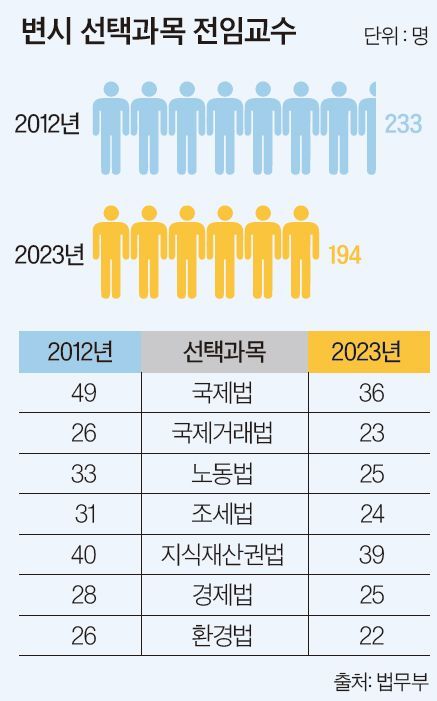
However, after twelve bar exams, even the seven elective subjects that were the last bastion of specialized education are now being ranked according to the exam logic of 'pass rate relative to preparation time.' In particular, the number of law school professors teaching bar exam elective subjects such as International Law and Labor Law has decreased by nearly 40 over the past decade.
According to the Law School Council (Chairman Lee Sang-kyung), the number of full-time professors for law elective subjects last year was 194, a 16.7% decrease from 233 in 2012. By subject, the decreases were: International Law 13, Labor Law 8, Tax Law 7, Environmental Law 4, International Trade Law 3, Economic Law 3, and Intellectual Property Law 1.
At a symposium on 'Improvement Measures for the Bar Exam System' held by the Law School Council on the 29th of last month, complaints about the increasingly deteriorating law school education environment continued. A professor from a regional law school said, "In smaller law schools, it is common for a constitutional law professor to also teach labor law, or an administrative law professor to also teach environmental law," adding, "In reality, there are only about 140 law school professors who specialize exclusively in elective subjects."
If education in elective subjects weakens, it could diminish the original purpose of law schools and the effectiveness of training practitioners. A dean of a law school in the metropolitan area explained, "Law school classes are more effective educationally when they are less related to the bar exam," adding, "Taking only subjects related to or helpful for the bar exam not only causes students to lose opportunities to develop their major fields but also significantly disadvantages them in employment after graduation."
For this reason, there are calls to convert elective subjects from bar exam requirements to graduation requirements in law schools. This would prevent last-minute cramming for exams and strengthen specialized subject education, ultimately enhancing practical competitiveness. A law school professor in Seoul said, "Currently, Seoul National University Law School operates nine major certification programs including Public Interest and Human Rights, International Legal Affairs, Tax Law, and Intellectual Property Law, but since these are not mandatory for graduation, students do not choose them much," adding, "If elective subjects were abolished and major certifications were set as mandatory graduation requirements, students could be immediately deployed to work after becoming lawyers without additional training, and the burden of elective subject exams would also be reduced."
Reporter Lee Soon-gyu, Legal Times
※This article is based on content supplied by Law Times.
© The Asia Business Daily(www.asiae.co.kr). All rights reserved.
![Clutching a Stolen Dior Bag, Saying "I Hate Being Poor but Real"... The Grotesque Con of a "Human Knockoff" [Slate]](https://cwcontent.asiae.co.kr/asiaresize/183/2026021902243444107_1771435474.jpg)

















