Livestock Consumer Price Index Decreases Instead
Local Butcher Shops Struggle in Price Competition with Large Supermarkets
As fruit and vegetable prices soar, the government is actively responding by injecting 150 billion won in emergency price stabilization funds. Meanwhile, additional subsidies have been provided mainly to large supermarkets for relatively stable-priced livestock products, dealing a direct blow to local butcher shops.
On the 3rd, the Ministry of Agriculture, Food and Rural Affairs announced that it would expand the Hanwoo and Handon discount events, which had been implemented using existing self-help funds, from 10 to 25 times a year and from 6 to 10 times a year, respectively, by injecting emergency price stabilization funds.
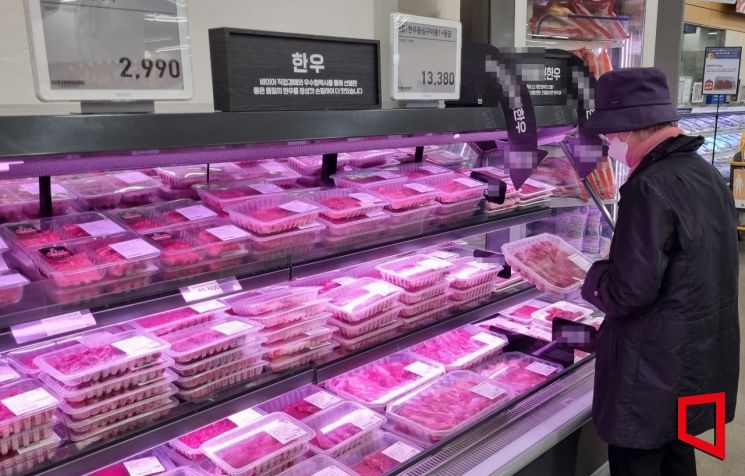 On the morning of the 8th, a citizen is selecting Korean beef at a large supermarket in Dongdaemun-gu, Seoul.
 [Photo by Sim Seong-a]
Hanwoo discounts will be held in April under the name ‘So (牛) Prize!’. Grade 1 sirloin will be sold at 7,510 won per 100g, grade 1 brisket at 4,730 won, and grade 1 bulgogi and soup cuts at 3,020 won or less. For pork, three discount events will be held in April alone, allowing consumers to purchase Handon pork belly at around 20% discounted prices, ranging from 1,650 to 2,090 won per 100g. Both discount events will take place at large supermarkets and medium- to small-sized marts.
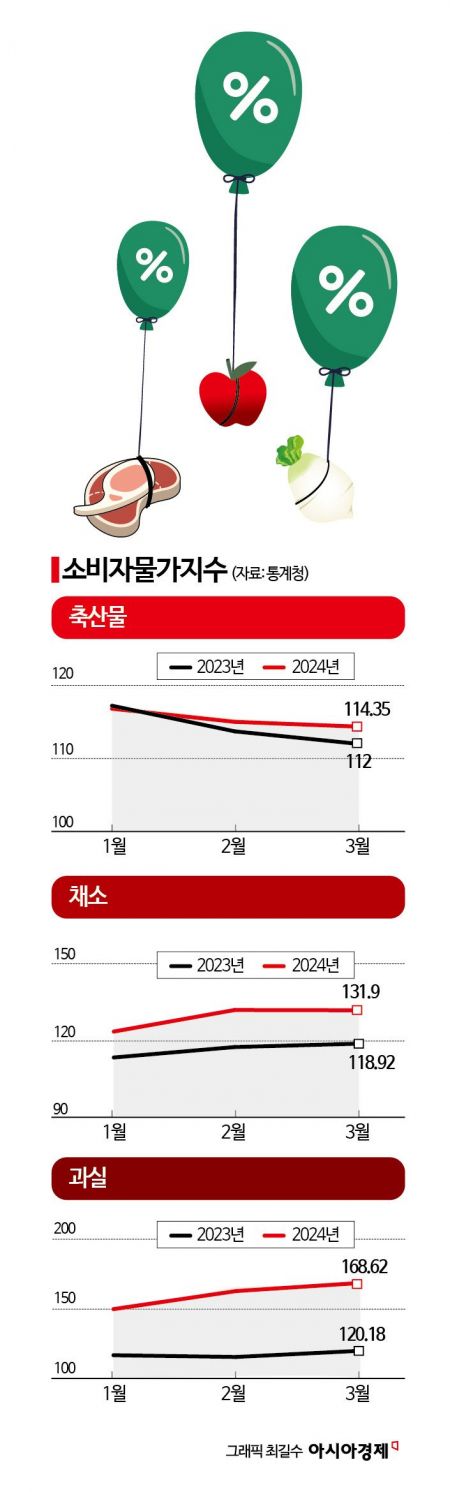
Questions have been raised about this decision, given that the domestic livestock market is relatively stable. According to Statistics Korea’s Consumer Price Index, vegetable prices rose by 8.8%, 12.2%, and 10.9% in January, February, and March compared to the same months last year, while fruit prices increased by 28.1%, 40.6%, and 40.3%, respectively. In contrast, livestock product prices decreased by 0.3% in January and rose only 1.1% and 2.1% in February and March. Minister Song Mi-ryeong of the Ministry of Agriculture, Food and Rural Affairs also acknowledged the stability of livestock prices on the 1st, stating, “Upon checking on-site, the supply and demand of domestic livestock products are relatively stable, and price stability is expected to continue.”
Nevertheless, on the 15th of last month, the government announced that it would allocate 19.5 billion won of the 150 billion won budget for agricultural and livestock price stabilization to livestock discounts, expanding discounts on Hanwoo, Handon, eggs, and chicken, and lowering delivery prices. A ministry official explained, “We have worked to stabilize livestock prices, which is why the current livestock price index is stable. Since labor and distribution costs may rise in the future, we are conducting discount events as a preventive measure.”
As of the 4th, the Hanwoo event price at Hanaro Mart in Seongbuk-gu, Seoul, was 7,510 won per 100g for grade 1 Hanwoo sirloin for grilling and 3,020 won for soup cuts. In the same area, Emart sold grade 1 Hanwoo bulgogi and soup cuts at 2,990 won and Handon pork belly at 2,080 won. Homeplus, through its own investment, offered a membership discount price of 4,990 won per 100g for grade 2 Hanwoo sirloin, with the event conducted in a format receiving government subsidies. A housewife in her 60s who was selecting Hanwoo soup cuts at the mart said, “It seems much cheaper than usual,” adding, “If I were to buy 300g of Hanwoo soup cuts elsewhere, it would cost about 20,000 won.”
On the other hand, local butcher shops without government subsidies faced different circumstances. In butcher shops in Seoul, Handon pork belly was priced around 2,300 to 2,500 won per 100g, grade 1 Hanwoo sirloin for grilling was 10,000 to 13,000 won, brisket was 5,000 to 6,000 won, and bulgogi and soup cuts were around 3,500 to 3,700 won. The price difference per 100g between discounted prices at large supermarkets and regular butcher shops ranged from as little as 220 won to more than 5,000 won.
Park Ok-seong (73), who has operated a butcher shop for 10 years about 600 meters from a large supermarket in Dongdaemun-gu, Seoul, lamented, “I heard that large supermarkets receive support for each category, whether eggs, meat, or fruit,” adding, “Big marts get promotional help and support for discount events, but we get nothing.” Another butcher shop owner, Park (57), said, “I understand the government supports discounts because prices are high these days,” and added, “Customers say that meat feels cheap because fruit and other prices are so high, but I don’t understand why the government supports meat prices at marts.”
A ministry official explained, “Many butcher shops conduct cash transactions or lack well-established POS systems, making it difficult to verify whether discount events were actually implemented,” and added, “For policy efficiency, we are focusing on large companies.”
Experts are concerned that the budget injected for price stabilization could inadvertently lead to price increases. Professor Andong-hyun of Seoul National University’s Department of Economics pointed out, “During the COVID-19 pandemic, many governments worldwide injected money into the private sector, leading to talk of ‘fiscal-induced inflation.’ If money is given directly to the private sector or subsidies are provided unnecessarily, it can stimulate consumption and become a factor that raises prices in the long term.”
© The Asia Business Daily(www.asiae.co.kr). All rights reserved.
![Clutching a Stolen Dior Bag, Saying "I Hate Being Poor but Real"... The Grotesque Con of a "Human Knockoff" [Slate]](https://cwcontent.asiae.co.kr/asiaresize/183/2026021902243444107_1771435474.jpg)

















