People Power Party Targets 120-140 Seats, Democratic Party 110-151 Seats
Voter Turnout: People Power Party "Not Expected to Be Much Higher" VS Democratic Party "Expected to Be High"
With two days remaining until the general election, the People Power Party expects to secure between 110 and 140 seats, while the Democratic Party anticipates winning between 110 and 151 seats. The People Power Party is counting on consolidating its support base, citing the constitutional amendment veto threshold and other factors. Encouraged by the highest early voting rate in the history of general elections, the Democratic Party has analyzed that if the election turns into a referendum, it could achieve an outright majority with a 'plus alpha (+α)'.
On the 8th, Yoon Hee-seok, spokesperson for the People Power Party, said on MBC Radio regarding the expected number of seats, "We are looking at between 110 and 150 seats," adding, "I cannot definitively say 40 seats; discussing exact numbers is a matter of divine territory." He introduced that the party views about 60 seats as battlegrounds where the support rate gap is within 5%. This means the number of seats could change significantly depending on public opinion shifts in the remaining two days. Kim Kyung-yul, emergency committee member of the People Power Party, set the target seats at "between 120 and 140."
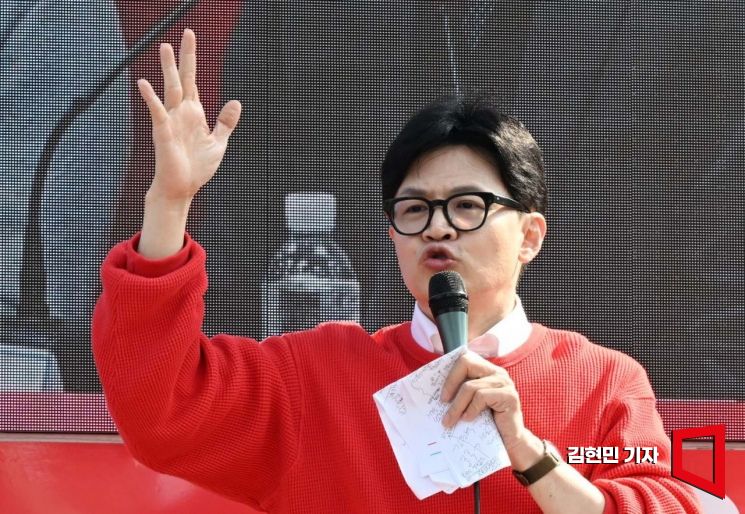 Handonghun, Emergency Response Committee Chairman and General Election Committee Chairman, is campaigning on the 5th at Mokdong Kkaebi Market in Yangcheon-gu, Seoul, to support candidate Gu Jaryong of Yangcheon-gu Gap. Photo by Hyunmin Kim kimhyun81@
The Democratic Party generally set its target seats at around 110 to 151. Han Byung-do, head of the Democratic Party's election strategy headquarters, predicted the outcome as "110 seats plus alpha," while stating, "We are heading toward the maximum expected number." Earlier, in mid-March, he had forecasted '153 seats plus alpha.' Kim Min-seok, head of the Democratic Party's general election situation room, mentioned, "I think we are fluctuating in the last two days somewhere between the maximum expected number (151 seats) and the realistic number."
The People Power Party believes that if conservative and other support bases consolidate, it will secure more than the existing 110 seats in battleground districts. In particular, it is counting on the consolidation of shy conservatives (voters who hide their political leanings but reveal them at the polling station). Hong Seok-jun, deputy head of the People Power Party's comprehensive situation room, said, "The atmosphere is improving, and there is a sense of increased voter participation." Conversely, the Democratic Party sets 110 seats as a lower limit but secretly hopes to secure an outright majority. Additionally, if seats from the Innovation Party of Korea are added, it is expected to approach the results of the 21st National Assembly.
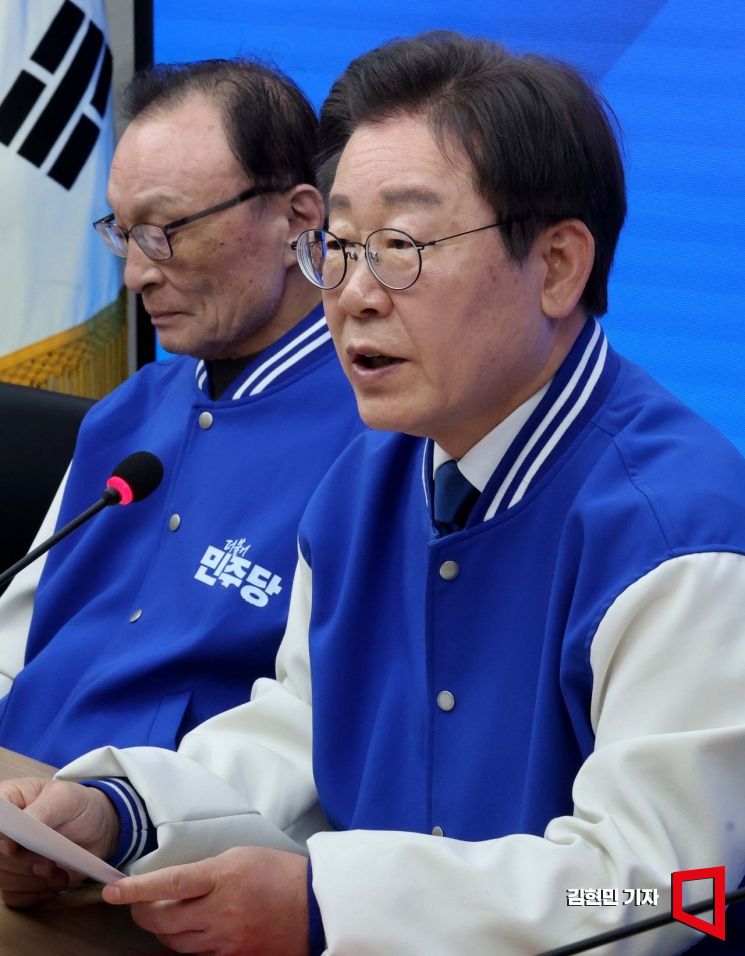 Lee Jae-myung, leader of the Democratic Party of Korea, is speaking at the Central Election Countermeasures Committee meeting held at the party headquarters in Yeouido, Seoul, on the 8th. Photo by Hyunmin Kim kimhyun81@
The key factor is voter turnout. Early voting held over two days on the 5th and 6th recorded a turnout rate of 31.28%, the highest ever for a general election. The ruling and opposition parties already show differing perspectives in analyzing the causes of the increased early voting rate and its impact on overall turnout.
The People Power Party analyzes that voters who had hesitated due to conspiracy theories related to early voting finally participated. With multiple vote counts being conducted in this election, concerns among conservatives about early voting were alleviated, leading to increased participation. On the other hand, the Democratic Party sees that a large number of voters previously classified as centrists or independents turned out to vote. Since these centrists and independents had not disclosed their preferred parties in polls but were leaning toward a regime judgment, the party expects the regime judgment sentiment to gain strength.
The remaining focus is on the overall turnout rate. The People Power Party believes that since those who would vote in the main election already participated in early voting, the actual turnout rate will not increase significantly. Even if it rises, if the increase is due to the 20s and 30s age groups, who have had low turnout rates, going to the polls, it would not be disadvantageous to the People Power Party. Conversely, the Democratic Party mentions a turnout rate of over 70% as an expectation. They anticipate massive voter participation if the election turns into a referendum. The Democratic Party expects to be favored if the overall turnout exceeds 65%.
© The Asia Business Daily(www.asiae.co.kr). All rights reserved.
![Clutching a Stolen Dior Bag, Saying "I Hate Being Poor but Real"... The Grotesque Con of a "Human Knockoff" [Slate]](https://cwcontent.asiae.co.kr/asiaresize/183/2026021902243444107_1771435474.jpg)
















