Following US Visit, South Korea, China, Japan, and North Korea-Japan Summit Talks Planned
Efforts to Hold Talks Despite Kim Yo-jong's Public Refusal
Aiming to Build Military and Diplomatic Influence Beyond Approval Ratings
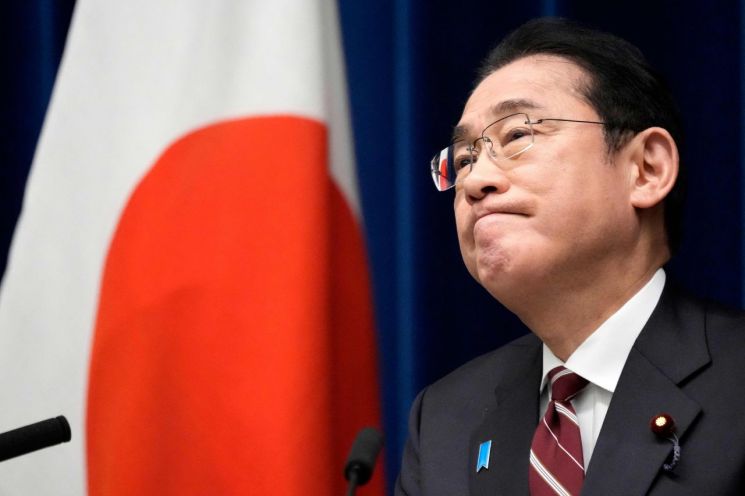
On the 10th, Japanese Prime Minister Fumio Kishida, who will visit the United States for a US-Japan summit, is showing an active diplomatic "wide-ranging approach" by pushing for a North Korea-Japan summit following the Korea-China-Japan summit. Prime Minister Kishida will hold a bilateral meeting with President Joe Biden at the White House in Washington DC on the 10th and participate in the US-Japan-Philippines trilateral summit on the 11th. This state visit by the Japanese prime minister to the United States is the first in nine years since former Prime Minister Shinzo Abe in April 2015.
Additionally, Prime Minister Kishida is coordinating his attendance at the Korea-China-Japan summit, expected to be held in Seoul at the end of next month. Although there were analyses suggesting that holding the trilateral summit in the first half of this year would be difficult, it is known that discussions have accelerated as China recently showed a positive stance following Japan.
In particular, Japan is also actively pursuing a North Korea-Japan summit separately. Despite Kim Yo-jong, the vice department head of the Workers' Party and sister of North Korean State Affairs Commission Chairman Kim Jong-un, recently publicly stating that "any contact or negotiations are refused," Kishida showed he is not giving up by saying in a CNN interview on the 7th (US time) that a "high-level approach" with North Korea is underway.
Many analyses suggest that Prime Minister Kishida's focus on international diplomatic events is due to his low approval ratings at home. Recent major opinion polls show that the Kishida Cabinet's approval rating has fallen to the 10-20% range, practically reaching levels just before resignation.
However, this approach is also interpreted as aiming to expand Japan's military and diplomatic influence. Taking advantage of this US-Japan summit, the two countries are expected to discuss joint development of military equipment and Japan's participation in AUKUS, the security alliance between the US, UK, and Australia. In particular, the US-Japan-Philippines summit may discuss the deployment of Japan's Self-Defense Forces to the Philippines.
Prime Minister Kishida's speech to the US Congress and efforts to promote a North Korea-Japan summit may be a strategic move to exert influence over North Korea and China even after the Biden administration. Yang Ki-ho, a professor of Japanese Studies at Sungkonghoe University, explained, "If former President Trump returns after Biden, bilateralism will strengthen, and current cooperation among Korea, the US, and Japan or AUKUS could become ineffective," adding, "Japan seems to intend to create a system to pressure China through its relationship with the US now."
© The Asia Business Daily(www.asiae.co.kr). All rights reserved.
![Clutching a Stolen Dior Bag, Saying "I Hate Being Poor but Real"... The Grotesque Con of a "Human Knockoff" [Slate]](https://cwcontent.asiae.co.kr/asiaresize/183/2026021902243444107_1771435474.jpg)















