Interest in Candidates Hwang Jeong-a and Park Jeong-hyun from the Democratic Party
Among 97 Female Candidates, 44 Are in Local Areas
In the Previous General Election, 213 Female Candidates Were Positioned
As the controversy over 'misogyny' and 'gender equality' emerged as key issues in the final stages of the April 10 general election, female candidates from both ruling and opposition parties are drawing attention. In particular, all eyes are on how candidates will perform in regions with fewer female candidates, such as Chungnam and Chungbuk.
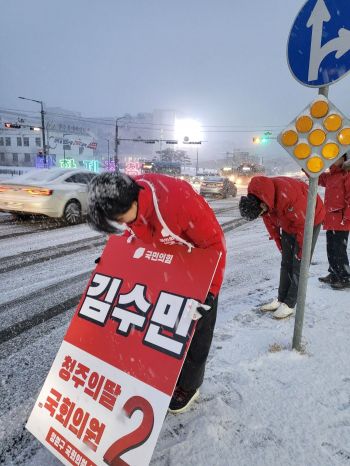 Among the 21 candidates running in the 8 constituencies of Chungcheongbuk-do for the April 10 general election, Kim Soo-min, the only female candidate from the People Power Party in Cheongju Cheongwon, Chungbuk, is greeting voters with eye contact.
 [Photo by Kim's campaign team]
 On February 28, Hwang Jeong-a, the Democratic Party of Korea candidate for the National Assembly representing Yuseong-gu Eul, Daejeon, greeted voters ahead of the April 10 general election.
 [Photo by Hwang's Facebook]
According to political circles on the 7th, among the 685 candidates running in 254 constituencies nationwide in this general election, 97 are female candidates, accounting for 14.2% of the total.
This marks a significant decline both in number and percentage compared to the previous 2020 general election, where 1,118 candidates ran and 213 were female. The number decreased by 116, and the percentage dropped sharply by 4.9 percentage points from 19.1% to 14.2%.
Especially by region, excluding the metropolitan areas of Seoul, Incheon, and Gyeonggi, so-called 'local' constituencies have only 44 female candidates. Seoul has 29, Incheon 3, and Gyeonggi 21, meaning the majority of female candidates are concentrated in the metropolitan area.
However, even in local areas, regions considered strongholds of the two major parties have relatively more female candidates.
In Gwangju, Jeonnam, and Jeonbuk, strongholds of the Democratic Party of Korea, there are 6, 3, and 2 female candidates respectively, while in Daegu and Gyeongbuk, where the People Power Party is dominant, there are 3 and 8 female candidates respectively.
In the so-called 'swing voter' regions of Daejeon, Sejong, Chungnam, and Chungbuk, there are 22, 7, 31, and 21 candidates respectively, but female candidates are almost nonexistent. Daejeon has 2, Sejong 0, and Chungnam and Chungbuk have only 1 female candidate each.
Among these, the realistically competitive candidates from major parties are Kim Soo-min from Cheongju Cheongwon in Chungbuk for the People Power Party, and Hwang Jeong-ah from Yuseong, Daejeon, and Park Jeong-hyun from Daedeok, Daejeon, for the Democratic Party.
A political insider from the Chungcheong region said, “The two major parties have strategically nominated female candidates mainly in strongholds where the chances of winning are high, and other female candidates have concentrated in the metropolitan area where accessibility and campaigning are easier. Since the proportion of female lawmakers is lower than that of men, the major parties need to pay more attention to female candidates outside the metropolitan area, and voters should break stereotypes and watch with interest.”
© The Asia Business Daily(www.asiae.co.kr). All rights reserved.
![Clutching a Stolen Dior Bag, Saying "I Hate Being Poor but Real"... The Grotesque Con of a "Human Knockoff" [Slate]](https://cwcontent.asiae.co.kr/asiaresize/183/2026021902243444107_1771435474.jpg)












