Mass Emergence of 'Jugi Cicadas' After 13-17 Years
Not Pests... "Play an Important Role in the Ecosystem"
This spring, reports have emerged that a massive swarm of cicadas will appear across the United States. The number is said to be as high as one trillion.
The New York Times (NYT) reported that around the end of April this year, a swarm of one trillion cicadas will emerge in 16 states in the Midwest and Southeast regions of the U.S. This is the largest swarm of cicadas to appear in 221 years since 1803.
However, the appearance of such a massive swarm of cicadas is not an abnormal phenomenon caused by climate change or other factors. This year is the year when two species of periodical cicadas, which emerge in large numbers once every decade or so, appear simultaneously. These cicadas, concentrated in 14 states from Illinois to Georgia and New Jersey, are characterized by emerging every 13 to 17 years, unlike regular cicadas that have cycles of 2 to 8 years.
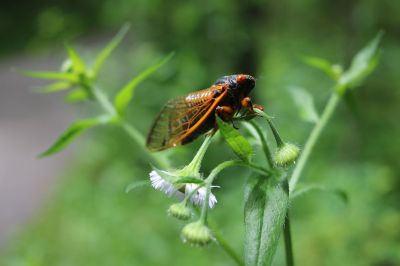 Periodical cicadas occurring in large numbers for the first time in 13 to 17 years
 [Image source=Pixabay]
Periodical cicadas are numbered in Roman numerals, with those belonging to the Great Southern Brood (Brood XIX) emerging every 13 years, and those belonging to the Northern Illinois Brood (Brood XIII) emerging every 17 years. Considering that one periodical cicada lays an average of about 600 eggs, it can be seen that an enormous number of cicadas enter the ecosystem of a specific area at a certain time.
They have black bodies and orange eyes, and although their appearance is unusual, they are not pests. They do not attack people or animals, nor do they transmit diseases. However, since their lifespan is only about a month, the cicada carcasses that fall on roads or sidewalks can create unpleasant scenes or odors.
John Cooley, a biology professor at the University of Connecticut, said, “Since cicadas are part of the forest ecosystem, there is no need to kill them with pesticides,” adding, “Pesticides could have a counterproductive effect as they can kill other organisms besides cicadas.”
In fact, the holes left by cicada larvae emerging from the ground improve soil aeration, making it easier for summer rainwater to seep into the soil and supply nutrients to roots. Moreover, cicada carcasses themselves become nutrients. Also, the branches where they lay eggs turn brown and naturally prune themselves, a phenomenon called ‘flogging.’
Former biology professor Jin Kritsky explained, “These cicadas actually play an important role in the ecosystem of the eastern forests.”
© The Asia Business Daily(www.asiae.co.kr). All rights reserved.
![Clutching a Stolen Dior Bag, Saying "I Hate Being Poor but Real"... The Grotesque Con of a "Human Knockoff" [Slate]](https://cwcontent.asiae.co.kr/asiaresize/183/2026021902243444107_1771435474.jpg)
















