Increase in Market Waiting Funds Such as Investor Deposits
'Cautious' Funds Also Observed in Parking-Type ETFs
Large sums of money are accumulating as investors hesitate to invest in the increasingly volatile stock market. The securities industry analyzes that the amount of funds waiting to enter the market has increased due to the rise in risk from uncertainty over interest rate cuts, driven by stronger-than-expected recent economic indicators.
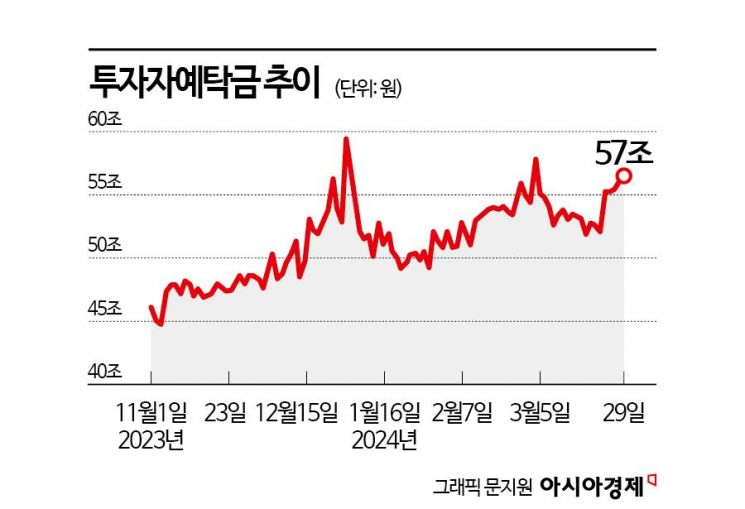
According to the financial investment industry on the 6th, as of the end of March, investor deposits, which had shifted to an increasing trend since the beginning of the month, reached about 56 trillion won. During the same period, the balance of individual investors' Comprehensive Personal Asset Management Accounts(CMA) also showed an upward trend, totaling 79.9 trillion won, and the amounts set in individual Money Market Funds (MMF) and corporate MMFs increased by 800 billion won and 27.6 trillion won respectively compared to the beginning of the year. This indicates an increase in short-term funds intended to temporarily avoid uncertainty while being ready to respond immediately when new investment opportunities arise.
In March, the U.S. Federal Reserve (Fed) maintained its forecast of three interest rate cuts this year, prompting market enthusiasm over a possible rate cut in June. However, subsequent economic data continued to support the robust growth of the U.S. economy, gradually reducing expectations for rate cuts. On the 4th, Neel Kashkari, President of the Federal Reserve Bank of Minneapolis, stated that there might be no rate cuts this year, making the delay in rate cuts a major risk factor currently affecting the market.
As this uncertainty persists, investors are turning their attention to parking-type Exchange Traded Funds (ETFs). In March, individual investors' funds were concentrated in parking-type ETFs. According to the Korea Exchange, over the past month, the KODEX CD Rate Active (Synthetic) ETF saw individual investors purchase 150.7 billion won worth, bringing its total assets under management (AUM) to about 7.8 trillion won, ranking it second among ETFs with the highest net individual purchases. Additionally, the TIGER 1-Year Bank Negotiable Certificate of Deposit Active (Synthetic) ETF recorded 67 billion won in net individual purchases, placing it among the top 10 ETFs.
Parking-type ETFs refer to products that calculate and compound interest daily based on ultra-short-term bond rates such as Negotiable Certificates of Deposit (CDs) and the Korea Overnight Financing Rate (KOFR). Park Yuan, a researcher at KB Securities, explained, "By utilizing parking-type ETFs, portfolio volatility can be efficiently controlled," adding, "Including parking-type ETFs in a portfolio can reduce the maximum loss during periods of high market volatility, thereby protecting returns."
Purchasing parking-type ETFs allows investors to earn interest even if the money is deposited for just one day, similar to a bank parking account. Choi Byung-wook, a researcher at Meritz Securities, said, "From the perspective of individual investors, parking-type ETFs seem to act as a 'parking space' to take a break when the stock market is weak," and added, "The biggest advantage of parking-type ETFs compared to bank parking accounts is that there is no limit on the amount." He further noted, "Since most bank parking accounts have limits within tens of millions of won, this is a significant advantage for institutional investors who need to manage large sums."
© The Asia Business Daily(www.asiae.co.kr). All rights reserved.
![Clutching a Stolen Dior Bag, Saying "I Hate Being Poor but Real"... The Grotesque Con of a "Human Knockoff" [Slate]](https://cwcontent.asiae.co.kr/asiaresize/183/2026021902243444107_1771435474.jpg)
















