Philoptics·YC Chem Achieve 'Double' in 7 Trading Days
AI Drives Surge in Data Processing Volume... Growth Expected in Glass Substrate Market
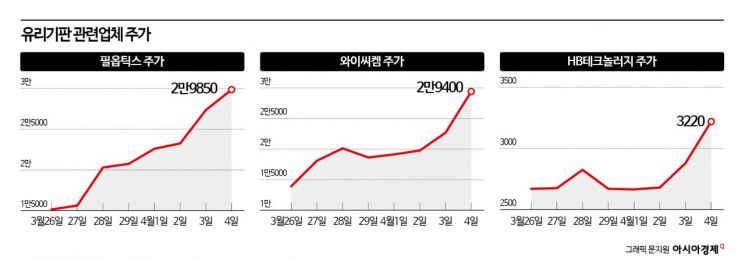
Interest in semiconductor glass substrates is growing in the domestic stock market. Recently, the stock prices of listed companies known to have secured glass substrate-related technologies, such as Philoptics, YC Chem, and HB Technology, have surged sharply. Expectations appear to have risen as companies including Intel, SKC, and Samsung Electro-Mechanics have decided to proceed with glass substrate-related businesses.
According to the financial investment industry on the 5th, Philoptics' stock price rose 97% over the past seven trading days. YC Chem's stock price increased by 112%, while HB Technology and Chemtronics also recorded gains of around 20%.
Glass substrates refer to substrates that use glass instead of conventional plastic materials. Being harder than organic materials, they allow for fine circuit formation and are resistant to heat and bending, making them advantageous for large-area applications. They also have strengths in terms of electrical signal loss and signal speed. Without an intermediate substrate, passive components such as MLCCs can be embedded in the glass, enabling the integration of more transistors. The semiconductor industry expects that adopting glass substrates will effectively advance semiconductor fine processes by two to three generations.
Of course, there are drawbacks. Due to the nature of glass, it is vulnerable to strong external shocks and cumulative pressure, making it difficult to increase yield during manufacturing. Low yield means higher manufacturing costs. Semiconductor substrates require holes on the surface to connect upper and lower circuit lines. To solve the problem of the glass core layer breaking when drilling holes, advanced drilling technology is necessary.
Changmin Lee, a researcher at KB Securities, explained, "The reason glass substrates have recently attracted attention is because AI is rapidly spreading," adding, "As AI data processing volume increases exponentially, organic material substrates will be difficult to handle by 2030." He further stated, "As early as 2026, high-performance computing (HPC) companies such as Intel, Nvidia, and AMD will begin adopting glass substrates," adding, "They will first be installed in high-quality products like AI accelerators and server CPUs, and then the range of products using them will gradually expand."
In May last year, U.S. company Intel announced its entry into the glass substrate business. Intel is continuing preparations for applying glass substrates while collaborating with some domestic semiconductor equipment companies. Domestic conglomerates including SKC, Samsung Electro-Mechanics, and LG Innotek have also started investing in glass substrate production to secure new growth engines. SKC established Absolix in partnership with Applied Materials (AMAT), the world's largest semiconductor equipment company. Absolix built a production plant in Georgia, USA, to manufacture glass substrates. They invested $240 million and will begin production from the second quarter of this year.
Earlier, Samsung Electro-Mechanics officially announced its entry into the glass substrate business at the world's largest home appliance and IT exhibition, CES 2024, earlier this year. Samsung Electro-Mechanics will jointly start research and development (R&D) on glass substrates with major group affiliates such as Samsung Electronics and Samsung Display. LG Innotek is also preparing for the glass substrate business. It is known that their major customers, North American semiconductor companies, have strong interest in glass substrates.
Equipment companies are also developing glass substrate-related technologies and promoting mass production of equipment. Philoptics supplied TGV mass production equipment for semiconductor packaging at the end of last month. Philoptics is the first to supply semiconductor glass substrate manufacturing equipment to a mass production line. YC Chem developed three types of core materials dedicated to semiconductor glass substrates last year. Recently, after customer R&D evaluations, they have entered mass production certification evaluations.
A financial investment industry official advised, "With growing interest in AI semiconductors recently, companies possessing new technologies are gaining attention," adding, "Since it takes time to reach mass production, it is necessary to consider the possibility of actual sales connection."
© The Asia Business Daily(www.asiae.co.kr). All rights reserved.
![Clutching a Stolen Dior Bag, Saying "I Hate Being Poor but Real"... The Grotesque Con of a "Human Knockoff" [Slate]](https://cwcontent.asiae.co.kr/asiaresize/183/2026021902243444107_1771435474.jpg)















