Follow-up Meeting on Livelihood Discussion
Significant Adjustment from Existing 130 Million Won
Employment Plans in Domestic Work and Childcare for Foreign Students and Marriage Immigrants Also Prepared
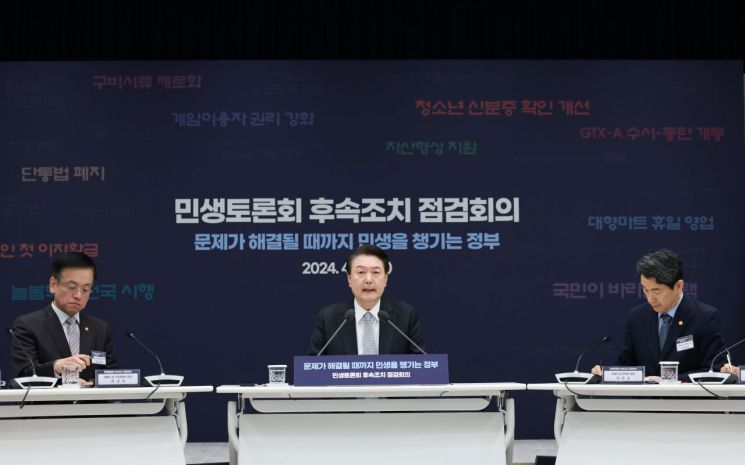 President Yoon Suk-yeol is speaking at the second follow-up meeting on economic sector inspection after the public livelihood discussion held at the Yongsan Presidential Office building in Seoul on the 4th. [Image source=Yonhap News]
The income criteria for the Buttress Jeonse Loan, which helps ordinary citizens prepare funds for jeonse deposits, will be significantly relaxed. For newlywed couples, the combined spousal income criterion, previously set at 75 million won, will be raised to 100 million won. The combined spousal income criterion for special loans for households with newborns will also be substantially increased from 130 million won to 200 million won. Additionally, measures will be put in place to allow foreign international students and marriage immigrant families residing in Korea to work in the domestic household and childcare sectors.
On the morning of the 4th, President Yoon Suk-yeol held an "Economic Sector Follow-up Measures Review Meeting on the Livelihood Discussion" under the theme "A Government Caring for Livelihoods Until Problems Are Solved" at the Freedom Hall of the Presidential Office. The meeting was convened to review the implementation of practical tasks in the economic sector and future plans, following the social sector meeting held on the 2nd.
President Yoon stated regarding the Buttress Jeonse Loan, "There are criticisms from young people that some government support programs act as a marriage penalty for newlyweds," and added, "This time, we will definitely change that." Accordingly, the income criteria will be adjusted as follows: ▲ Buttress Jeonse Loan for newlyweds from 75 million won to 100 million won ▲ Special loan for households with newborns from 130 million won to 200 million won ▲ Earned Income Tax Credit combined spousal income criterion from 38 million won or less to 44 million won or less.
Yoon: "Delaying Marriage Registration to Obtain Loans Is Common"
President Yoon explained, "The individual income criterion for receiving the Buttress Jeonse Loan is 50 million won per year, but for newlyweds, the combined income criterion is 75 million won, so it is common for couples to delay marriage registration to qualify for the loan," and added, "From now on, the income criterion for newlyweds will be raised to a combined 100 million won, with 50 million won per person."
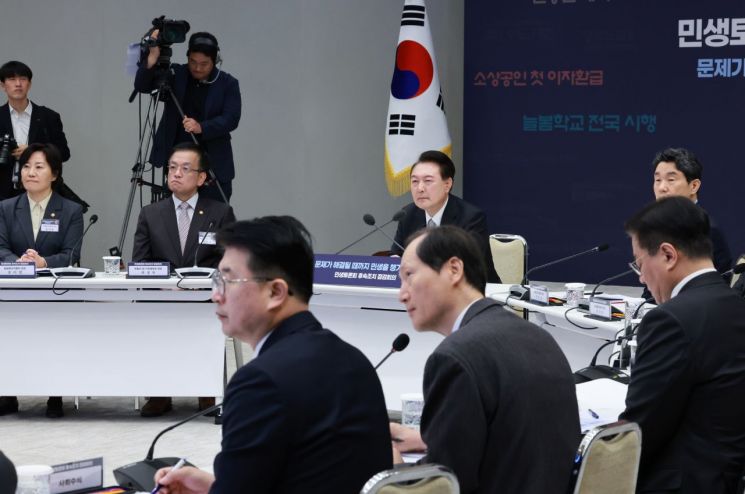 President Yoon Suk-yeol is attending the 2nd follow-up measures and economic sector review meeting after the public livelihood discussion held at the Yongsan Presidential Office building in Seoul on the 4th, listening to the follow-up measures promotion plan presented by Lee Wan-gyu, Chief of the Legislative Office.
 [Image source=Yonhap News]
To ease the burden on dual-income couples, active measures will be taken to allow foreign international students and marriage immigrant families residing in Korea to work in the household and childcare sectors. President Yoon said, "Above all, it is important to reduce the childcare burden on dual-income couples," and urged, "The Ministry of Justice, Ministry of Employment and Labor, and other related ministries should actively establish measures so that foreigners residing in Korea can be entrusted with children by parents with peace of mind."
President Yoon added, "Allowing the 163,000 foreign international students and 39,000 marriage immigrant families already residing in Korea to work in the household and childcare sectors is an effective method," and said, "Employment within the home will not be subject to minimum wage restrictions, and a flexible market will be formed according to supply and demand."
Furthermore, President Yoon emphasized that the state should take an interest in and directly manage the rights and interests of unorganized workers who are not union members, and instructed the Ministry of Employment and Labor to establish a 'Department for Support of Unorganized Workers.'
President Yoon stated, "We plan to complete the revision of subordinate laws and regulations that the government can handle by the first half of the year at the latest, and finish all by the end of this year," and added, "We are doing our best to ensure that livelihood bills pending in the National Assembly are passed within the term of the 21st National Assembly."
He continued, "Amendments to the Distribution Industry Development Act to allow large marts to close on weekdays, amendments to the Urban and Residential Environment Maintenance Act to ease reconstruction safety inspection regulations, and the abolition of the Device Distribution Act to reduce communication fees?these are all important and urgent bills," and emphasized, "We will prepare bills containing the contents discussed at the Livelihood Discussion as quickly as possible and submit them immediately once the 22nd National Assembly is formed, doing our best to ensure their swift passage."
President Yoon explained that preparations are underway for the Restriction of Special Taxation Act to support corporate value-up and amendments to the Elderly Welfare Act to revitalize elderly welfare housing and Silver Towns. He promised to accelerate budget execution for projects that can be done with this year's budget and to ensure that projects planned for next year are fully reflected in the budget.
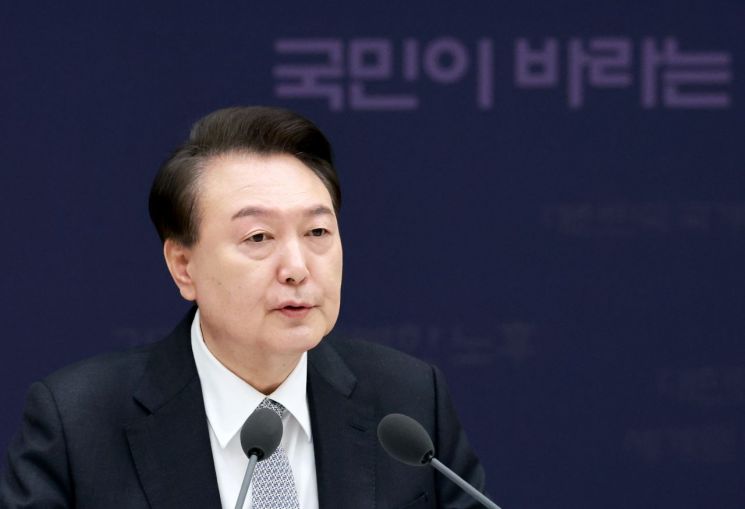 President Yoon Suk-yeol and Choi Sang-mok, Deputy Prime Minister for Economic Affairs and Minister of Economy and Finance, are speaking at the 2nd follow-up meeting on the people's livelihood discussion and economic sector review held on the 4th at the Yongsan Presidential Office building in Seoul.
 [Image source=Yonhap News]
Regarding the 24 livelihood discussions held from January to March, President Yoon said, "The biggest change in our government is that policy agendas are not decided from the government's perspective as a policy supplier, but are discovered and promoted by listening to the voices of the people as policy demanders and from the people's standpoint," and added, "We will continue to communicate closely with the public through livelihood discussions until the people's lives and satisfaction with changes are directly felt."
President Yoon mentioned that the livelihood discussions have clearly shown that administration must be conducted in a multidimensional and complex manner, and encouraged public officials amid changes in work styles. He joked, "I wonder if the Ministry of Employment and Labor will sue us for overwork. But go ahead and sue. I will take the punishment after retirement."
Yoon: "Concerns About Abolishing Short Selling Are Groundless... Policy Will Be Maintained"
He also indicated that the short selling ban policy will continue for the time being. President Yoon said, "When abolishing short selling, there were concerns that it would not meet global standards and foreign investment might decrease, but that was groundless," and assessed, "Seeing the recent increase in foreign investment in the stock market, the short selling ban policy was correct." However, he added, "If an illegal short selling control IT system is established, it would be fine to align with global standards," and emphasized, "Since we are working hard to build the IT system, we will maintain the abolition policy until the stage where investors' damages can be prevented."
He positively evaluated the Ministry of Land, Infrastructure and Transport's swift youth housing policy and its establishment. President Yoon pointed out, "Youth housing issues are scattered across several ministries," and explained, "It's not that one ministry should monopolize it, but comprehensive coordination and budget control are necessary for effective policies, which is why it was established." He also said, "I evaluate the role of youth aides as important in this process," and stressed, "Let's abolish all marriage penalties in every field, with young public officials centered around youth aides observing closely."
Regarding educational reform, he pointed out that the Ministry of Education must take the lead. President Yoon said, "There are various directions for educational reform, but the most important thing is that the Ministry of Education itself must be educated," and urged, "The Ministry of Education should reform so that it no longer supervises individual issues but focuses solely on changing the education system."
Finally, President Yoon emphasized agriculture-related matters, saying, "Rural innovation is important, but rural structural reform is more important," and added, "Rural reform was the Saemaul Undong (New Village Movement) promoted during former President Park Chung-hee's era, and a second Saemaul Undong as a rural reform movement must begin."
The event was attended by government officials including Choi Sang-mok, Deputy Prime Minister and Minister of Economy and Finance; Lee Ju-ho, Deputy Prime Minister and Minister of Education; Song Mi-ryeong, Minister of Agriculture, Food and Rural Affairs; Ahn Deok-geun, Minister of Trade, Industry and Energy; Lee Jeong-sik, Minister of Labor; Park Sang-woo, Minister of Land, Infrastructure and Transport; Kang Do-hyung, Minister of Oceans and Fisheries; Oh Young-joo, Minister of SMEs and Startups; Bang Ki-seon, Director of the Office for Government Policy Coordination; Kim Ju-hyun, Chairman of the Financial Services Commission; and Lee, Chief of the Legislation Office. From the Presidential Office, Lee Kwan-seop, Chief Secretary; Sung Tae-yoon, Policy Chief; Park Chun-seop, Senior Secretary for Economic Affairs; and Jang Sang-yoon, Senior Secretary for Social Affairs, also participated.
© The Asia Business Daily(www.asiae.co.kr). All rights reserved.
![Clutching a Stolen Dior Bag, Saying "I Hate Being Poor but Real"... The Grotesque Con of a "Human Knockoff" [Slate]](https://cwcontent.asiae.co.kr/asiaresize/183/2026021902243444107_1771435474.jpg)

















