18,100 Right-Turn Traffic Accidents Last Year
Slight Increase Compared to 2022
"Road Condition Improvements Must Be Concurrent"
Although the revised Road Traffic Act, which requires drivers to stop first when making a right turn at an intersection, has marked its first year of enforcement, the number of right-turn traffic accidents and fatalities has remained similar or even increased. Experts emphasize that drivers still lack sufficient understanding of the law and stress the importance of active government promotion and guidance.
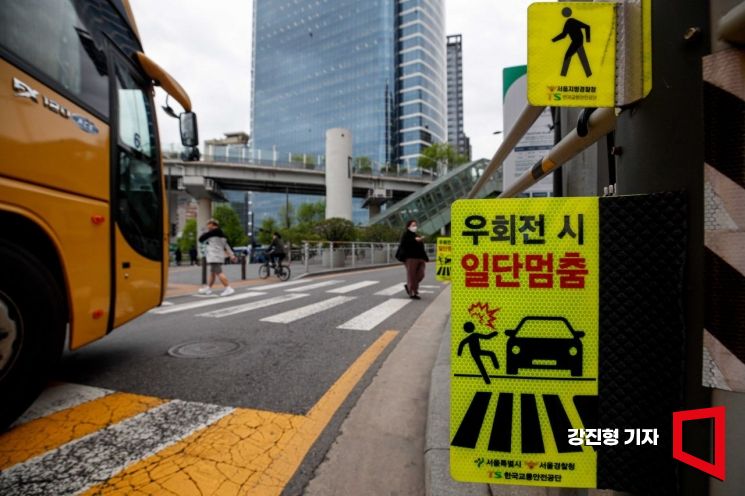 A sign regarding temporary stop for right turns is posted at a crosswalk near Seoul Station.
 [Photo by Kang Jin-hyung]
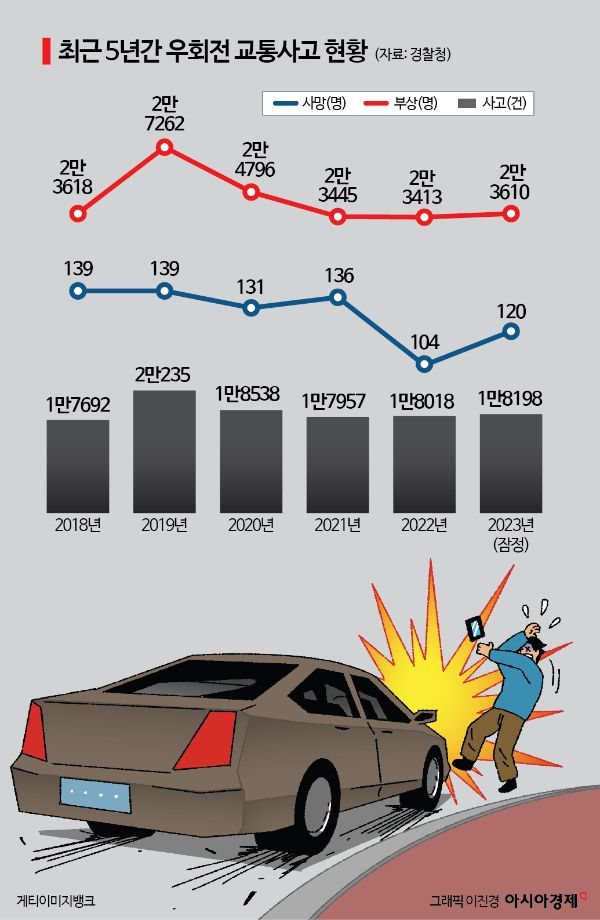
According to the National Police Agency on the 3rd, the provisional number of right-turn traffic accidents last year was 18,198 cases, a slight increase compared to 18,018 cases in 2022 before the revised Road Traffic Act was enforced. The number of deaths and injuries also slightly increased or remained similar at 120 and 23,610 respectively, compared to 104 deaths and 23,413 injuries in 2022.
The currently enforced revised Road Traffic Act mandates that vehicles making a right turn at an intersection must come to a complete stop and proceed slowly regardless of pedestrian signals. Due to frequent traffic accidents involving right-turning vehicles, regulations concerning right turns at intersections were implemented twice, in July 2022 and January 22 last year. After a three-month promotion and guidance period, full enforcement including penalties began on April 22 last year. Violations result in fines of 70,000 KRW for vans, 60,000 KRW for passenger cars, and 40,000 KRW for motorcycles, along with 15 penalty points.
However, even after one year of enforcement, no significant reduction in right-turn traffic accidents has been observed. Over the past five years from 2018 to last year, right-turn traffic accidents have exceeded 17,000 cases annually, and the number of fatalities has remained in the 120 range.
In fact, on the 25th of last month, a middle school student riding a bicycle and crossing a crosswalk at an intersection in Gijang-gun, Busan, was fatally struck by a large bus making a right turn. The bus was found to have failed to comply with the requirement to stop completely and proceed slowly while checking left and right when turning right. A National Police Agency official stated, "The right-turn stop law is related to drivers' driving culture and habits, so it is difficult to change overnight," adding, "We plan to produce and distribute promotional videos that intuitively explain the law and conduct guidance within the first half of the year."
Experts advise that raising drivers' awareness through promotional activities is most important. In January, the Gangseo Police Station Traffic Safety Division in Seoul conducted enforcement against right-turn violations, and most drivers caught within an hour reportedly said they "did not know the details of the law." This indicates that many drivers are not properly informed about the revised law. Mr. Lee (53), who has 25 years of driving experience, said, "I sometimes remember seeing 'Right Turn Stop' banners on the street while driving, but I don't know the exact details," adding, "There is no noticeable change when making a right turn at intersections compared to before."
There are also calls for efforts to improve road environments, such as installing right-turn traffic lights. It is suggested that structural preventive measures like installing right-turn signals and adjusting the distance between intersections and crosswalks should be implemented alongside relying on drivers' attitudes to create a synergistic effect. The right-turn traffic lights, which were piloted at 25 locations nationwide in January last year, have now increased to 205 locations.
Professor Yoo Jeong-hoon of the Department of Traffic System Engineering at Ajou University said, "The direction of the right-turn stop law itself is correct. However, unlike advanced traffic countries where drivers learn to stop and proceed slowly first, Korea is accustomed to traffic light culture, so stopping where there is no traffic light is unfamiliar and uncomfortable, which has prevented complete improvement," adding, "If right-turn traffic lights and intersection location adjustments are implemented according to road conditions alongside the right-turn stop law, I believe the effects will gradually appear over time."
© The Asia Business Daily(www.asiae.co.kr). All rights reserved.
![Clutching a Stolen Dior Bag, Saying "I Hate Being Poor but Real"... The Grotesque Con of a "Human Knockoff" [Slate]](https://cwcontent.asiae.co.kr/asiaresize/183/2026021902243444107_1771435474.jpg)
















