April 1st, 4 PM at Shinbal Hub Center, 'Communication and Empathy Time' with TP Staff
Discussion on Strategies for Fostering New Industries in Busan, a Global Hub City with Strengths
On the 1st at 4 p.m., Busan City held a ‘Communication and Empathy Time’ at the Advanced Footwear Convergence Hub Center with Mayor Park Hyung-jun and employees of Busan Technopark.
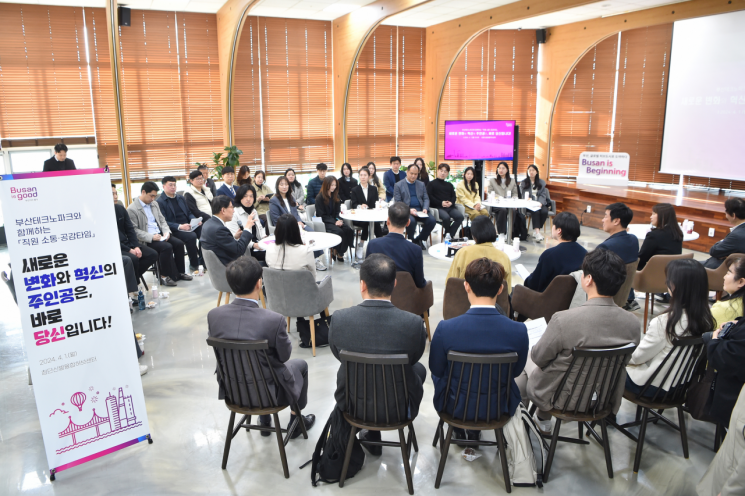 On the 1st at 4 PM, Busan City held a 'Communication and Empathy Time' at the Advanced Footwear Convergence Hub Center with Mayor Park Hyung-jun and employees from Busan Technopark.
This was the third session following the one at Busan Design Promotion Agency on the 25th of last month, aimed at promoting free policy communication between Mayor Park and employees, targeting city-affiliated organizations and business offices.
The event was organized to share the vision of a ‘Global Hub City’ and to freely communicate and brainstorm with employees on ways to foster Busan’s strengths in logistics, finance, digital and new industries to transform Busan into an international business free city surpassing Singapore and Hong Kong.
Busan Technopark, established in 1999 and celebrating its 25th anniversary this year, has played the role of an innovation platform leading collaboration among industrial entities such as local universities, companies, research institutes, and local governments, contributing to the growth of new industries and regional companies.
Last year, resident company ‘Nara Space Technology’ succeeded in launching the nation’s first domestically developed micro satellite, and hosted the Asian startup expo ‘FLY ASIA,’ which attracted over 10,000 participants from 43 countries and facilitated investment discussions worth approximately 190 billion KRW.
Recognizing these achievements, Busan Technopark received the highest ‘S’ grade in the management evaluation by the Ministry of SMEs and Startups among 19 technoparks nationwide last year.
Before the meeting, Mayor Park visited the research center of FILA Holdings, a resident company in the Footwear Hub Center, where he observed a biomechanical test for developing optimal performance shoes such as running shoes. He also toured the site developing sole materials using eco-friendly materials, reviewing innovative changes in the footwear industry and encouraging the efforts of the resident company employees.
Opened in July 2019, the Footwear Hub Center houses 27 companies including major footwear firms like FILA and K2, as well as footwear material and parts companies, employing over 200 workers.
It is an integrated facility with a one-stop support system for manufacturing, logistics, and technical support in the footwear industry, serving as a base for innovation in Busan’s footwear industry and regional job creation.
During the ‘Employee Communication and Empathy Time,’ about 40 employees of Technopark shared the ‘Busan New Industry Development Strategy’ and discussed key implementation plans together.
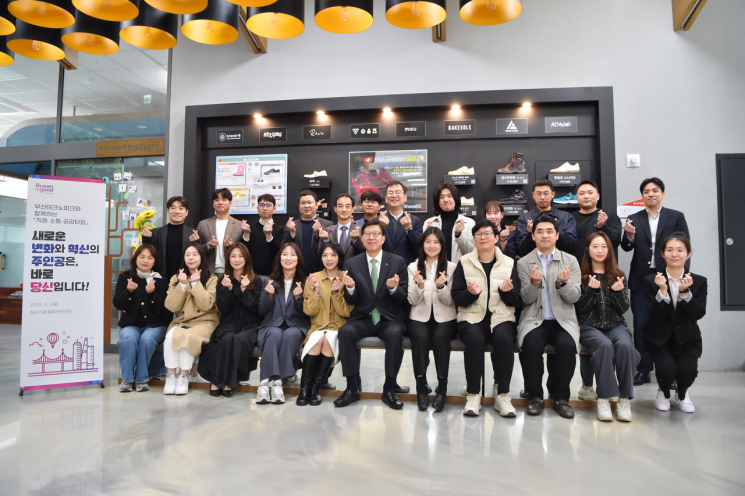 Mayor Park Hyung-jun and employees of Busan Technopark are taking a commemorative photo during the 'Communication and Empathy Time'.
At this session, Mayor Park emphasized the importance of industry-academia-government cooperation rather than relying on the strength of a single institution to overcome the current crisis Busan faces and to become a global hub city.
He urged Busan Technopark to actively play a role in creating a virtuous cycle system where ▲universities help companies grow through talent development and technical support linked to regional strategic industries, ▲companies coexist by hiring excellent local talent, and ▲local governments act as catalysts.
Following this, during the Q&A session, Mayor Park and employees had a meaningful time communicating openly about work difficulties and suggestions.
Mayor Park Hyung-jun said, “Busan has well-established infrastructure to revitalize traditional manufacturing industries based on innovation capabilities and to foster new industries,” adding, “I expect a virtuous cycle structure where meaningful results come out through industry-academia-government branches and the main actors voluntarily participate in cooperation.” He further stated, “Let us prepare together for the transformation into a modular organization leading innovation, an organization where the 4Cs are alive.”
The ‘4Cs’ refer to ① Critical Thinking, ② Creativity, ③ Collaboration, and ④ Communication.
© The Asia Business Daily(www.asiae.co.kr). All rights reserved.
![Clutching a Stolen Dior Bag, Saying "I Hate Being Poor but Real"... The Grotesque Con of a "Human Knockoff" [Slate]](https://cwcontent.asiae.co.kr/asiaresize/183/2026021902243444107_1771435474.jpg)
















